Chronic joint pain has a way of wearing you down. You try rest. You try ice. You try the over-the-counter remedies lining your medicine cabinet. And still, the ache lingers.
What if your body could simply heal itself, with a little help?
That’s the idea behind prolotherapy — a regenerative treatment that’s helped patients manage pain for nearly a century. If you’ve been searching for answers about this therapy, you’re in the right place. Let’s break down exactly what prolotherapy is, what’s in it, and how it might help you move and feel better.
What Is Prolotherapy?
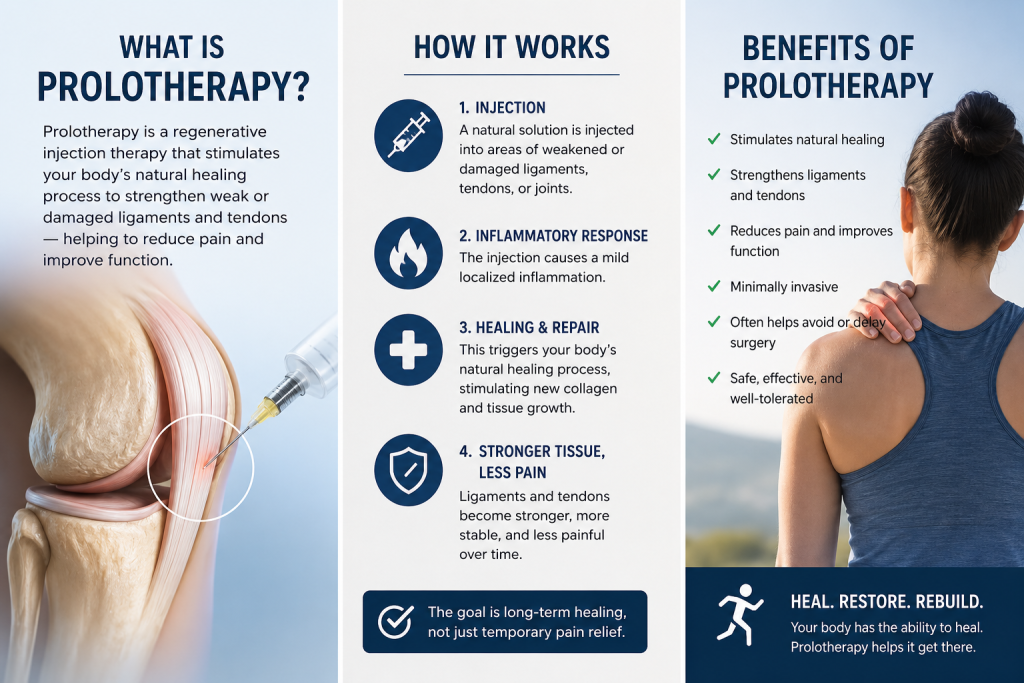
Prolotherapy, short for “proliferation therapy,” is a regenerative injection treatment designed to strengthen weakened or damaged connective tissue. It targets ligaments, tendons, and joints — the structural “glue” that holds your body together.
Here’s the core concept: prolotherapy injections introduce a mild irritant into the injured area. This triggers your body’s natural healing response, prompting it to produce new collagen and tissue. Over time, that means stronger, more stable joints and less pain.
Think of it as nudging your body to repair itself, rather than masking the pain with medication.
A Brief History of Prolotherapy
Prolotherapy isn’t a new trend. Physicians have used variations of this treatment since the 1930s, and it gained wider clinical use in orthopedic and sports medicine throughout the latter half of the 20th century. Decades of refinement have made today’s prolotherapy injections more precise, safer, and better understood than ever.
How Prolotherapy Differs from Cortisone Shots
It’s easy to confuse prolotherapy with cortisone (steroid) injections, but they work in opposite ways:
- Cortisone shots reduce inflammation and temporarily numb pain. They don’t repair tissue, and overuse can actually weaken it.
- Prolotherapy injections intentionally create a small, controlled inflammatory response. This stimulates the body’s repair process rather than suppressing it.
In short: cortisone calms things down. Prolotherapy wakes the healing process up.
What Is in Prolotherapy Treatment?
This is one of the most common questions patients ask — and for good reason. Knowing what’s being injected helps you feel confident about the process.
Common Solutions
The most frequently used solution in prolotherapy is dextrose, a simple, naturally occurring sugar. Dextrose prolotherapy is well-studied, widely used, and generally considered very safe.
Depending on your specific condition and treatment plan, your provider may also use:
- Dextrose solution — the most common base ingredient, used to create the proliferative effect
- Saline — sometimes combined with dextrose to adjust concentration
- Local anesthetic — often added to minimize discomfort during the injection
- Other regenerative additives — in some advanced protocols, providers may combine prolotherapy with other regenerative approaches for enhanced results
Your treatment plan is never one-size-fits-all. A skilled provider customizes the solution and injection sites based on your specific injury, symptoms, and goals.
How the Solution Triggers Healing
Once injected, the solution causes a localized, controlled irritation at the site of the damaged ligament or tendon. Your immune system responds the way it would to any minor injury:
- Blood flow increases to the area
- Growth factors are released
- Fibroblasts (cells responsible for collagen production) are activated
- New, stronger connective tissue begins to form
This isn’t an overnight fix. It’s a gradual rebuilding process, which is why prolotherapy typically involves a series of treatments rather than a single visit.
How Do Prolotherapy Injections Work?
Curious what the actual appointment looks like? Here’s a general overview.
The Step-by-Step Process
- Evaluation — Your provider assesses your pain, medical history, and the specific joint or ligament involved.
- Targeted mapping — Using palpation or imaging guidance, the provider identifies exact injection points.
- Injection — The solution is injected directly into the affected ligament, tendon, or joint space.
- Multiple sites — Depending on the area being treated, several injections may be given in one session.
- Short recovery window — Most appointments take well under an hour, and many patients return to light activity the same day.
What Happens After Treatment
Mild soreness, swelling, or stiffness at the injection site is normal for a few days. That’s actually a sign the healing response has been activated. Most patients need a series of three to six sessions, spaced several weeks apart, to achieve lasting results.
What Conditions Can Prolotherapy Treat?
Prolotherapy is most often used for chronic musculoskeletal pain caused by ligament or tendon laxity. Common applications include:
- Chronic low back pain
- Knee osteoarthritis
- Rotator cuff injuries and shoulder pain
- Tennis elbow and golfer’s elbow
- Hip pain and instability
- Ankle sprains that haven’t fully healed
- Plantar fasciitis
- Sacroiliac (SI) joint pain
- Degenerative disc-related discomfort
If you’ve been told your pain comes from “instability” or “weakness” in a joint, rather than a structural tear requiring surgery, prolotherapy may be worth discussing with your provider.
Who Is a Good Candidate for Prolotherapy?
Prolotherapy tends to work well for adults dealing with chronic, nagging pain that hasn’t responded to rest or conservative care. It’s a particularly good fit if you:
- Have tried physical therapy or anti-inflammatories without lasting relief
- Want to avoid or delay surgery
- Are looking for a treatment with minimal downtime
- Have joint instability rather than a complete tissue rupture
Because the body’s healing capacity naturally changes with age, your provider will evaluate your overall health, activity level, and specific diagnosis before recommending a treatment plan. Patients across a wide age range — from active 30-somethings to those well into their 70s — have used prolotherapy as part of their pain management strategy.
Benefits of Prolotherapy Injections
Why are so many patients exploring this option? A few reasons stand out:
- Minimally invasive. No surgical incisions, no general anesthesia.
- Addresses the root cause. Rather than masking pain, it targets tissue weakness directly.
- Low downtime. Most patients resume normal activities quickly.
- Complements other treatments. Often used alongside physical therapy for stronger, longer-lasting results.
- Long history of use. Decades of clinical application back its safety profile.
Isn’t that the kind of treatment most people are looking for? One that works with the body, not against it?
What to Expect: Side Effects and Recovery
Like any injection-based treatment, prolotherapy carries some mild, temporary side effects:
- Soreness or stiffness near the injection site
- Mild swelling or bruising
- Temporary increase in pain for a day or two before improvement begins
Serious complications are rare when it is administered by an experienced provider. Most patients describe the recovery as comparable to a deep muscle workout — a bit uncomfortable at first, followed by gradual improvement.
Why Choose Opdahl Regenerative Medicine for Prolotherapy
Not all providers are created equal. Precision matters — both in diagnosing the true source of your pain and in delivering the injections accurately.
At Opdahl Regenerative Medicine, prolotherapy treatment plans are built around your specific anatomy and goals, not a generic protocol. The focus is on identifying the actual cause of joint or ligament instability, then designing a regenerative approach aimed at long-term relief rather than temporary masking of symptoms.
Conclusion
Prolotherapy offers a compelling, science-backed option for people dealing with chronic ligament and tendon pain. By introducing a simple solution, often dextrose-based, injections stimulate your body’s own repair mechanisms instead of relying on medication or surgery alone. For many patients between their 30s and 70s, this regenerative approach has opened the door to lasting pain relief and renewed mobility.
If chronic pain has been holding you back, it may be time to ask whether prolotherapy is right for you.
Frequently Asked Questions
What is prolotherapy used for? Prolotherapy treats chronic pain caused by weakened ligaments and tendons, commonly in the knees, back, shoulders, hips, and elbows.
What is in prolotherapy treatment? Most prolotherapy solutions use dextrose (a natural sugar), sometimes combined with saline and a local anesthetic to reduce discomfort.
How many prolotherapy sessions are usually needed? Most patients need three to six sessions, spaced several weeks apart, to achieve lasting improvement.
Is prolotherapy painful? Mild soreness and swelling are common for a day or two after injections, but the procedure itself is generally well-tolerated.
How is prolotherapy different from PRP or stem cell therapy? Prolotherapy uses a simple irritant solution like dextrose, while PRP and stem cell therapies use components derived from the patient’s own blood or tissue. All three are regenerative approaches but work through different mechanisms.