Table of Contents
Last Updated: October 19, 2026
Why These 5 Exercises Target Chronic Knee Pain
Chronic knee pain is persistent discomfort in the knee joint that lasts beyond the normal healing window, often driven by osteoarthritis, tendon strain, or years of physical work. At OPDAHL Regenerative Medicine, we see this daily in active adults who want to keep moving. The right knee exercises build the muscles that support the joint: quadriceps, hamstrings, glutes, and calves. Stronger support means less load through the joint itself.
The five exercises below are low-impact, require no equipment, and train the muscles that stabilize the knee through daily movement. Below, we’ll show you exactly how to do each one, how often to train, and how to scale the routine week by week.
Key Takeaway
The muscles around the knee absorb load the joint can’t. Strengthening them is the most reliable non-surgical path to knee pain relief.
How to Pick Exercises Based on What’s Causing Your Pain
The cause of your chronic knee pain should shape which exercises you emphasize. Knee arthritis responds well to quadriceps and glute strengthening that reduces joint compression. Tendon irritation often needs controlled loading with slower, deliberate reps. If your pain comes from hip or glute weakness, the glute bridge and clamshell matter more than the rest.
A common mistake is treating every knee the same. Start with the exercises that match your cause, then add the others as tolerance improves. If you are unsure what is driving your pain, a clinical assessment with dynamic ultrasound can identify the root cause before you train around it.
1. Straight-Leg Raise
The straight-leg raise strengthens the quadriceps, the large thigh muscle that controls knee extension, without bending the joint. It is one of the safest starting points for chronic knee pain because the knee stays straight throughout.
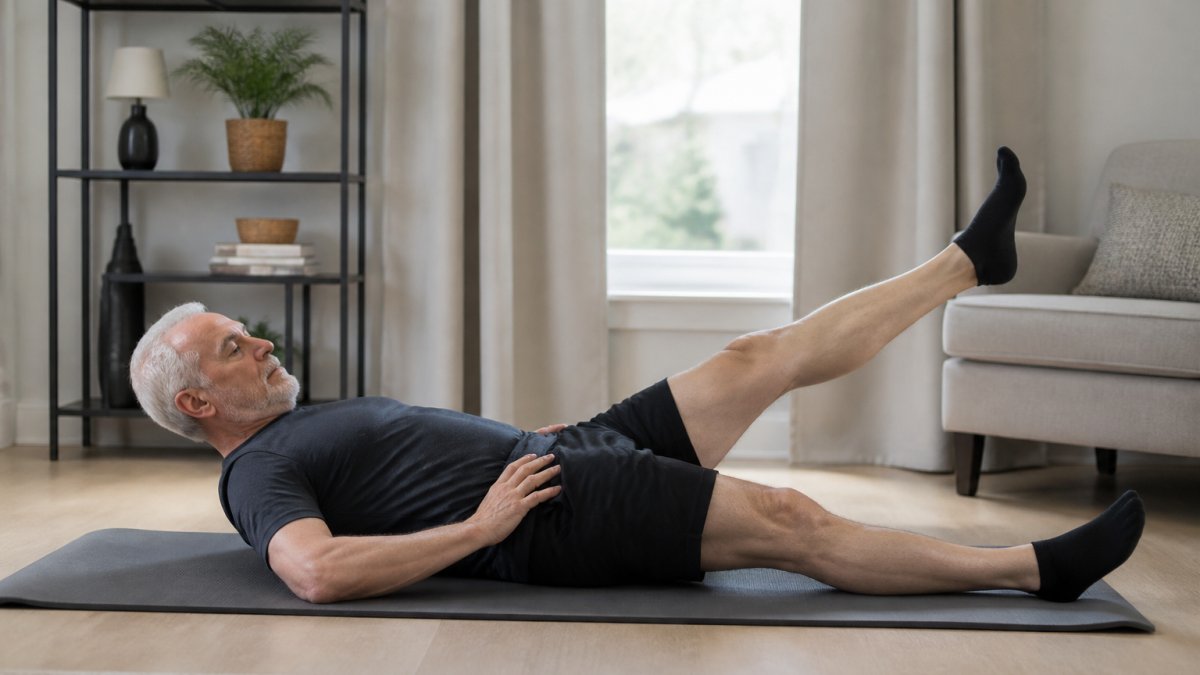 A man in his sixties lying on a yoga mat in a bright living room, one leg straight and raised about 45 degrees, hand resting on his hip, calm and focused expression
- Lie on your back with one knee bent and the other leg flat.
- Tighten the thigh muscle of the straight leg, then raise it to about 45 degrees.
- Hold for five seconds, then lower slowly.
- Complete 2 sets of 10 reps per leg.
Keep the knee straight but not locked. If raising the full leg is uncomfortable, shorten the range or perform a quad set first.
2. Quad Set
A quad set is an isometric contraction of the quadriceps performed with the leg flat and the knee still. It builds the thigh muscle with almost no joint movement, which makes it ideal on high-pain days.
Shrey Vazir – Physiotherapist
Sit or lie with the affected knee straight. Press the back of the knee down toward the floor or bed, tightening the thigh muscle. Hold for five to ten seconds, then relax. Aim for 10 reps, two to three times daily.
Pro Tip
Do quad sets while watching television or waiting at an appointment. They add up fast and never flare the joint the way loaded movement can.
3. Sit-to-Stand
Sit-to-stand trains the quadriceps and glutes through a functional pattern you use every day. It is a chair squat: stand up and sit down with control, using the chair for balance support.
Start seated in a sturdy chair with feet hip-width apart. Lean slightly forward, press through your heels, and stand. Lower back down slowly. Perform 2 sets of 8 to 10 reps. To make it easier, use a higher seat or push off the armrests. To progress, lower the seat or add a light weight.
4. Glute Bridge
The glute bridge strengthens the glute muscles, which control hip extension and take stress off the knee. Weak glutes are a frequent, overlooked contributor to chronic knee pain.
Lie on your back with knees bent and feet flat, hip-width apart. Squeeze the glutes and lift the hips until your body forms a straight line from shoulders to knees. Hold two seconds at the top, then lower. Do 2 sets of 10 to 12 reps. Keep the movement in the hips, not the lower back.
5. Standing Hamstring Curl
The standing hamstring curl strengthens the hamstrings, the muscles at the back of the thigh that support the knee and control bending. It also improves balance.
Schedule Appointment →
Stand holding a chair or counter for balance support. Bend the affected knee, bringing your heel toward your glutes. Hold briefly, then lower with control. Complete 2 sets of 10 to 12 reps per leg. Keep the standing leg slightly soft and your torso upright.
Watch Out
Do not swing the leg or use momentum. A slow, controlled curl builds the hamstring; a fast one mostly tests your balance and risks a strain.
Knee Strengthening Exercises: A Week-by-Week Progression
Progression is where most home routines fail. People either do too much too soon or never add load, so the knee never adapts.
| Week |
Focus |
Sets and Reps |
How It Should Feel |
| 1 |
Learn form |
1-2 sets, 8-10 reps |
Mild effort, no sharp pain |
| 2-3 |
Build consistency |
2 sets, 10-12 reps |
Mild to moderate discomfort at most |
| 4-6 |
Add load |
2-3 sets, 12-15 reps |
Muscle fatigue, joint calm |
| 7+ |
Maintain and progress |
2-3 sets, add resistance |
Steady strength gains |
Aim to train two to three times per week, with rest days between sessions. The Hospital for Special Surgery knee-strengthening guidance recommends working within a mild-to-moderate discomfort range, not pushing through sharp pain.
Pain monitoring rule: mild discomfort during exercise that settles within an hour is acceptable. Sharp pain, swelling, or pain that lingers into the next day means you modify: reduce reps, shorten the range, or drop back a week.
Low-Impact Exercises for Bad Knees That Pair With This Routine
Low-impact exercises for bad knees give you cardio and mobility without pounding the joint. Walking on flat ground, stationary cycling, and swimming are the standard choices, and the arthritis activity guidance from the CDC supports regular movement for joint health.
Pair one low-impact activity on your non-strength days. Keep sessions short at first, then extend as tolerance improves. The AAOS knee conditioning program is a useful free reference for additional knee exercises and hold times.
Exercises to avoid with knee pain include deep squats, high-impact jumping, and any movement that produces sharp pain or next-day swelling. Swap them for controlled, low-impact versions.
If pain persists despite consistent training, or if you have failed physical therapy and steroid injections, a clinical evaluation can identify what is driving the pain. OPDAHL Regenerative Medicine uses dynamic ultrasound to assess the joint and surrounding tissue, then builds a non-surgical plan focused on restoring mobility and reducing inflammation. Our team, including Dr. Carlos Tagabuel, N.D. and Dr. Andrew Wojciechowski, treats both acute injuries and chronic pain.
Frequently Asked Questions
What is the best exercise for severe knee pain?
When pain is severe, start with the least demanding option: a quad set. Sit or lie with the affected knee straight, tighten the thigh muscle, press the back of the knee down, hold five seconds, and relax. It builds quadriceps strength without bending the joint or bearing weight. Add a straight-leg raise once the quad set feels comfortable, and keep ranges small. Severe pain that persists at rest, or comes with swelling or locking, warrants an evaluation before you progress.
How often should you do exercises for chronic knee pain?
Two to three sessions per week is a reasonable starting point for knee strengthening exercises, with at least one rest day between sessions so the muscles recover. The Hospital for Special Surgery recommends two to three times weekly and staying within mild to moderate discomfort. Daily gentle range-of-motion work, such as a quad set or short hamstring stretch, is usually fine. Increase frequency before you increase resistance, and back off if pain lingers more than a day after a session.
Which exercises should be avoided with knee pain?
Skip deep squats, full-depth lunges, high-impact jumping and plyometrics, and heavy leg extensions through a painful range. Running on hard surfaces and any movement that causes sharp pain or swelling the next day also belong on the avoid list. These are the exercises to avoid with knee pain because they load a bent joint under speed or body weight. Substitute mini squats, step-ups to a low box, and controlled sit-to-stand instead.
Can exercise help knee osteoarthritis?
Yes. Strengthening the quadriceps, hamstrings, glutes, and calves supports the joint and can reduce stiffness and pain with daily activity. Low-impact exercises for bad knees, including walking, cycling, and swimming, are commonly recommended for knee arthritis. Exercise does not reverse cartilage wear, so expect gradual improvement in strength and function over weeks rather than an overnight fix. A clinician or physical therapist can tailor the plan to your diagnosis.
When should you stop exercising because of knee pain?
Stop if you feel sharp or stabbing pain, the knee gives way, or swelling appears within an hour of finishing. Mild to moderate discomfort during the movement that settles within 24 hours is generally acceptable. If pain stays above your usual baseline the next day, cut the reps, shorten the hold, or reduce range. Persistent swelling, locking, or pain that wakes you at night calls for a professional assessment before continuing.
Chronic knee pain rarely resolves with rest alone, and surgery is not the only path forward. Consistent strengthening, smart progression, and knowing when to seek help make the difference. If exercise alone is not enough, OPDAHL Regenerative Medicine can assess the root cause with advanced diagnostics and build a non-surgical plan around your goals. Get started with OPDAHL Regenerative Medicine and schedule an appointment to find out what is actually driving your knee pain.