How Does PRP Work? The Science Behind Your Body’s Healing Toolkit
Quick answer: How does PRP work? PRP (platelet-rich plasma) works by concentrating your own platelets — cells packed with growth factors — and injecting them directly into an injured area. Once there, these growth factors control chronic inflammation, recruit stem cells and other repair cells, stimulate new blood vessel growth, and trigger your body to rebuild healthy tissue. Below, we break down exactly how each step happens.
Platelets are most commonly known as the tiny cells that stop you from bleeding when you get a cut or a scrape, but that’s only a fraction of what they do. You can think of platelets as miniature delivery packages. Each one is loaded with over 300 different bioactive molecules, including proteins called growth factors, signaling molecules, and other compounds that orchestrate tissue repair.
Some of the most important growth factors found in platelets include:
- PDGF (Platelet-Derived Growth Factor) – Attracts repair cells to the injury site, stimulates new tissue growth, and helps build new blood vessels.
- TGF-β (Transforming Growth Factor Beta) – Promotes collagen production (the structural protein that gives tendons, ligaments, and cartilage their strength), stimulates tissue remodeling, and helps regulate inflammation.
- VEGF (Vascular Endothelial Growth Factor) – The body’s primary signal for building new blood vessels, which is critical for delivering oxygen and nutrients to healing tissue.
How Is PRP Made?
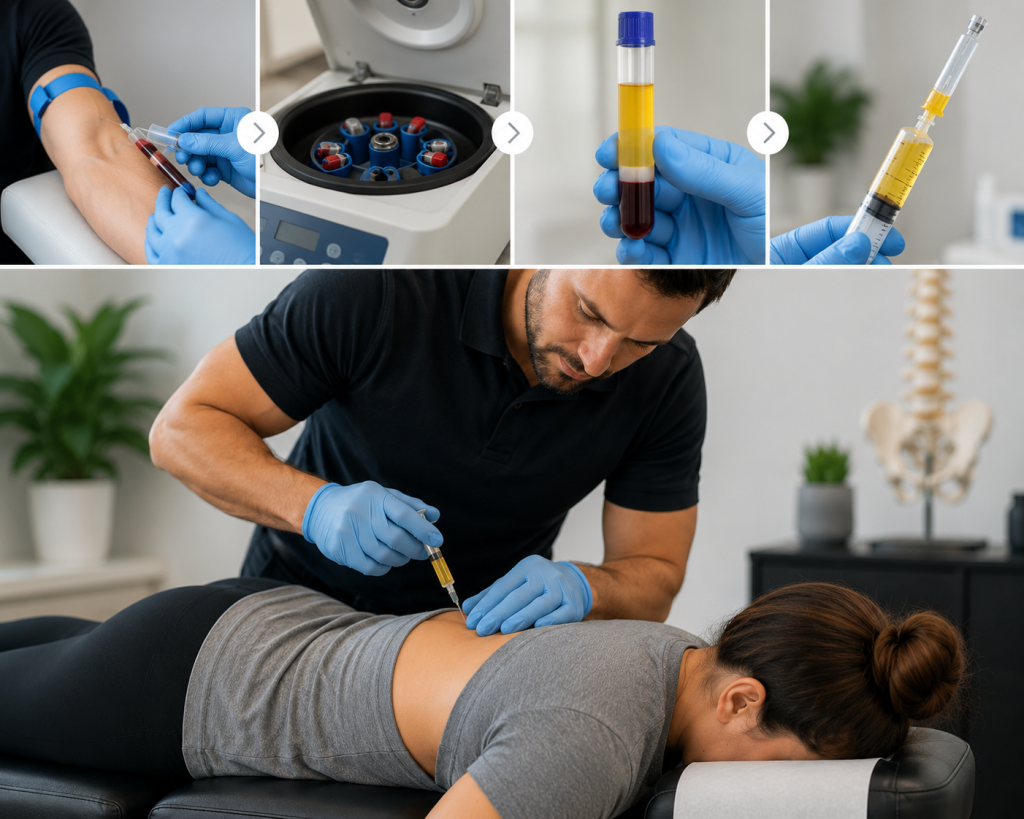
Before PRP can go to work in the body, it has to be prepared from your own blood. The process is simple and happens in one office visit:
- Blood draw. A small sample of your blood is drawn, similar to a routine lab test.
- Centrifugation. The blood is spun in a centrifuge, which separates it into layers by density — red blood cells, platelet-poor plasma, and a concentrated layer of platelets and plasma.
- Concentration. The platelet-rich layer is drawn off and concentrated to roughly 2 to 8 times the platelet count found in normal blood.
- Injection. That concentrated plasma is injected directly into the injured tendon, ligament, joint, or soft tissue using ultrasound guidance for precision.
Because PRP comes from your own blood, there’s no risk of rejection or disease transmission, which is a key reason it’s considered such a safe regenerative option.
When PRP is injected into an injured area, these growth factors are released in high concentrations right where they’re needed most. Think of it as delivering a concentrated care package of healing instructions directly to the site of damage. Here’s what happens next, step by step.
Step 1: Controlling Inflammation
Inflammation gets a bad reputation, but it’s actually the body’s first response to injury, and it’s essential. The problem arises when inflammation becomes chronic, meaning it lingers for weeks, months, or even years without resolving. Chronic inflammation is a hallmark of conditions like osteoarthritis and tendinopathy, and it’s one of the main reasons these conditions cause ongoing pain and progressive tissue breakdown.
PRP works on inflammation in a remarkably sophisticated way. Rather than simply shutting inflammation down the way a cortisone shot or anti-inflammatory medication does, PRP helps the body resolve inflammation naturally and transition into the repair phase. Your body has two main types of immune cells called macrophages that play opposing roles in the healing process.
- M1 macrophages are the “first responders.” They create inflammation to clean up damaged tissue and fight infection. They’re necessary early on, but if they stick around too long, they cause ongoing tissue damage.
- M2 macrophages are the “builders.” They calm inflammation, promote tissue repair, stimulate new blood vessel growth, and help lay down new, healthy tissue.
In chronic injuries, the body often gets stuck in the M1 (inflammatory) phase and can’t make the switch to M2 (repair). Research has shown that PRP helps push macrophages from the M1 state toward the M2 state. The result is that the destructive cycle of chronic inflammation is interrupted, and the body’s natural repair machinery can finally get to work. This is fundamentally different from cortisone, which suppresses all inflammation indiscriminately and can actually weaken tissue over time.
Step 2: Recruiting Your Body’s Repair Cells
Once inflammation is brought under control, the next challenge is getting the right cells to the injury site. Healing requires specialized cells to be called to the scene, and PRP acts as a powerful recruiting signal. The growth factors released from platelets create a chemical trail that attracts repair cells and draws them toward the injury. It’s similar to how a search-and-rescue team uses a flare or beacon to signal their location. This is the next step in answering how does PRP work.
Among the most important cells recruited by PRP are mesenchymal stem cells (MSCs). These are your body’s versatile repair cells, and they have the ability to develop into many different tissue types depending on what’s needed. When MSCs arrive at a tendon injury, signals in the local environment guide them to become tendon cells. At a cartilage defect, they can differentiate into cartilage-producing cells. PRP not only attracts these stem cells to the area but also stimulates their proliferation (so there are more of them) and guides their differentiation (so they become the right type of cell). This recruitment process is one of the key reasons PRP promotes actual tissue repair rather than just symptom relief.
Step 3: Building New Blood Vessels
Healing tissue is hungry. It needs a constant supply of oxygen, nutrients, and additional repair cells, and all of that arrives through blood vessels. One of the most important things PRP does is stimulate angiogenesis, the formation of new blood vessels. This is especially critical for tendons and ligaments. These structures have notoriously poor blood supply compared to muscles or skin, which is a major reason why tendon injuries heal so slowly (or sometimes don’t fully heal at all). When you have a condition like tennis elbow, Achilles tendinopathy, or plantar fasciitis, the damaged tendon is often starved for the blood flow it needs to repair itself.
Step 4: Rebuilding and Remodeling Tissue
PRP stimulates fibroblasts (cells responsible for building the structures, making collagen, and healing wounds) to ramp up their repair and rebuilding activity. In tendons and ligaments, this means increased production of the organized collagen fibers that give these tissues their strength and flexibility. In joints with osteoarthritis, PRP has been shown to stimulate cartilage cells to produce more of the proteins that make up the healthy cartilage matrix, while simultaneously reducing the enzymes that break cartilage down. This remodeling phase doesn’t happen overnight. It unfolds over weeks to months, which is why the full benefits of PRP are typically felt gradually, often peaking around three to six months after treatment. The tissue is literally being rebuilt from the inside out, which takes time.
Frequently Asked Questions About How PRP Works
How long does it take for PRP to start working? Most patients notice gradual improvement over several weeks, with the full remodeling effects typically peaking three to six months after treatment, since PRP triggers a biological repair process rather than an instant fix.
Is a PRP injection painful? Most patients feel mild pressure or soreness at the injection site for a day or two, similar to a deep muscle ache. Local anesthetic and ultrasound guidance are often used to minimize discomfort.
How many PRP treatments will I need? Many conditions respond to a single injection, though some patients benefit from a series of 2–3 injections spaced several weeks apart, depending on the severity and location of the injury.
What conditions does PRP treat? PRP is commonly used for tendinopathies (tennis elbow, Achilles tendinopathy, plantar fasciitis), ligament injuries, osteoarthritis, and other soft tissue injuries where the body’s natural healing has stalled.
Is PRP safe? Because PRP is made from your own blood, there is no risk of allergic reaction, rejection, or disease transmission, making it one of the safer regenerative injection options available.
Takeaway – How does PRP work?
The science behind PRP can seem complex, but the takeaway is simple: PRP works by concentrating your own blood’s platelets and delivering their healing signals directly to damaged tissue. It controls chronic inflammation, recruits repair cells including stem cells, builds new blood vessels, and stimulates the production of healthy new tissue. It’s not a painkiller. It’s not a band-aid. It’s a biological therapy designed to support genuine tissue repair from the inside out. How does PRP work? When you have more questions like this email us or give a call!
Ready to find out if PRP is right for you? Opdahl Chiropractic & Regenerative Medicine offers a full spectrum of care from chiropractic and massage therapy to cutting-edge regenerative injection therapies like PRP, all under one roof. Call us today to schedule a consultation and take the first step toward getting back to the life you love.