Table of Contents
Last Updated: October 5, 2026
What Forward Head Posture Is and Why It Happens
Forward head posture is a head and neck alignment problem where the head sits ahead of the shoulders instead of stacked over them. We see this pattern often in patients who spend long hours at screens. (Source: Statista’s 2026 research on screen time habits)
The cause is rarely one dramatic event. It builds slowly:
- Hours of screen use with the head tilted down
- Phone posture that pulls the neck into flexion
- Slouching in a supportive chair with no lumbar support
- Previous injuries from car accidents, sports or even slip and falls
Over time, this becomes a postural habit. The body adapts to the position you hold most.
How to Tell If You Have Forward Head Posture
A simple posture assessment starts at a wall. Stand with your heels, hips, and shoulder blades touching it. If the back of your head does not reach the wall without tilting your chin up, you likely have some degree of forward head posture.
Other common signs include:
A trained professional can confirm this with a proper exam.
Forward Head Posture Exercises to Strengthen Key Muscles
Forward head posture exercises work best when they target the muscles that pull your head back into alignment. The goal is simple: strengthen what is weak, and the posture follows.
Aim for these three to four times per week.
Chin Tucks
The chin tuck is the foundation of posture correction. Sit tall, look straight ahead, and glide your head straight back like you are making a double chin. Hold for 5 seconds, then relax.
- Do 10 reps
- Keep your eyes level the whole time
- Do not tilt your chin down
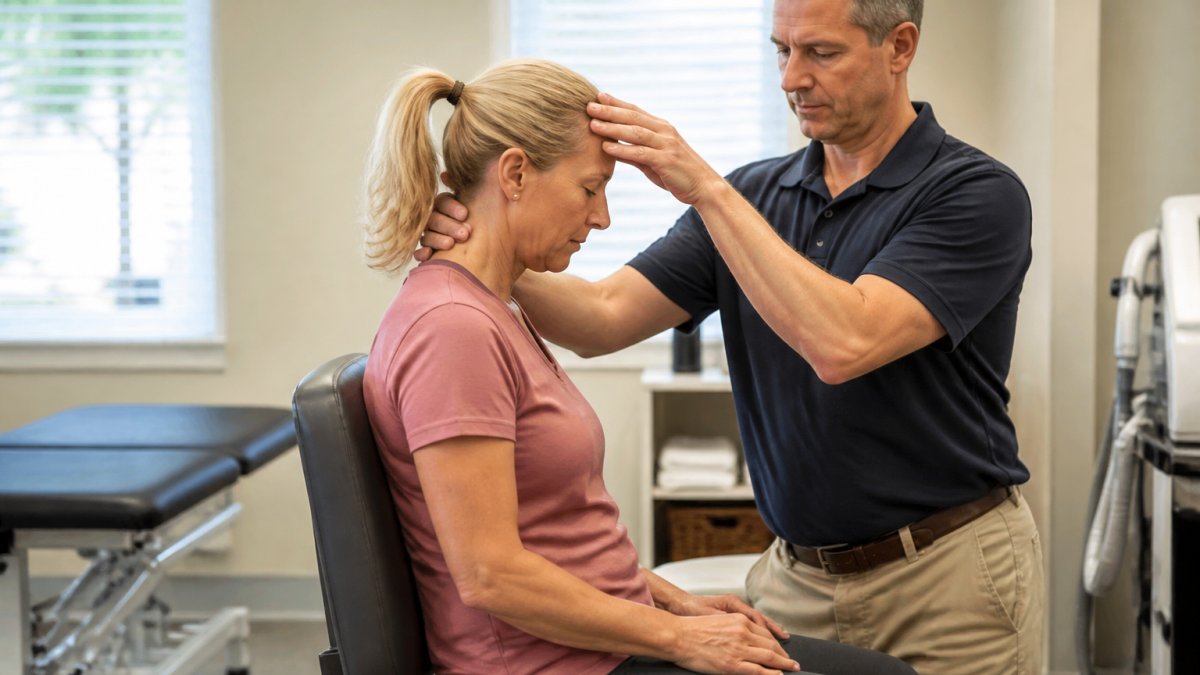 Physical therapist guiding a patient through chin tuck exercises to correct forward head posture in a clinic.
Deep Neck Flexor Strengthening
Deep neck flexors are the small muscles at the front of your neck. They support head and neck alignment. A common mistake is cranking the neck forward instead of lifting gently.
- Lie on your back with your head neutral
- Nod slowly, as if saying yes
- Hold for 5 to 10 seconds
Scapular and Lower Trapezius Exercises
Your scapular muscles and lower trapezius hold your shoulder alignment in place. Weakness here lets the shoulders roll forward.
- Squeeze your shoulder blades together
- Hold for 5 seconds
- Do 10 reps, twice daily
Pro TipDo chin tucks in small doses throughout the day, not just once. Five reps every hour beats 30 reps in one sitting for building a new postural habit.
Forward Head Posture Stretches to Release Tight Muscles
Forward head posture stretches target the muscles that have tightened from years of slouching. Stretching alone will not fix the problem, but it makes strengthening work easier.
How To Fix Forward Head Posture For Good
Conor Harris
Hold each stretch for 20 to 30 seconds. Never bounce.
Upper Trapezius Stretch
The upper trapezius stretch releases the muscle that runs from your neck to your shoulder.
- Sit tall and hold the chair with one hand
- Tilt your head away from that side
- Use your free hand to add gentle pressure
Chest and Thoracic Mobility Stretches
Tight chest muscles pull the shoulders forward, and a stiff thoracic spine locks the whole upper body in a rounded position. Thoracic mobility work opens both.
- Foam rolling the upper back for 1 to 2 minutes
- Doorway chest stretch, 30 seconds per side
- Seated thoracic rotation, 10 reps per side
A common mistake is stretching hard and skipping the strengthening. That combination rarely holds.
Forward Head Posture Desk Setup: Ergonomics That Support Alignment
A good forward head posture desk setup removes the daily triggers that pull your head forward. Ergonomics will not correct posture on its own, but it stops you from undoing your exercise work every afternoon.
Set up your workstation like this:
- Top of the screen at eye level
- Screen about an arm’s length away
- Feet flat, hips and knees near 90 degrees
For phone posture, raise the device instead of dropping your head. Small changes add up over a workday.
How Long to Correct Forward Head Posture: A Week-by-Week Plan
Most people notice easier, more comfortable neck positioning within 4 to 6 weeks of consistent practice, and visible postural change typically takes 8 to 12 weeks.
Two expectations to set up front. First, posture change and symptom relief are not the same thing.
Here is a progression to consider. Each phase builds on the last, and you only move forward when the current phase feels easy for two consecutive sessions. (Source: guidelines from the Occupational Safety and Health Administration (OSHA) on ergonomics)
Schedule Appointment →
| Phase | Focus | Frequency | Session length | Progression rule |
|---|
| Weeks 1-2 | Awareness and gentle mobility | Daily | 5-8 min | Chin tucks 5 sec hold x 8 reps; add a second set when easy |
| Weeks 3-4 | Add strengthening and stretching | 3-4 days per week | 12-15 min | Deep neck flexor holds to 10 sec x 10; scapular squeezes 5 sec x 10 |
| Weeks 5-8 | Progress load and integrate habits | 4-5 days per week | 15-20 min | Add band rows and wall slides; increase holds before reps |
| Weeks 9-12 | Maintain and personalize | 3-4 days per week | 10-15 min | Keep the two hardest exercises; rotate the rest |
Weeks 1-2: Build Awareness and Gentle Mobility
Start with chin tucks and easy neck stretches. Do not push into pain. The goal is awareness, not strength yet.
- Chin tucks: 5-second hold, 8 reps, once or twice daily
- Upper trapezius stretch: 20 seconds per side, 2 rounds
- Seated thoracic rotation: 8 slow reps per side
If a chin tuck causes a headache or dizziness, reduce the hold to 2 seconds and the range to a small nod. If that still triggers symptoms, skip chin tucks this week and work only on thoracic rotation and the doorway chest stretch until you can be assessed.
Weeks 3-4: Add Strengthening and Stretching
Layer in deep neck flexor strengthening and scapular work. Add the upper trap stretch and chest mobility after each session.
- Deep neck flexor nods: 10-second hold, 10 reps
- Scapular squeezes: 5-second hold, 10 reps, twice daily
- Doorway chest stretch: 30 seconds per side
A common mistake is adding strengthening and dropping the mobility work. Keep both. Tight chest and thoracic tissue will pull your shoulders forward faster than your scapular muscles can pull them back.
Weeks 5-8: Progress Load and Integrate Daily Habits
Increase hold times and reps as the exercises get easy. Tie your routine to daily cues, like after your morning coffee or every work break.
- Add a light resistance band row: 12 reps, 2 sets
- Add wall slides: 10 reps, 2 sets
- Keep chin tucks at 5 reps every hour during work hours
Progression rule: when you can complete the target reps with clean form and no increase in symptoms for two sessions in a row, add one set or five seconds to the hold.
Weeks 9-12: Maintain and Personalize
By this point, most people have a short list of exercises that help most and a few that do nothing. Keep the two or three that give you the clearest change in how your neck feels, and rotate the rest in once or twice a week. Maintenance is 3 to 4 short sessions per week, not daily grinding.
Regressions for Pain, Stiffness, or Limited Mobility
Not everyone can start with a standard chin tuck. Use these swaps:
- Neck pain with chin tucks: start with isometric holds against your own hand instead of moving your head
- Very stiff upper back: use a rolled towel under the upper back instead of a foam roller, and keep the roll to 30-60 seconds
- Shoulder pain with scapular squeezes: do them lying face down on a firm surface to reduce load
How to Track Progress Without a Diagnosis
You do not need imaging or a clinical measurement to know whether the plan is working. Track three simple things in a notes app:
- Comfort: rate neck tightness at the end of the workday on a 0-10 scale
- Function: note whether turning your head to check a blind spot or look over your shoulder feels easier
- Consistency: mark each day you completed at least one session
A useful pattern is a slow drop in end-of-day tightness over 3 to 4 weeks, even if your posture photos look similar. If comfort, function, and consistency are all flat after 6 weeks, change one variable, usually frequency, before adding exercises.
Watch OutIf neck pain, headaches, or numbness into the arm gets worse as you progress, stop and get checked. Pushing through nerve symptoms can set you back weeks.
When to Seek Professional Help for Forward Head Posture
Forward head posture is a description of alignment, not a diagnosis. The same head-forward position can come from years of screen habits, from a stiff thoracic spine, from weak deep neck flexors, from an old whiplash injury, or from a nerve or joint problem in the neck.
See a professional if you have pain that limits daily activity, numbness or tingling in the arms, or symptoms that do not improve after several weeks of consistent exercise. These signs point to something beyond a simple postural habit.
Symptoms That Warrant Prompt Assessment
Some symptoms should not wait for a few weeks of home exercise. Seek care soon if you have:
- Pain that is worsening rather than easing over days
- Numbness, tingling, or weakness in the shoulder, arm, or hand
- Balance problems, unsteadiness, or a feeling that the room is moving
These do not automatically mean something serious, but they change the evaluation. A clinician can check strength, sensation, reflexes, and neck motion, and decide whether imaging or a referral is needed.
When Professional Guidance Helps Most
Beyond red flags, professional input is worth it when:
- Exercises make symptoms worse instead of better
- You have a history of neck or spine injury or surgery
- Pain radiates into the shoulder, arm, or hand
A physical therapist or physician can identify which muscles are actually weak, which joints are stiff, and whether your symptoms are coming from posture, a joint, a disc, or a nerve. That distinction drives the plan.
What to Expect at an Evaluation
A typical assessment includes a posture and range-of-motion exam, strength testing of the neck and shoulder blades, a neurological screen, and a review of your daily positions at work and on your phone.
At OPDAHL Regenerative Medicine, our team uses advanced diagnostic tools, including dynamic ultrasound, to find the root cause of neck and joint pain.
Key TakeawayConsistency beats intensity. Short daily sessions over 8 weeks outperform long, occasional workouts for correcting forward head posture.
Frequently Asked Questions
Can forward head posture be corrected?
Yes, forward head posture can often be improved with consistent effort. A combination of strengthening exercises for deep neck flexors and scapular muscles, stretching tight chest and upper trapezius muscles, and adjusting your daily ergonomics can help restore better alignment. Progress takes time, and results vary based on factors like how long you have had the posture, your overall health, and how consistently you practice. A qualified professional can assess your specific situation and recommend a tailored plan.
How long does it take to correct forward head posture?
The time to correct forward head posture varies. Many people notice improvement in symptoms within 4 to 6 weeks of consistent exercise and ergonomic changes, but lasting postural change may take several months. A progressive plan that starts with gentle mobility and adds strengthening over 8 weeks is a reasonable framework. Factors like age, severity, and daily habits affect the timeline. For personalized guidance, consult a healthcare provider.
What exercises help with forward head posture?
Key exercises for forward head posture include chin tucks to activate deep neck flexors, and scapular exercises like rows or wall slides to support shoulder alignment. Stretches for the upper trapezius and chest muscles help release tightness. Aim for a mix of strengthening and stretching 3 to 5 times per week. Start gently and progress gradually to avoid strain.
Can phone or computer use contribute to forward head posture?
Yes, prolonged screen use, especially looking down at phones or leaning toward a computer, encourages the head to drift forward. This sustained position can tighten chest and neck muscles and weaken postural muscles over time. To reduce the effect, raise your screen to eye level, take frequent breaks to stand and stretch, and practice chin tucks during the day. Setting up an ergonomic workspace is also important.
Schedule Appointment