Table of Contents
Last Updated: October 6, 2026
Rotator Cuff Pain Treatment Without Surgery: What to Know First
Rotator cuff pain treatment without surgery starts with understanding what is actually injured. The rotator cuff is a group of four muscles and tendons that hold your shoulder joint in place and let you lift and rotate your arm. When one of those tendons gets irritated or torn, reaching overhead, sleeping on that side, or lifting a bag of groceries can hurt.
Many cases improve with a structured plan of rest, physical therapy, and activity changes.
Here is the part most guides skip: the type and size of your tear matter more than the label on your diagnosis. A small partial tear and a full-thickness tear need very different plans.
Key Takeaway
A rotator cuff tear is not automatically a surgical problem. The size of the tear, your age, and how well you respond to therapy guide the decision far more than the diagnosis alone.
Rotator Cuff Tear Exercises: A Safe Progressive At-Home Plan
Rotator cuff tear exercises work best when you build up slowly instead of pushing through pain. The goal is to restore motion first, then add strength. Skipping that order is the single most common mistake we see.
Before starting, get a proper diagnosis. The American Academy of Orthopaedic Surgeons guidance on rotator cuff tears explains why imaging matters before you load an injured tendon. If a movement causes sharp pain, stop and check with a clinician.
Phase 1: Gentle Mobility and Isometric Holds
Phase 1 lasts roughly one to two weeks. Keep it easy. The aim is to wake up the shoulder without stressing the tendon.
- Pendulum swings: lean forward, let the arm hang, and make small circles. Two sets of 10 each direction.
- Isometric holds: press your hand against a wall at waist height and hold for 5 seconds. Do 10 reps.
- Pain-free range of motion: slide your hand up a wall only as far as comfort allows.
Do these daily. Mild soreness is fine. Sharp pain is not.
Phase 2: Band Strengthening and Range-of-Motion Work
Move to Phase 2 once daily motion feels easier, usually after two to three weeks. Now you add light resistance.
- Band external rotation: elbow at your side, pull a light band outward. Two sets of 12.
- Band rows: squeeze your shoulder blades together. Two sets of 12.
- Overhead reach: use a stick or towel to assist the arm upward.
Progress by adding reps before adding resistance. This is where patience pays off.
Watch Out
Pushing into sharp pain during strengthening can re-injure the tendon and set your recovery back weeks. If a move hurts beyond mild soreness, drop back to the previous phase.
Rotator Cuff Pain Physical Therapy: What a Good Program Looks Like
Rotator cuff pain physical therapy is a guided, staged program that combines hands-on treatment, targeted exercise, and activity changes over several weeks to months. It is not just a list of stretches.
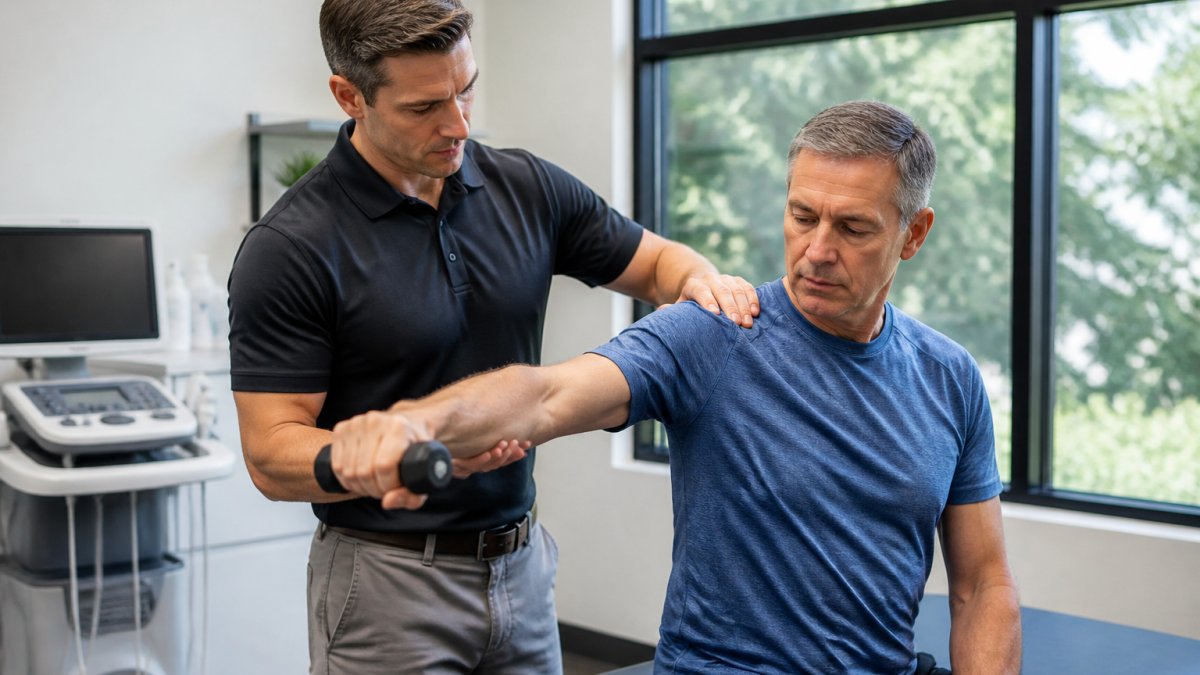 A physical therapist guiding a middle-aged patient through a gentle shoulder range-of-motion exercise in a bright, modern clinic room with an ultrasound machine visible in the background
Expect sessions to focus on three things: restoring range of motion, rebuilding strength, and retraining how you move so you stop aggravating the tendon.
How Therapy Differs by Tear Type and Severity
A common pattern in nonsurgical care is that the diagnosis changes the starting point, the loading, and the timeline:
- Tendinopathy (no tear): Therapy can often start with active range of motion and light resistance within the first week. Most people see meaningful improvement in 6 to 12 weeks with consistent daily exercise.
- Partial-thickness tear: Start with isometrics and pain-free range of motion for 1 to 2 weeks before adding band resistance. Strengthening usually begins around week 2 to 3, and return to heavier activity often takes 3 to 6 months.
- Full-thickness tear: Begin with protected range of motion and isometrics, and delay resisted strengthening until pain and motion allow, often 3 to 6 weeks. Full return to overhead or heavy work can take 6 to 12 months, and some full-thickness tears in older adults may not fully heal structurally even when pain improves.
Age, activity demands, and injury mechanism also matter. A younger person with a traumatic tear from a fall often needs a different plan than an older adult with a degenerative tear that developed gradually. A sudden traumatic tear with weakness may need surgical review sooner, while a degenerative partial tear often responds well to a longer conservative trial.
Manual Therapy, Activity Modification, and Pain Relief Options
Manual therapy means hands-on work to loosen tight tissue around the shoulder. It helps, but it works best alongside exercise, not instead of it. A therapist may use soft tissue mobilization, joint mobilization, or dry needling as adjuncts, but the exercise program is the core driver of recovery.
Activity modification is the unglamorous hero here. Small changes add up:
- Sleep with a pillow supporting the affected arm, or sleep on the opposite side with the affected arm propped on a pillow.
- Avoid repeated overhead reaching and heavy lifting for now.
- Carry loads close to your body, not with an outstretched arm.
- Use ice for 15 to 20 minutes after activity to calm irritation; use heat before exercise if stiffness is the main issue.
For pain relief, many people use ice after activity and an over-the-counter anti-inflammatory as directed on the label. Corticosteroid injections can calm a flare, but they treat symptoms, not the tendon itself, and repeated injections may weaken the tendon over time.
Pro Tip
Ask your therapist for a written home program with sets, reps, and a clear rule for when to progress. A plan you can follow between visits is what drives most of the improvement.
Rotator Cuff Injury Recovery Time: Milestones and What to Expect
Rotator cuff injury recovery time varies widely, but most people who avoid surgery see meaningful improvement over several months, not days. The National Institute of Arthritis and Musculoskeletal and Skin Diseases overview of shoulder problems notes that recovery depends on tear severity and how consistently you follow your plan.
Here is a realistic milestone map to set expectations:
Schedule Appointment →
| Timeframe | Typical Milestone | What You Can Do |
|---|
| Weeks 1-2 | Pain settles with rest | Light daily tasks, gentle motion |
| Weeks 3-6 | Motion improves | Start light strengthening |
| Weeks 6-12 | Strength builds | Most daily activities |
| Months 3-6 | Function returns | Gradual return to sport or heavy work |
Some people improve faster. Others need longer. A full-thickness tear often takes more time than a partial one.
Pro Tip
Track your progress weekly, not daily. Shoulders heal in waves, so a bad day does not mean you are going backward. Look at the trend over two to three weeks.
When to Consider Surgery for Rotator Cuff Tear
Surgery is worth considering when nonsurgical care has not worked after a fair trial, or when the tear is large or caused by a sudden injury. A fair trial usually means several months of consistent therapy and activity changes.
Signs it may be time to talk to a surgeon:
- A complete tear after a fall or sudden injury
- Persistent weakness you cannot lift your arm against
- Pain that keeps getting worse despite good therapy
- A tear that is getting larger on repeat imaging
For many partial tears and degenerative tears, though, conservative management remains the better first step. Surgery has real recovery time and risks, so it should be a considered choice, not a reflex.
Red Flags and How Treatment Differs by Tear Type and Severity
Treatment differs sharply by tear type, and knowing which category you fall into helps you set realistic expectations. A partial tear often responds to therapy and time. A full-thickness tear may need more support, and a sudden traumatic tear may need surgical review sooner. Tendinopathy, where the tendon is irritated but not torn, usually responds fastest to a structured loading program.
Matching the Plan to the Injury
- Tendinopathy: Focus on progressive loading and activity modification. Most people improve over 6 to 12 weeks without imaging changes.
- Partial-thickness tear: Start with pain-free motion and isometrics, then add resistance. Recovery often takes 3 to 6 months, and pain relief does not always mean the tear has healed structurally.
- Full-thickness tear: Protected motion first, then gradual strengthening. Some people do well without surgery, especially older adults with degenerative tears, but full return to heavy overhead work can take 6 to 12 months.
- Traumatic tear with sudden weakness: This is the case most likely to need prompt surgical evaluation, because the tendon may not heal on its own.
Age, activity demands, and injury mechanism all affect the plan. A younger person with a sports injury and a high-demand job may need a more aggressive timeline and closer follow-up than an older adult with a gradual onset of pain.
When to Stop Self-Treating and Get Evaluated
Stop self-treating and get evaluated if you notice:
- Sudden severe pain after an injury
- Inability to lift the arm at all
- Numbness, tingling, or weakness in the hand
- Pain that wakes you every night despite rest
- A shoulder that looks deformed or out of place
- New bruising or swelling around the shoulder after a fall
These signs can point to something beyond a simple strain. A proper exam, often with dynamic ultrasound, helps identify the root cause. This approach focuses on finding the actual problem before building a plan.
Realistic Expectations for Newer Therapies
Adjuncts such as shockwave therapy, platelet-rich plasma, and other regenerative injections are sometimes offered for rotator cuff pain. The evidence for these is mixed, and most are not proven to reliably heal a full-thickness tear. A common pattern is that people feel better after treatment, but pain relief does not mean the tendon has structurally healed. Established care, including physical therapy, activity modification, and judicious use of medication or injections, remains the foundation for most nonsurgical plans. If you are considering an adjunct therapy, ask what the realistic goal is: pain relief, improved function, or structural healing. Those are not the same thing.
MedlinePlus shoulder injuries and disorders resource
Conclusion: Building a Plan That Keeps You Moving
Shoulder pain can make you feel like your active life is slipping away, but most rotator cuff problems do not require surgery. The path forward is a clear diagnosis, a progressive exercise plan, and patience with the timeline.
We focus on nonsurgical care that targets the root cause. Our team uses advanced diagnostic tools, including dynamic ultrasound, to pinpoint what is driving your pain.
Get started with OPDAHL Regenerative Medicine and take the first step toward lasting shoulder relief. Schedule an appointment to find out what is really going on with your shoulder.
Frequently Asked Questions
Can rotator cuff pain get better without surgery?
Many people with rotator cuff pain improve without surgery, especially with partial tears, tendinopathy, or inflammation. A structured program of physical therapy, activity modification, and pain relief can reduce symptoms and restore shoulder function over several weeks to months. Full-thickness tears in older adults may still respond to nonoperative care, but outcomes vary. A proper evaluation, often with dynamic ultrasound, helps determine whether conservative management is likely to work for your specific injury.
What exercises can help rotator cuff pain?
Start with gentle isometric holds and pendulum swings to keep the shoulder moving without strain. Progress to band exercises like external rotation, internal rotation, and scapular retraction. Avoid overhead pressing or heavy lifting until pain settles. A physical therapist can tailor a progressive plan based on your tear type and range of motion. Stop any exercise that sharply increases pain and check with a clinician before advancing.
How long does it take for a rotator cuff injury to heal without surgery?
Recovery time varies by tear severity and treatment response. Mild tendinopathy may improve in 4 to 6 weeks. Partial tears often take 3 to 6 months of progressive rehabilitation. Full-thickness tears managed without surgery may take 6 months or longer to reach maximum improvement. Pain scores and shoulder strength guide progress. If symptoms persist beyond 6 months despite consistent nonsurgical care, surgery may be worth discussing.
When should you see a doctor for rotator cuff pain?
See a doctor if you have arm weakness, cannot lift your arm, hear a pop with sudden pain, or have pain that persists beyond a few weeks despite rest. Night pain that disrupts sleep or pain after a fall also warrants evaluation. A clinician can use dynamic ultrasound to assess tendon damage and rule out other causes. Early diagnosis helps you start the right treatment and avoid unnecessary delays.
Schedule Appointment