Table of Contents
Last Updated: October 7, 2026
How Exercise Helps Knee Osteoarthritis
Exercise is one of the most effective ways to manage knee osteoarthritis and reduce pain.
Patients who combine targeted strengthening with low-impact activity often see meaningful gains in mobility and pain. Start slowly and progress gradually, your body needs time to adapt.
Research shows consistent exercise reduces knee pain and stiffness.
The best approach combines several types of movement:
- Strengthening exercises for muscles around the knee
- Low-impact aerobic activity for joint health
- Stretching and range-of-motion work
- Warm-up and cool-down routines
You don’t need expensive equipment or a gym membership. Most effective knee osteoarthritis exercises can be done at home. Consistency matters more than intensity.
Low Impact Knee Exercises for Pain Management
Low-impact activities protect your knee joint while still building strength and cardiovascular fitness, moving your knee without the jarring impact of running or jumping.
Walking is the simplest low-impact activity, strengthening leg muscles and improving circulation without stressing your knee. Start with short walks on flat surfaces and increase distance as your knee gets stronger.
Cycling is another excellent low-impact option, building quadriceps strength without bearing full body weight. Stationary bikes are ideal because you control resistance and speed.
Walking and Cycling for Joint Health
Walking and cycling are foundational low-impact knee exercises most people can do safely, improving cardiovascular health while strengthening the muscles that support your knee.
Start with 10-15 minute walks on flat, even surfaces, avoiding hills and uneven terrain until your knee feels stronger.
For cycling, begin with 10-15 minutes on a stationary bike.
Gradually increase duration by 5 minutes each week, and rest when needed, some days your knee will feel better than others.
Chair-Based Exercises
Chair exercises are perfect if standing is difficult or painful, building strength while keeping weight off your knee.
Seated knee extensions:
Sit upright in a chair. Straighten one leg out in front of you.
Seated marching:
Sit upright. Lift one knee up toward your chest. Lower it slowly. Alternate legs in a marching motion.
Seated glute squeezes:
Sit upright. Squeeze your buttock muscles tight. Hold for 2-3 seconds. Relax. Repeat 15-20 times.
Do chair exercises 3-4 times per week; they’re gentle enough for daily use if you don’t overdo it.
Quadriceps Strengthening for Knee Pain
Your quadriceps sit on the front of your thigh. Strong quads are essential for knee osteoarthritis exercises because they stabilize the joint and reduce stress on damaged cartilage; weak quads let your knee move incorrectly, increasing pain.
Many people with knee pain avoid using their quads, creating a cycle: weak muscles lead to more pain, less activity, and weaker muscles. Breaking this cycle is crucial.
Quadriceps strengthening should be part of your routine 3-4 times per week. Start basic, progress slowly, and prioritize proper form over repetition count.
Straight-Leg Raises and Variations
Straight-leg raises are among the most effective quadriceps strengthening exercises, building strength without bending your knee, safer for osteoarthritis.
Basic straight-leg raise:
Lie on your back. Bend one knee with your foot flat on the floor. Keep your other leg straight.
Seated straight-leg raise:
Sit in a chair. Place a rolled towel under one knee. Tighten your thigh and straighten your leg.
Standing straight-leg raise:
Stand facing a counter or wall for balance.
Progress by adding ankle weights once the basic version feels easy. Start with 1-2 pounds.
Wall Sits and Modified Squats
Wall sits build isometric strength, working your muscles without moving the joint, excellent for knee osteoarthritis exercises.
Wall sit:
Stand with your back against a wall. Feet should be about 12 inches from the wall and shoulder-width apart.
Start with shorter holds and gradually increase the time as strength improves.
Modified squat:
Stand facing a counter or sturdy chair. Feet should be shoulder-width apart. Bend your knees slightly, about 30 degrees.
Never bend your knees more than 90 degrees if you have knee osteoarthritis.
Hip and Glute Strengthening for Knee Support
Your hip and glute muscles play a huge role in knee health. When they’re weak, your knee compensates, increasing stress on the joint and worsening pain.
Hip and glute strengthening is one of the most important aspects of managing knee osteoarthritis, yet many people focus only on the knee. Strengthening your hips and glutes significantly reduces knee pain.
Do these exercises 3-4 times per week. They’re gentle enough to do daily if needed.
Glute Bridges and Clamshells
Glute bridges activate and strengthen your buttock muscles while engaging your core for better overall stability.
Glute bridge:
Lie on your back. Bend both knees with feet flat on the floor, about hip-width apart.
Single-leg glute bridge:
Once the basic glute bridge feels easy, try lifting one foot slightly off the floor. This increases the challenge.
Clamshell:
Lie on your side. Bend both knees to about 45 degrees. Keep your feet together.
Clamshells strengthen the muscles on the outside of your hip, improving knee alignment and reducing pain.
Lateral Band Walks and Step-Downs
Lateral band walks strengthen the hip muscles that stabilize your knee during movement. You’ll need a resistance band.
Schedule Appointment →
Lateral band walk:
Place a resistance band around both legs just above your knees. Stand with feet hip-width apart, knees slightly bent.
Start with a light band. As you get stronger, progress to a heavier band.
Step-down:
Stand on a low step or stair (4-6 inches high). Stand on one leg.
Step-downs teach your muscles to control your knee as you move down, important for stairs and daily activities.
Exercises to Avoid With Knee Osteoarthritis
Certain movements stress an arthritic knee too much. Avoiding them prevents flare-ups and further joint damage.
High-impact activities should be avoided:
- Running and jogging
- Jumping and plyometrics
- High-impact aerobic classes
- Sports with quick direction changes
Deep bending movements stress the joint:
- Deep squats (more than 90 degrees)
- Lunges with deep knee bends
- Kneeling exercises
- Leg press machines with heavy weight
Repetitive twisting motions can irritate the joint:
- Pivoting on a bent knee
- Twisting while weight-bearing
- Certain yoga poses that twist the knee
Listen to your body. If an exercise causes sharp pain or swelling, stop doing it. Some soreness is normal when starting new exercises. Sharp or stabbing pain is not.
Your Weekly Knee Osteoarthritis Exercise Plan
A structured plan helps you stay consistent. This weekly routine combines strengthening, low-impact cardio, and stretching. Adjust based on how your knee feels.
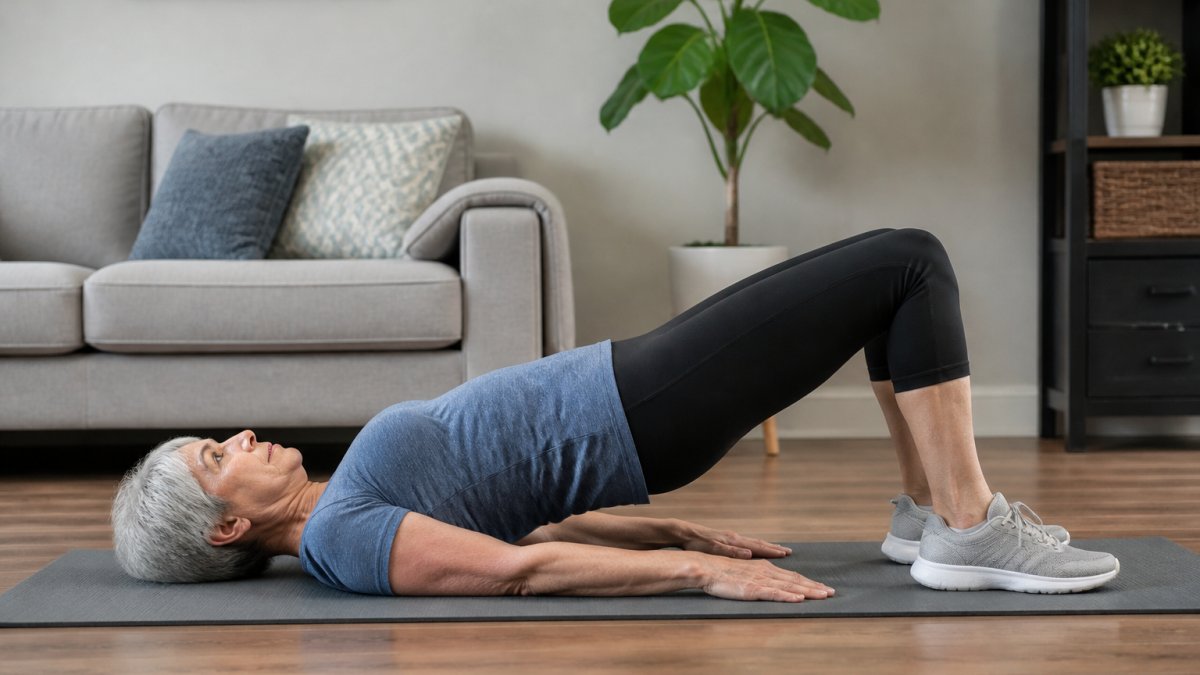 Older adult performing a glute bridge exercise on a yoga mat at home, demonstrating proper form with neutral spine alignment and controlled movement
Monday: Quadriceps and Low-Impact Cardio
- 5-minute warm-up walk
- Straight-leg raises: 2 sets of 12-15 reps per leg
- Wall sits: 3 sets of 20-30 seconds
- 10-15 minute walk or stationary bike
- 5-minute stretching
Tuesday: Hip and Glute Strengthening
- 5-minute warm-up walk
- Glute bridges: 2 sets of 15-20 reps
- Clamshells: 2 sets of 15-20 reps per side
- Lateral band walks: 2 sets of 12-15 steps
- 5-minute stretching
Wednesday: Rest or Light Activity
- Gentle walking only (10-15 minutes)
- Light stretching if desired
Thursday: Chair Exercises and Low-Impact Cardio
- Seated knee extensions: 2 sets of 12-15 reps per leg
- Seated marching: 2 minutes
- Seated glute squeezes: 2 sets of 15-20 reps
- 10-15 minute walk or stationary bike
- 5-minute stretching
Friday: Full-Body Strengthening
- 5-minute warm-up walk
- Straight-leg raises: 2 sets of 12-15 reps per leg
- Glute bridges: 2 sets of 15-20 reps
- Step-downs: 2 sets of 10-12 reps per leg
- Lateral band walks: 2 sets of 12-15 steps
- 5-minute stretching
Saturday: Low-Impact Cardio
- 20-30 minute walk or stationary bike
- 5-minute stretching
Sunday: Rest and Recovery
- Light stretching only
- Rest your knee
| Exercise Type |
Frequency |
Duration |
Best For |
| Quadriceps strengthening |
3-4x per week |
10-15 minutes |
Knee stability |
| Hip and glute work |
3-4x per week |
10-15 minutes |
Knee alignment |
| Low-impact cardio |
4-5x per week |
15-30 minutes |
Joint health |
| Stretching |
Daily |
5-10 minutes |
Flexibility |
| Rest days |
1-2x per week |
Full day |
Recovery |
Warm-Up and Cool-Down Routine
Always warm up before exercise. Warm muscles are more flexible and less prone to injury.
5-minute warm-up:
- Gentle walking in place: 1 minute
- Arm circles: 10 circles each direction
- Leg swings forward and back: 10 each leg
- Leg swings side to side: 10 each leg
- Gentle marching: 2 minutes
5-minute cool-down and stretching:
Stretch each muscle group for 20-30 seconds. Don’t bounce. Gentle, steady pressure is best.
- Quadriceps stretch: Stand and pull one foot toward your buttock
- Hamstring stretch: Sit and reach toward your toes
- Calf stretch: Step back and press your heel into the floor
- Hip flexor stretch: Lunge position with back knee down
- Glute stretch: Sit and pull one knee toward your chest
Cool-down stretching improves flexibility and reduces soreness.
Progressive Progression and Flare-Up Management
Progress gradually. Increase repetitions or duration by about 10% each week. This gives your body time to adapt.
Signs you’re progressing well:
- Exercises feel easier
- You have less pain during and after exercise
- You can do more repetitions with good form
- Your knee feels stronger in daily activities
If an exercise becomes too easy, progress by:
- Adding more repetitions
- Adding resistance (ankle weights or bands)
- Increasing exercise duration
- Trying a harder variation
Managing flare-ups:
Some days your knee will hurt more than usual. This is normal. A flare-up doesn’t mean you’ve done damage.
When your knee flares up:
- Reduce exercise intensity by 50%
- Skip the most challenging exercises
- Focus on gentle movement like walking
- Ice your knee for 15-20 minutes after exercise
- Take an extra rest day
Most flare-ups resolve within a few days. Return to your normal routine gradually once pain decreases.
Pain should decrease during and after exercise. If pain increases significantly or lasts for hours after exercise, you’ve done too much. Dial back the intensity next time.
Watch Out
Sharp, stabbing pain during exercise is a warning sign. Stop immediately and rest. This is different from normal exercise soreness. Contact a healthcare provider if sharp pain continues.
When to Consult a Specialist
Most people with knee osteoarthritis can manage their condition with exercise and lifestyle changes (the CDC). Sometimes professional guidance helps.
Consider consulting a specialist if:
- Pain is severe (7 or higher on a 10-point scale) and doesn’t improve with exercise
- Your knee swells significantly or feels unstable
- You can’t perform daily activities like climbing stairs or walking
- Home exercises aren’t helping after 4-6 weeks of consistent effort
- You’ve had steroid injections that provided only temporary relief
A physical therapist can assess your situation and create a personalized plan, ensuring you do exercises correctly and progress safely.
At OPDAHL Regenerative Medicine, we use advanced diagnostic tools like dynamic ultrasound to identify the root causes of your knee pain. This helps us determine whether your osteoarthritis might benefit from regenerative medicine approaches in addition to exercise.
A consultation with a specialist doesn’t mean surgery is necessary. Most knee osteoarthritis can be managed without surgery when you have the right approach.
Knee pain from osteoarthritis doesn’t have to limit your life. Consistent exercise strengthens the muscles that support your knee, reduces pain, and improves mobility.
Frequently Asked Questions
What is the best exercise for osteoarthritis in your knees?
Low-impact aerobic activities like walking and cycling combined with targeted strengthening exercises work best for knee osteoarthritis. Quadriceps strengthening is particularly effective because strong thigh muscles reduce stress on the joint. The most beneficial approach combines aerobic activity, muscle strengthening, and range-of-motion work tailored to your pain level. Start with exercises you can perform without sharp pain, and progress gradually over weeks.
What should you not do with osteoarthritis of the knee?
Avoid high-impact activities like running, jumping, or intense plyometrics that jar the knee joint. Skip exercises that cause sharp pain or swelling. Do not push through pain during movement, mild discomfort during exercise is acceptable, but sharp pain signals you should stop. Avoid prolonged immobility, as stiffness worsens osteoarthritis symptoms. Also limit repetitive twisting or pivoting motions and deep squats beyond your comfortable range.
How long does it take to feel relief from knee osteoarthritis exercises?
Most people notice improved range of motion and reduced stiffness within 2-4 weeks of consistent exercise. Pain relief typically develops over 6-8 weeks as muscles strengthen and joint stability improves. Results depend on exercise consistency, pain severity at baseline, and whether you combine exercise with other treatments. Staying active prevents symptoms from worsening, even if pain doesn’t disappear completely.
Can knee osteoarthritis exercises replace surgery or injections?
Exercise is often an effective first-line approach and can prevent or delay the need for surgery in many cases. However, severe osteoarthritis or persistent pain despite consistent exercise may require additional treatment options. Regenerative medicine approaches, physical therapy, and targeted exercise programs together offer an alternative pathway to surgery for many patients. Consult a specialist to determine whether your condition requires intervention beyond exercise alone.