Table of Contents
Last Updated: October 19, 2026
How Regenerative Medicine Targets Both Acute and Chronic Pain
Regenerative medicine uses the body’s own biological materials to support tissue repair and reduce pain without surgery.
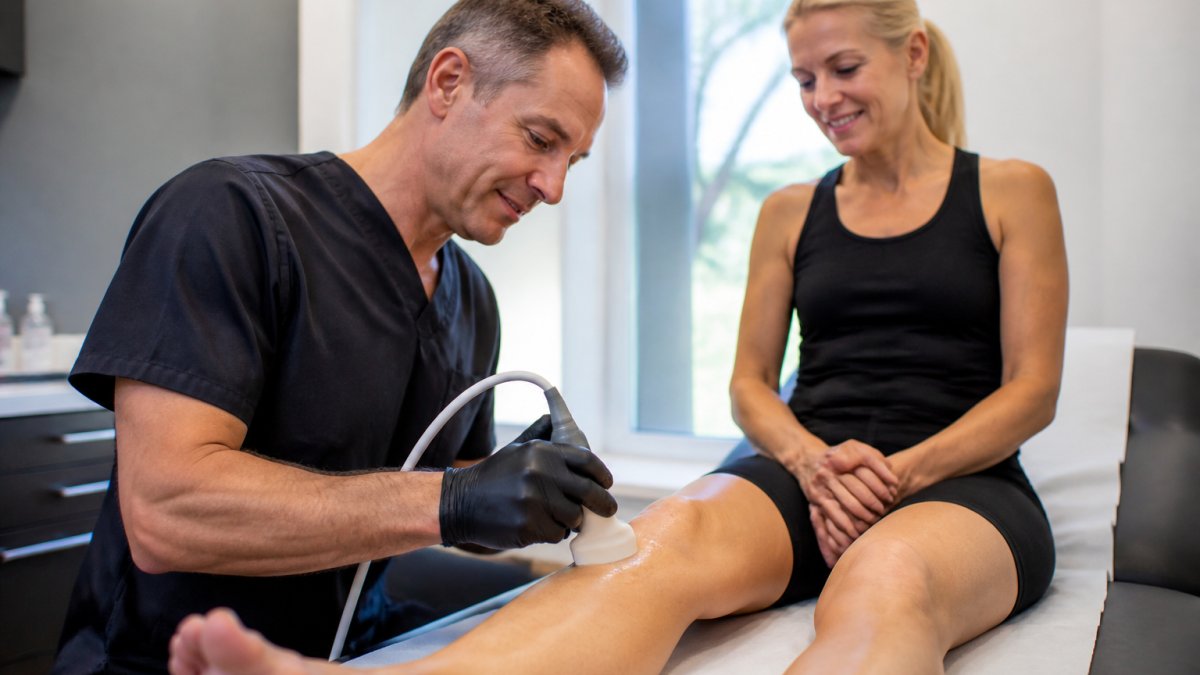 Doctor using dynamic ultrasound to examine a patient’s knee during a regenerative medicine consultation
That distinction matters. Pain is a symptom, not a diagnosis.
Most people arrive at our clinic after trying pain medication, (tylenol, ibuprofen) physical therapy, chiropractic care, or steroid injections with limited results. The fair question is: how is this different?
Conventional treatments usually manage symptoms: steroids reduce inflammation temporarily, and pain medication interrupts nerve signals.
Stem Cell Therapy for Joint and Spine Pain
Stem cell therapy involves injecting cells into an injured joint or spinal structure to support the body’s natural healing process where tissue has been damaged.
A common mistake is assuming all stem cell clinics offer the same thing. They do not. Cell source, concentration, and injection guidance vary widely, and those differences affect outcomes.
Platelet-Rich Plasma (PRP) Therapy
PRP therapy uses a sample of your own blood, spun in a centrifuge to concentrate platelets and growth factors, then injected into the painful area. It is minimally invasive and typically completed in a single visit.
PRP is often chosen for tendon and ligament injuries, while regenerative approaches may suit joint damage or spine conditions. Neither is a guaranteed fix, and candidacy depends on the specific injury.
Regenerative Medicine for Acute Pain: Injuries and Sudden Onset
Acute pain is the gap most guides skip. They default to chronic joint pain, leaving athletes, tradespeople, and weekend warriors wondering whether regenerative care is only for long-term problems.
Acute pain means discomfort that started recently, typically within days to weeks after a specific event: a fall, a twist, a bad lift, a sudden pop during a run. The tissue is damaged but has not yet remodeled into scar tissue or chronic degeneration.
How Acute Pain Is Assessed Before Treatment
A responsible workup does not start with an injection. It starts with a diagnosis. In our clinic that means:
- History and mechanism of injury. How the tissue was loaded, in what direction, and how soon pain appeared.
- Dynamic ultrasound. Real-time imaging of the tendon, ligament, or joint while the patient moves, which catches partial tears and tendon gliding problems a static image can miss.
- Functional testing. Strength, range of motion, and provocation maneuvers to confirm which structure is actually generating the pain.
- Red-flag screening. Fractures, complete ruptures, infections, and nerve compression that require a different pathway entirely.
Without that step, a biologic injection can land in the wrong tissue, mask a fracture, or delay a repair that needed surgery weeks earlier.
The Healing-Phase Window
Soft tissue healing moves through predictable phases: inflammatory in the first days, proliferative over the following weeks, and remodeling for months.
Injecting into a hot, acute inflammatory flare is different. Most practitioners first calm the acute response, confirm the diagnosis, and then decide whether a biologic adds anything. For a mild ankle sprain already improving with load management, it often does not.
When Regenerative Care Is the Wrong Call for Acute Pain
Honest candidacy means saying no sometimes. Regenerative approaches are generally not the first move when:
- There is a complete tendon or ligament rupture that needs surgical repair.
- A fracture is present or suspected.
- The injury is infected or the skin over the site is compromised.
- The pain is neuropathic, radiating, burning, or numb, which points to a nerve problem, not a tissue-repair problem.
- The injury is already healing well with rest, bracing, and graded loading.
For a construction worker with a fresh shoulder strain, early intervention may help the injury heal without becoming chronic, but only after imaging confirms the rotator cuff is intact and the pain comes from the tendon, not the joint or neck. Timing and accurate diagnosis decide whether that is realistic.
Key TakeawayAcute pain is not automatically a green light for regenerative care. It is a reason to get a fast, precise diagnosis, and then decide whether the biologic actually adds value on top of load management and rehabilitation.
What Acute-Pain Patients Should Track
Because acute injuries can improve on their own, tracking matters more than a single good week. Useful markers include pain at rest versus with activity, time to return to specific tasks, over-the-counter medication use, and whether range of motion improves week over week. If those markers are flat or worsening two to four weeks after treatment, reassess the diagnosis rather than adding another injection.
Regenerative Medicine for Chronic Pain: When Conventional Treatments Fall Short
Regenerative medicine for chronic pain targets tissue that has failed to heal over months or years.
Steroid injections are a familiar example: they calm a flare-up for weeks, but pain frequently returns once the effect wears off.
Regenerative treatments aim for sustained relief by supporting tissue repair rather than suppressing symptoms. Results vary by condition, and honest expectations matter more than marketing promises.
Regenerative Medicine Candidacy: Who Benefits and Who Should Wait
Regenerative medicine candidacy depends on the type and severity of the injury, your overall health, and how your body responded to prior treatment.
Schedule Appointment →
Candidate selection typically favors patients with localized joint or tendon pain who have not found lasting relief from conservative care.
| Patient Profile | Likely Fit | Why |
|---|
| Active adult with a recent ligament injury | Strong | Tissue still healing, early intervention helps |
| Chronic osteoarthritis, failed steroid injections | Moderate | Depends on joint damage severity |
| Severe joint destruction, bone-on-bone | Weak | May need surgical evaluation |
| Active infection or bleeding disorder | Not suitable | Safety risk, different care needed |
The table above is a general guide, not a diagnosis. A consultation is the only way to know your own situation.
Regenerative Medicine Recovery Time: What to Expect Week by Week
Regenerative medicine recovery time varies by treatment and individual, but most patients follow a similar pattern: light daily activities within a few days, building toward normal movement over several weeks.
- Days 1-3: Mild soreness at the injection site, rest and limited activity
- Week 1-2: Gradual return to light activity, guided rehabilitation begins
- Weeks 3-6: Progressive strengthening, improved range of motion
- Weeks 6-12: Most patients notice meaningful changes in pain and function
Watch OutPushing through pain too early is the most common setback. Patients who skip the rehabilitation phase often report that relief stalls, because healing tissue needs controlled loading, not heavy strain.
Safety, Evidence, and Regulatory Status of Regenerative Treatments
Safety and evidence separate honest clinics from hype. Regenerative treatments are generally minimally invasive but not risk-free, and no provider should promise a cure. The harder question is whether a specific product, from a specific source, for a specific diagnosis, has evidence behind it.
What the Regulatory Categories Actually Mean
The FDA’s framework for regenerative medicine therapies draws lines that patients rarely hear explained in a consultation:
- Same-day, same-patient procedures. When a patient’s own blood or tissue is collected, minimally manipulated, and returned in a single procedure, the classic PRP or bone-marrow-concentrate model, the regulatory burden is lighter than for manufactured products.
- More-than-minimally-manipulated or expanded cells. Culturing, expanding, or otherwise altering cells changes the regulatory category and generally requires an investigational new drug application or an approved biologics license.
- Unapproved products marketed as stem cells. Some clinics advertise products derived from birth tissue, amniotic fluid, or donor sources as “stem cell therapy.” Many of these are not approved for injection, and some have been the subject of FDA warning letters.
That third category is where patients get hurt, financially and sometimes physically. A product being sold does not mean it is cleared for the use being sold.
How Evidence Strength Varies by Condition
Evidence is not a single verdict but a spectrum that varies across conditions:
- Tendinopathy (elbow, patellar, Achilles). PRP has the most published research of any regenerative approach, with multiple randomized trials and mixed but generally favorable results for chronic cases that failed conservative care.
- Knee osteoarthritis. Evidence is moderate and inconsistent. Some trials show meaningful pain and function improvement; others show results similar to placebo injections. Response appears to depend on osteoarthritis severity, with advanced bone-on-bone disease responding poorly.
- Partial ligament and muscle injuries. Evidence is promising but thinner, often limited to smaller trials and case series.
- Spine and discogenic pain. Evidence is emerging and the procedures are more invasive, which raises both risk and the bar for candidacy.
- Systemic or autoimmune conditions, neurological disease, and cosmetic uses. These are largely outside the musculoskeletal evidence base and should be treated with extra caution.
The National Institutes of Health maintains public research databases where patients can look up the specific condition and therapy being recommended. Reading even two or three abstracts changes the quality of the conversation.
Questions That Separate Responsible Care from Marketing
A provider who cannot answer these clearly is one to reconsider:
- What is the exact product, and where does it come from? Autologous (your own) versus donor-derived matters enormously for both regulation and risk.
- Is this use approved, or is it investigational? Both answers can be legitimate, but the patient deserves to know which one applies.
- What does your own follow-up data show? Not published studies from other clinics, this clinic’s outcomes for this condition.
- What is the plan if it does not work? A defined next step, including surgical referral, is a sign of an honest practice.
- What are the known risks? Infection, bleeding, reaction to the injection, and, for some products, immune reactions to donor material.
Pro TipAsk two direct questions before any treatment: where does the biologic material come from, and what does the clinic’s own follow-up data show? A provider who cannot answer both clearly is one to reconsider.
Tracking Outcomes and Follow-Up
Relief that is not measured cannot be evaluated. Useful outcome measures include a validated pain score, a function score for the joint or region, changes in medication use, and durability of benefit at three, six, and twelve months. Some patients need one treatment; others may need a repeat or staged plan. Knowing which applies to your condition is part of informed consent.
Cost, Insurance, and Value: Making an Informed Decision
Cost and insurance coverage deserve a straight answer. Many regenerative treatments are not covered by insurance because they are considered investigational for certain uses, so patients often pay out of pocket.
Pricing depends on the treatment, the number of injections, and the complexity of your case.
Weighing value means looking past the upfront number. Compare cost against the potential to delay or avoid surgery, the downtime involved, and how long relief tends to last.
Conclusion: Is Regenerative Medicine Right for Your Pain?
The honest answer: it depends on your injury, history, and goals. What we offer is a clear diagnosis, an honest assessment of candidacy, and a plan built around your body rather than a one-size-fits-all protocol.
At OPDAHL Regenerative Medicine, our team uses advanced diagnostic tools including dynamic ultrasound to identify the root cause of pain in the knees, shoulders, hips, and spine.
If you have tried conservative treatments without lasting relief, schedule an appointment with OPDAHL Regenerative Medicine.
Frequently Asked Questions
What is regenerative medicine for pain relief?
Regenerative medicine uses biological treatments like stem cell therapy and platelet-rich plasma (PRP) to support the body’s natural repair processes. For pain relief, these therapies aim to reduce inflammation and promote tissue repair in damaged joints, tendons, or ligaments. Unlike medications that mask symptoms, regenerative treatments target the underlying damage to provide sustained relief and improved joint function. A consultation with a qualified provider can determine if you are a candidate.
Can regenerative medicine help with acute pain?
Yes, regenerative medicine for acute pain can be effective for recent injuries such as ligament sprains, tendon strains, or muscle tears. PRP therapy, for example, is often used to support healing after sports injuries. Treatment is most effective when started soon after the injury, before chronic inflammation or scar tissue develops. A provider will assess the injury type and severity to recommend the best approach.
How long does it take to see results from regenerative medicine?
Regenerative medicine recovery time varies by treatment and condition. Some patients notice reduced pain within 2 to 4 weeks, while others experience gradual improvement over 3 to 6 months as tissue repairs. PRP injections often show earlier effects than stem cell therapies. Your provider will outline a personalized timeline and may recommend rehabilitation to support healing and improve outcomes.
Who may be a candidate for regenerative medicine?
Regenerative medicine candidacy depends on your condition, overall health, and treatment history. Ideal candidates include adults with joint pain, osteoarthritis, or sports injuries who have not found relief from physical therapy, steroid injections, or pain medication. Active individuals and workers with physically demanding jobs may benefit. A thorough evaluation, including dynamic ultrasound, helps determine if regenerative treatments are right for you.
Schedule Appointment