Table of Contents
Last Updated: October 26, 2026
What Are Bone Spurs in Knees?
Bone spurs in knees, also called osteophytes, are small bony growths that develop on the edges of bones in the knee joint. They form when the body tries to repair damage to cartilage or bone by building extra bone material. This process happens gradually over months or years, often without causing any pain at first. (Source: the National Institute of Arthritis and Musculoskeletal and Skin Diseases (NIAMS))
The knee joint connects the thighbone, shinbone, and kneecap, with cartilage covering bone ends to enable smooth movement. When cartilage wears down, bones rub together, triggering the body to deposit extra bone around joint edges. These bony growths stabilize a damaged joint but can sometimes cause problems.
Most people discover bone spurs incidentally on X-rays during imaging for other concerns. The good news: many bone spurs never cause symptoms and require no treatment.
How Bone Spurs Form Around the Knee Joint
Bone spurs develop when cartilage loss creates joint instability. The most common cause is osteoarthritis, where cartilage gradually deteriorates. As the protective cartilage thins, the bones underneath experience more pressure and friction.
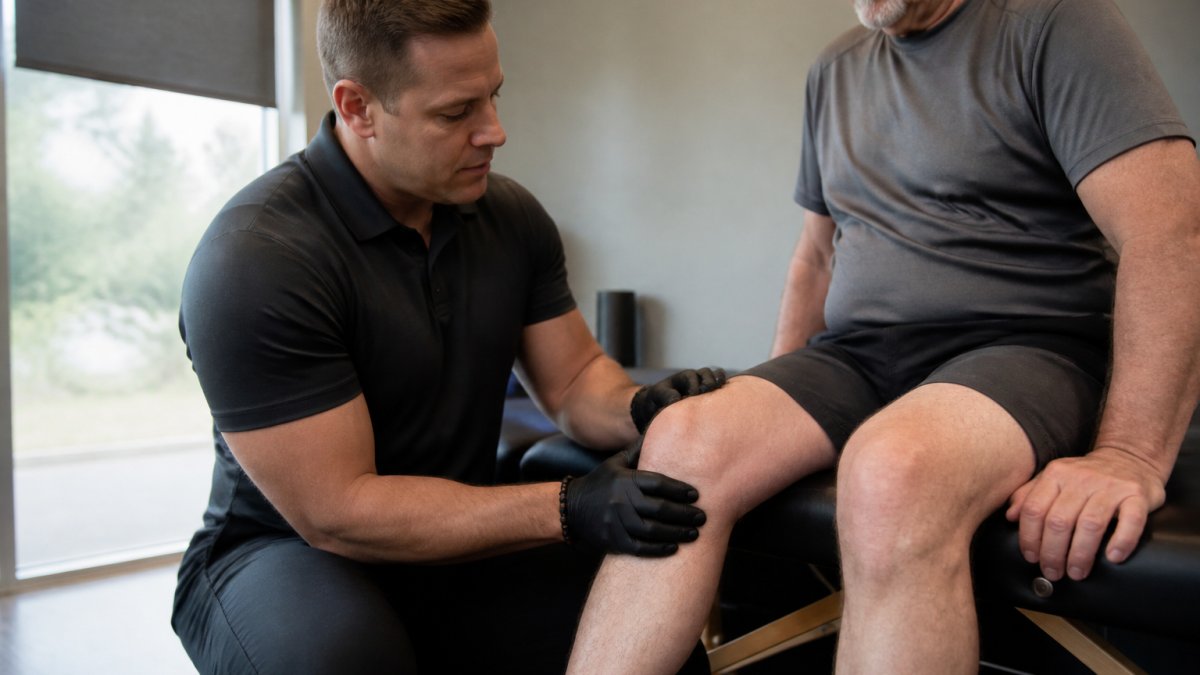 Professional demonstrating bone spur assessment technique on patient’s knee in modern clinical setting with natural lighting
Several factors trigger bone spur formation:
- Cartilage loss from osteoarthritis, the primary driver of spur development
- Previous knee injuries, trauma to ligaments or meniscus can accelerate cartilage breakdown
- Repetitive stress, activities that overload the joint increase spur risk
- Age and wear, bone-on-bone contact worsens with time
- Joint misalignment, uneven weight distribution speeds cartilage loss
When bones rub together, the body increases surface area to distribute pressure more evenly. Unfortunately, these growths can irritate surrounding tissues, tendons, or ligaments, causing symptoms.
Knee Bone Spur Symptoms You Should Know
Many people with bone spurs have no symptoms whatsoever. They live normally without knowing the growths exist. However, when spurs do cause problems, the signs are unmistakable.
Common symptoms include:
- Pain during movement, especially when bending or straightening the knee
- Stiffness, particularly in the morning or after rest
- Swelling and tenderness, around the affected area
- Reduced range of motion, difficulty fully bending or extending the leg
- Clicking or grinding sensations, as the spur irritates tissue during movement
The severity varies widely. Some people experience mild discomfort with certain activities. Others have significant pain that limits daily function. A spur that presses on a nerve or tendon causes sharper, more localized pain than one simply irritating the joint capsule.
Pain typically worsens with activity and improves with rest. Stair climbing, kneeling, or prolonged standing can trigger flare-ups. Understanding your pain pattern helps determine the best treatment approach.
Diagnosis: How Your Doctor Identifies Bone Spurs
Your doctor begins with a detailed history and physical examination, assessing range of motion, swelling, tender areas, and ligament stability. This evaluation often reveals the actual pain source, sometimes the spur itself, but often underlying cartilage loss, inflammation, or muscle weakness.
Imaging: What X-rays and Other Tests Show
X-rays clearly show bone spurs and reveal spur size, location, and cartilage space narrowing. However, a visible bone spur on X-ray does not automatically mean it’s causing your pain. Many people have large spurs visible on imaging but experience no symptoms, while others with minimal spur visibility report significant pain from inflammation or cartilage damage.
MRI provides detailed cartilage assessment, reveals joint fluid, identifies meniscus or ligament damage, and shows how surrounding tissues relate to the spur. This is especially useful when X-ray findings don’t match your symptom pattern.
Dynamic ultrasound performed during movement shows how the spur interacts with tendons, ligaments, and bursa in real time, pinpointing which structure the spur irritates during specific movements.
Interpreting Your Results: Spur Visibility vs. Symptom Causation
A spur visible on X-ray may be incidental, unrelated to your pain. Your doctor must correlate the spur’s location and size with your pain pattern, swelling location, and movement limitations. For example, a medial (inner) spur should cause inner knee pain; if your pain is lateral (outer), the medial spur is likely not the culprit. Your doctor assesses whether underlying cartilage loss or inflammation is the primary driver, as treatment priorities differ: addressing cartilage damage and inflammation may resolve pain even if the spur remains visible.
Pro Tip
Bring a list of your specific pain triggers and symptoms to your appointment. Detailed information about when pain occurs, what movements cause it, and whether swelling or stiffness accompanies it helps your doctor correctly interpret imaging and identify the true pain source.
Knee Bone Spur Treatment Options
Treatment depends on two factors: whether the spur causes symptoms, and whether underlying cartilage damage or inflammation is present. Asymptomatic spurs found on imaging typically need no treatment, regular monitoring ensures they don’t progress. Symptomatic spurs require intervention, and most people start with conservative approaches before considering advanced therapies or surgery.
Conservative Management: A Structured Progression
Phase 1: Immediate Pain Management and Activity Modification
Identify and modify activities that trigger pain rather than resting completely, which worsens stiffness. Use a railing for stairs, cushion for kneeling, and alternate sitting and standing every 20-30 minutes if prolonged standing triggers symptoms.
Apply ice for 15-20 minutes several times daily after aggravating activities. Use heat for morning stiffness and circulation. Many find alternating ice and heat effective.
Over-the-counter anti-inflammatory medications like ibuprofen reduce pain and swelling. If inadequate relief occurs after 2-3 weeks, discuss prescription-strength options with your doctor.
Phase 2: Restore Function and Prevent Progression (Weeks 2-6)
Physical therapy is essential for lasting improvement. A skilled physical therapist designs exercises targeting the specific structures affected by your bone spur. Treatment typically focuses on three areas:
- Strengthening: Quadriceps, hamstring, and hip exercises stabilize the knee and reduce cartilage stress. Common exercises include straight-leg raises, wall squats, and step-ups.
- Flexibility: Stretching prevents stiffness and reduces knee stress.
- Movement pattern correction: Your therapist teaches proper form for walking, stairs, and sitting to minimize joint stress.
Physical therapy typically involves 2-3 sessions per week for 4-8 weeks with daily home exercises. Most people see improvement within 3-4 weeks with consistency.
Weight management reduces joint stress significantly. Each pound of body weight creates 3-6 pounds of force across the knee during walking. Losing 10 pounds reduces knee stress by 30-60 pounds per step.
Schedule Appointment →
Phase 3: Address Underlying Inflammation (Weeks 4-12)
If pain persists despite activity modification, physical therapy, and weight management, consider anti-inflammatory diet changes: increase omega-3 fatty acids, colorful vegetables, fruits, and whole grains. Reduce processed foods, added sugars, and saturated fats.
Pro Tip
Track your symptoms as you progress through conservative care. Note pain levels (on a 0-10 scale), activities that trigger symptoms, swelling patterns, and range of motion. This record helps you and your doctor assess whether the current approach is working and when to consider the next step.
Advanced Therapies: When Conservative Care Plateaus
When conservative management doesn’t eliminate pain after 8-12 weeks, advanced therapies address underlying cartilage damage and persistent inflammation.
Regenerative medicine approaches reduce inflammation and promote healing. Common approaches include platelet-rich plasma (PRP) injections and other biologic treatments. Treatment typically involves 1-3 injections spaced weeks apart, with improvement occurring over 2-3 months.
Corticosteroid injections provide short-term pain relief within days, lasting 3-6 months. They’re useful for breaking pain cycles or managing flare-ups. Most doctors limit them to 3-4 per year due to risks with repeated use.
Hyaluronic acid injections lubricate the joint and may reduce inflammation. Typically 3-5 injections given weekly, benefits develop over several weeks and may last 6-12 months.
Surgery: When Other Options Haven’t Provided Relief
Surgery becomes appropriate when conservative care and advanced therapies haven’t provided adequate relief after 3-6 months of consistent effort. The goal is to remove the spur and any loose bone fragments irritating surrounding tissues, and to address underlying cartilage damage if present.
Arthroscopic surgery is the most common approach for isolated bone spurs. The surgeon makes two or three small incisions (typically 1/4 inch each) and uses a camera to view the joint. Specialized instruments remove the spur and smooth rough bone edges.
Open surgery may be necessary for large spurs, extensive cartilage damage, or when multiple joint problems need correction. This approach allows better access and the ability to address multiple issues simultaneously. Recovery takes longer, typically 3-6 months, but results can be more comprehensive.
Importantly, surgery doesn’t prevent new spurs from forming. If the underlying cartilage damage and joint instability persist, additional spurs may develop over time. This is why addressing the root cause, cartilage loss, inflammation, and joint mechanics, matters.
Watch Out
Surgery carries risks including infection, blood clots, persistent stiffness, and in rare cases, nerve or blood vessel injury. Discuss these possibilities thoroughly with your surgeon, including infection rates at their facility and their complication history, before deciding on this approach.
Knee Bone Spur Surgery: When It’s Necessary
Surgery becomes an option when conservative and advanced therapies haven’t provided adequate relief. The goal is to remove the spur and any loose bone fragments irritating surrounding tissues.
Arthroscopic surgery is the most common approach. The surgeon makes small incisions and uses a camera to view the joint. Specialized instruments remove the spur and smooth rough bone edges. The procedure typically takes 30-60 minutes.
Recovery from arthroscopy is faster than open surgery. Most people return to light activities within 2-3 weeks. Full recovery takes 6-12 weeks depending on the extent of damage found during surgery.
Larger spurs or extensive cartilage damage may require open surgery. This approach allows the surgeon better access and the ability to address multiple problems. Recovery takes longer, typically 3-6 months, but results can be more comprehensive.
Surgery doesn’t prevent new spurs from forming. If the underlying cartilage damage persists, additional spurs may develop. This is why addressing the root cause matters. Preventing further cartilage loss reduces the risk of future problems.
Prevention and Long-Term Knee Health
Preventing bone spurs means protecting your cartilage and maintaining joint health. This starts with understanding what damages cartilage and taking steps to avoid it.
Maintain a healthy weight through regular exercise and good nutrition. Use proper technique during activities to protect your knees. Avoid repetitive high-impact activities or balance them with lower-impact exercise and recovery time.
| Prevention Strategy | Key Benefit | Frequency |
|---|
| Weight management | Reduces joint stress with every step | Ongoing |
| Strength training | Stabilizes knee and protects cartilage | 3x per week |
| Low-impact exercise | Maintains fitness without excessive stress | Daily or most days |
| Anti-inflammatory diet | Reduces joint inflammation naturally | Daily |
| Proper movement technique | Prevents uneven cartilage wear | Every activity |
Address injuries promptly with proper rehabilitation to prevent long-term problems. Regular check-ups catch problems early, especially if you have risk factors for arthritis, family history, previous injuries, or demanding physical work.
Bone spurs in knees often develop silently, causing no problems for years. But when they do cause pain, effective treatment exists. Conservative approaches help most people regain function and reduce discomfort.
At OPDAHL Regenerative Medicine, we specialize in identifying the root cause of your knee pain using dynamic ultrasound and advanced diagnostic tools. Our patient-centered approach focuses on restoring mobility, increasing joint strength, and reducing inflammation, helping you return to the activities you love.
Frequently Asked Questions
What causes bone spurs in the knee?
Bone spurs form when the body responds to joint stress, cartilage loss, or repetitive pressure. Osteoarthritis is the most common cause, as cartilage breaks down, the joint becomes unstable, triggering excess bone growth at the joint edges. Injury, ligament damage, and chronic inflammation also accelerate spur formation. Age and repetitive wear increase your risk, which is why bone spurs in knees are common in older adults and athletes.
What are the symptoms of knee bone spurs?
Many people have no symptoms at all. When bone spurs do cause problems, you may experience knee pain, stiffness (especially in the morning), swelling, tenderness along the joint, and reduced range of motion. Pain often worsens with activity or prolonged standing. Some people feel a catching or grinding sensation during movement. Symptoms vary widely depending on the spur’s size and location.
Do bone spurs in the knee always require surgery?
No. Many bone spurs never cause symptoms and don’t need treatment. Even symptomatic spurs often respond well to conservative approaches: activity modification, physical therapy, anti-inflammatory medication, and ice therapy. Surgery is typically reserved for cases where conservative treatment fails and the spur significantly limits function or causes persistent pain. Your healthcare provider can help determine whether your situation warrants surgical intervention.
What happens if bone spurs in the knee go untreated?
Asymptomatic bone spurs usually remain stable and cause no problems. However, untreated symptomatic spurs may worsen over time, leading to increased pain, reduced mobility, and progressive joint damage. Bone spurs can also irritate surrounding tendons and ligaments, causing additional inflammation. Early diagnosis and conservative management often prevent progression and preserve knee function better than waiting until symptoms become severe.
Schedule Appointment