Table of Contents
Last Updated: October 14, 2026
Understanding Knee Osteoarthritis and Activity Limitations
Knee osteoarthritis is a degenerative joint condition where the cartilage protecting your knee bones wears down, causing pain, stiffness, and reduced mobility (the CDC). The challenge isn’t just managing pain, it’s knowing what not to do with knee osteoarthritis so you don’t accelerate the damage.
Knee Osteoarthritis Exercises to Avoid
Not all exercise hurts your knees. The problem is high-impact movements and repetitive stress that overload a joint already losing cartilage.
High-Impact Sports and Activities
High-impact activities involve your body striking a hard surface repeatedly, and that pounding accelerates wear on an arthritic knee.
Activities to avoid or modify:
- Running and jogging on pavement
- High-impact aerobics and jumping exercises
- Tennis and racquetball
These aren’t permanently forbidden, some people with mild osteoarthritis tolerate light jogging on soft surfaces. But with moderate to severe knee osteoarthritis, they typically increase pain and inflammation within hours or the next day.
The impact isn’t just the activity, it’s force multiplied by frequency. One tennis match might feel fine; playing three times a week will likely trigger a flare.
Repetitive Movements and Overuse
Repetitive pounding and overuse are common culprits in knee osteoarthritis progression. Your knee wasn’t designed to handle the same motion thousands of times daily without rest.
Common repetitive movements that stress the knee:
- Stair climbing repeatedly (occupational or habitual)
- Prolonged standing on hard floors
- Repetitive lunging or squatting motions
The pattern matters more than the single instance. Climbing stairs once is fine; climbing multiple flights daily, especially in jobs like construction or delivery work, accumulates stress over time. Overuse sneaks up gradually: you feel fine during the activity but have increased pain that evening or next morning.
Deep Lunges and Movements That Stress the Knee
Certain movements place extreme stress on the knee joint even when performed correctly. Deep lunges and similar moves bend your knee to angles that compress cartilage and stress joint structures.
Movements to avoid:
- Deep lunges (especially weighted lunges)
- Full-depth squats below 90 degrees
- Bulgarian split squats
These movements aren’t inherently bad for healthy knees, but with osteoarthritis the extra compression can trigger pain and inflammation. The deeper you bend, the more force concentrates on damaged cartilage.
Daily Habits and Positions to Modify
Beyond exercise, everyday habits significantly impact knee osteoarthritis progression. How you sit, stand, lift, and carry compounds over time.
El Paso Manual Physical Therapy
Prolonged Sitting and Cross-Legged Positions
Sitting itself is not the problem. Staying in one position for hours without movement stiffens your knee and reduces circulation to the joint.
Positions to avoid or limit:
- Sitting cross-legged for extended periods
- Deep knee bends while sitting (heels pulled toward buttocks)
- Kneeling on hard floors
Cross-legged sitting is particularly problematic: it rotates your knee inward and compresses the joint, aggravating osteoarthritis. Even 20-30 minutes can trigger stiffness and pain.
The fix is simple: change positions every 30 minutes, stand, walk, or shift seated position.
Heavy Lifting and Work-Related Knee Strain
Occupational load is one of the most underrated drivers of knee pain. Jobs involving lifting, kneeling, squatting, or climbing accumulate stress across a shift.
Workplace habits to modify:
- Lifting heavy loads with knees fully bent and twisted
- Carrying weight on one side of the body for long periods
- Repeated deep squatting or kneeling on hard surfaces
Practical changes:
- Lift with your hips and a partial knee bend rather than a deep squat, keeping the load close to your body
- Use a dolly, cart, or team lift for loads over roughly 50 pounds
- Wear knee pads when kneeling is unavoidable
If your job requires repetitive kneeling, squatting, or heavy lifting, discuss it with your clinician. Work modifications are often as important as exercise changes.
Weight Management and Knee Load
Excess body weight increases the load your knee carries every step. A common rule of thumb: each pound of body weight adds roughly three to four pounds of force across the knee during walking. Modest weight loss, even 5-10% of body weight, often produces meaningful pain relief and improved function.
What not to do:
- Crash dieting that causes rapid loss and muscle wasting
- Relying on weight loss alone without strength training
- Assuming weight is the only factor when pain is present
Pair gradual weight loss with low-impact strengthening so the muscles supporting the knee stay strong.
Footwear and Surface Choices
Your shoes and walking surfaces directly affect knee load. Poor footwear and hard surfaces increase shock transmission to your joints.
Footwear to avoid:
- High heels (shift weight forward, increase knee stress)
- Worn-out shoes with no cushioning
- Flip-flops and unsupported sandals
Surfaces to limit:
- Hard pavement for walking or running
- Concrete floors (common in retail and warehouse work)
- Uneven terrain that requires constant stabilization
Better choices: supportive, cushioned sneakers with good arch support, and softer surfaces such as grass, tracks, or treadmills. Many people find that simply switching shoes noticeably reduces knee pain.
Key Takeaway
Small daily changes, how you sit, lift, carry, and walk, often matter as much as which exercises you choose. Protect the joint across the whole day, not just during workouts.
Best Exercises for Knee Osteoarthritis
The goal isn’t to stop moving, it’s to move in ways that protect your knee while maintaining strength and flexibility.
Schedule Appointment →
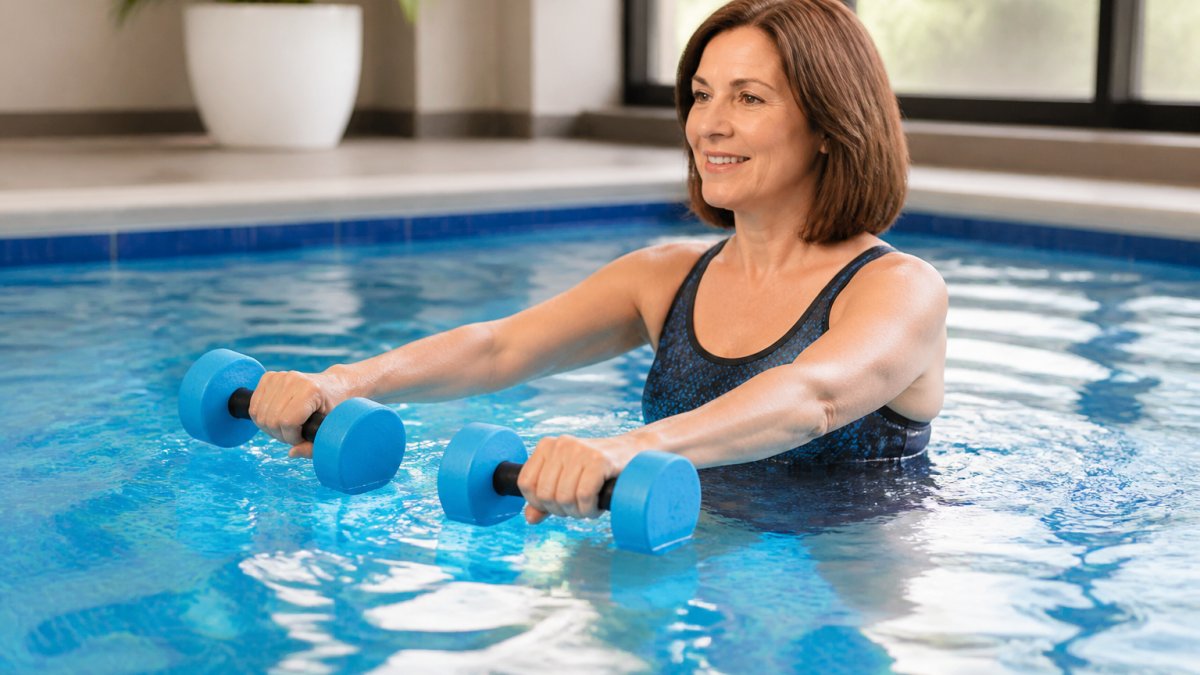 Middle-aged adult doing gentle water aerobics for knee health to avoid what not to do with knee osteoarthritis.
Low-Impact Activity and Safer Alternatives
Low-impact activities reduce stress on your knee while keeping you active, building strength and maintaining joint function without high-impact pounding.
Safe exercise options:
- Swimming and water aerobics (water supports body weight)
- Walking on soft surfaces at a comfortable pace
- Isometric exercises (muscle contraction without joint movement) (Source: the National Institutes of Health (NIH))
Water-based exercise is particularly valuable: buoyancy reduces stress on your knee by up to 50%, letting you work muscles without overloading the joint (ncbi.nlm.nih.gov).
Consistency at moderate intensity beats occasional intense workouts. Three 30-minute low-impact sessions per week typically maintain strength better than one intense session that triggers a flare.
Knee Osteoarthritis Flare-Up: What to Do
Despite your best efforts, flare-ups happen. A flare is a sudden increase in pain, swelling, or stiffness that lasts longer than your usual baseline. Knowing how to respond prevents the flare from worsening and shortens recovery time.
A Practical Stop, Modify, or Resume Framework
Most practitioners find a simple three-question check works better than a universal rule. Ask yourself before, during, and after activity:
- Is my pain above my normal baseline right now? If yes, stop the activity.
- Does the pain ease within 30 minutes of stopping? If yes, you can usually modify and continue at a lower intensity. If no, stop for the day.
- Is my pain back to baseline by the next morning? If yes, you can resume at your previous level. If no, you did too much, reduce duration or intensity by roughly half next time.
This is sometimes called the “24-hour rule” or “pain-monitoring rule” in physical therapy settings. It is not a formal guideline, but it is widely used because it is easy to apply and self-correcting.
When to Stop, Modify, or Resume: Worked Examples
- Walking: You normally walk 30 minutes pain-free. Today, pain starts at 10 minutes. Stop. Tomorrow, try 15 minutes. If pain stays at baseline the next morning, add 5 minutes per session until you return to 30.
- Stair climbing: You feel a sharp twinge on the third flight. Stop and take the elevator for the rest of the day. Resume stairs one flight at a time when pain is back to baseline.
- Stationary cycling: You feel aching after 20 minutes. Reduce resistance and try 10 minutes. If that is pain-free, keep 10 minutes for a week before adding time.
What to Do During a Flare
During a flare, your goal shifts from building fitness to calming the joint. This is when modification becomes critical.
During a flare, avoid:
- Any activity that pushes pain above your baseline
- High-impact movements
- The specific exercise that triggered the flare
Instead, focus on:
- Gentle range-of-motion exercises (moving your knee without resistance)
- Isometric exercises such as quad sets and straight-leg raises
- Walking at a comfortable, pain-free pace on flat ground
A typical flare lasts 2-7 days. Gentle movement usually reduces stiffness faster than complete rest. Many people make flares worse by returning too quickly to their normal activity level. After a flare subsides, increase activity over 5-7 days using the 24-hour rule above.
Red-Flag Symptoms: When to Seek Medical Care
Most flares are expected osteoarthritis symptoms and settle with rest and modification. Some symptoms are not typical and warrant prompt evaluation.
Contact a healthcare provider promptly if you experience:
- Severe swelling that does not improve with rest and ice after 48 hours
- Warmth, redness, or fever alongside knee pain, possible infection
- Inability to bear weight on the leg
These symptoms suggest something beyond typical osteoarthritis progression. A healthcare provider can determine whether you need imaging, a different treatment approach, or evaluation for another condition.
Watch Out
Do not treat a hot, swollen, red knee with fever at home. That combination can indicate infection and needs same-day medical attention.
Medication and Self-Treatment Pitfalls
What you do for pain matters as much as what you avoid doing. A few common mistakes:
- Exceeding label doses of over-the-counter pain relievers. Acetaminophen and NSAIDs have maximum daily doses, and NSAIDs carry gastrointestinal, kidney, and cardiovascular risks with long-term use. Follow the label and check with a clinician if you take other medications.
- Relying on painkillers to push through activity. Masking pain lets you overload the joint and can worsen the flare.
- Using unproven remedies in place of evaluation. Some supplements and topical products have limited evidence. They are not a substitute for diagnosis when red flags are present.
At OPDAHL Regenerative Medicine, we evaluate patients who have tried standard approaches without adequate relief. Advanced diagnostic tools such as dynamic ultrasound help identify the specific structures causing pain, allowing for targeted treatment.
Common Mistakes That Make Knee Pain Worse
Understanding what makes pain worse helps you avoid these pitfalls.
Mistake 1: Pushing through pain thinking it builds strength. Pain is your body’s signal that something is wrong.
Mistake 3: Ignoring weight management. Extra body weight increases knee load.
Mistake 5: Neglecting strength training. Weak muscles around your knee force the joint to work harder.
Mistake 6: Wearing unsupportive footwear. Shoes matter more than most people realize.
Moving Forward With Knee Osteoarthritis
Living well with knee osteoarthritis means making smart choices about movement and activity.
The specific activities you avoid depend on your individual situation. Mild osteoarthritis allows more activity than severe cases.
Start by identifying which activities trigger increased pain. Avoid those for now. Build your routine around low-impact options that feel good. Gradually test whether you can tolerate previously problematic activities as your strength improves.
Understanding what not to do with knee osteoarthritis is crucial, but the real challenge is finding an approach that works specifically for your situation. At OPDAHL Regenerative Medicine, we use advanced diagnostic tools including dynamic ultrasound to identify exactly what’s causing your pain.
Frequently Asked Questions
Which exercises should you avoid with knee osteoarthritis?
High-impact exercises like running, jumping, and high-impact aerobics place excessive stress on the knee joint and should be avoided. Deep lunges, heavy squats, and repetitive pivoting movements common in sports like tennis also aggravate joint pain. Instead, choose low-impact activities such as swimming, walking on soft surfaces, or stationary cycling. If you’re unsure whether a specific exercise is safe, consult with a healthcare provider who can assess your individual condition and recommend modifications.
Should you stop exercising when knee osteoarthritis flares up?
Complete rest can actually make knee osteoarthritis worse over time. During a flare, modify your activity level rather than stopping entirely. Continue gentle, low-impact movements like short walks on flat surfaces or water-based exercises if pain allows. Pain serves as a guide, if an activity increases pain significantly or causes swelling, avoid it temporarily. Resume normal activity gradually as pain subsides. If a flare persists beyond a few days or is severe, contact your healthcare provider for guidance.
What is the number one mistake that makes knees worse?
Continuing high-impact or repetitive activities despite pain is the most common mistake. Many people push through discomfort thinking it will improve, but this often accelerates joint damage and inflammation. Ignoring pain signals and failing to modify movement patterns allows the condition to worsen. Other significant mistakes include prolonged sitting in positions that stress the knee, carrying excess weight, and avoiding all physical activity out of fear. The key is finding the balance between appropriate rest and gentle, consistent movement.
Can too much rest make knee osteoarthritis worse?
Yes. Prolonged immobility can lead to joint stiffness, muscle weakness, and reduced range of motion, all of which increase pain and disability. Regular, gentle movement helps maintain joint function and strengthens supporting muscles. The goal is active rest during flares, continuing low-impact activities while avoiding movements that provoke pain. Staying sedentary for extended periods typically worsens long-term outcomes. Work with a healthcare provider to develop an activity plan that balances recovery during flares with consistent, appropriate movement.
Schedule Appointment