Quick Summary
A thrown-out back is an acute strain or spasm of the muscles and ligaments supporting the spine, and most cases improve with the right steps in the first few days. Stop activity, find a comfortable position, ice for the first 48 hours, use over-the-counter pain relief safely, and choose relative rest over bed rest. Reassess at 48 to 72 hours and call your doctor if pain is unchanged or worse. While this is basic advice the main message I want to get across is that 99% of you that throw your back out think its normal. It’s due to getting older, wear and tear etc. It is absolutely not normal. All too often do patients come into our office and say something like “Oh I threw my back out when I bent over to pickup a kitchen towel off the floor. No biggie!” Wrong. That is the most absurd thing I hear patients tell me. Your thrown out back is not due to old age, wear and tear, or normal. A standard middle aged back can deadlift between 135 – 210 lbs, but yes that kitchen towel or pencil you dropped destroyed your back. We have a patient in her 80s that strictly comes in for maintenance care that can deadlift over 200 lbs and never hurts her back. Now that you’ve listened to me ramble the point of this story is that if you threw your back out your back is incredibly damaged and super weak. It is screaming at you to nurse it back to health.
Table of Contents
What It Means When You Threw Your Back Out
If you threw back out, you likely felt a sudden sharp pain in your lower back that stopped you mid-motion. The good news is that most cases improve with the right steps in the first few days. (Source: National Institutes of Health (NIH) guidelines)
The term covers a few related problems. You may have overstretched a muscle, torn small fibers in a ligament, or triggered a muscle spasm that makes your back lock up. The pain can be intense, but the underlying injury is usually not serious.
Common Causes and Triggers
Most thrown-out back cases share a short list of triggers:
- Lifting a heavy object with poor form
- Twisting while bending forward
- A sudden awkward movement, like reaching for something
A common mistake is assuming the injury came from one big event. Often, the muscle was already tight or tired, and a small motion pushed it over the edge.
Symptoms of an Acute Back Strain or Spasm
Acute back pain from a strain usually brings:
- Sharp pain in the lower back
- Stiffness and limited movement
- A feeling that the back locks up
Swelling and inflammation build over the first day. Most people feel the worst pain in the first 12 hours.
What to Do When You Throw Your Back Out: The First 24 to 72 Hours
When you throw your back out, the first 24 to 72 hours matter most. A clear plan for rest, ice, and gentle movement helps control pain and sets up a faster recovery. Follow these steps in order, and reassess at each checkpoint.
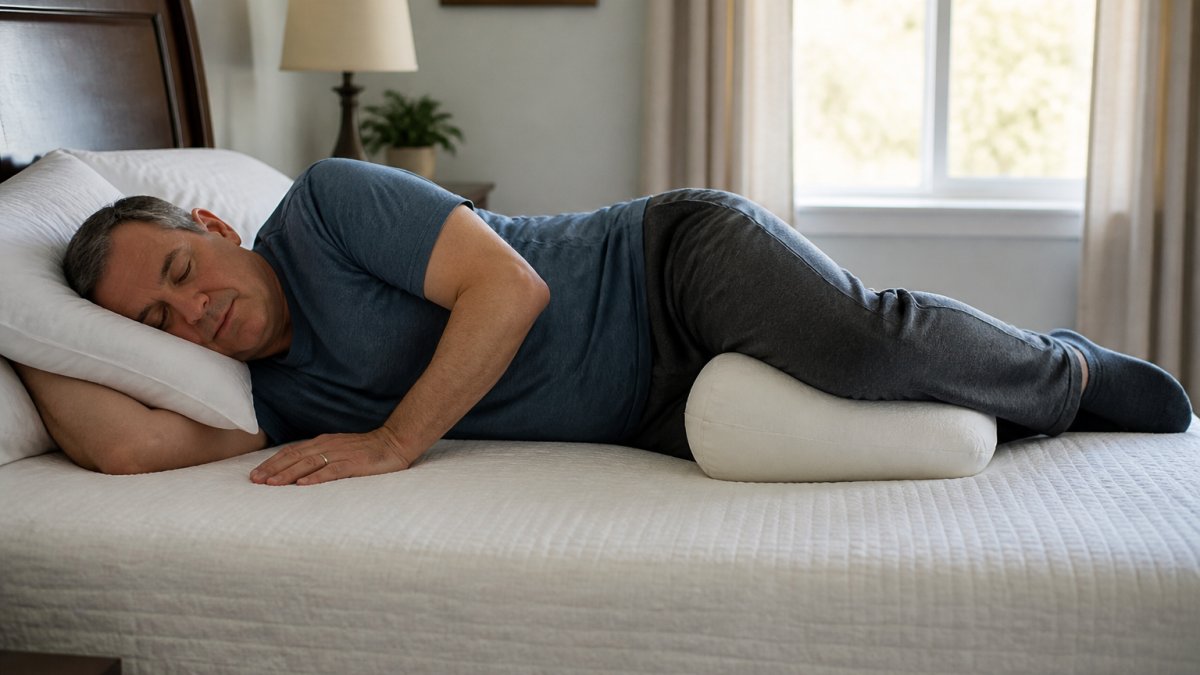 Diagram showing the ideal resting position for a thrown-out back using a pillow between the knees on a firm bed.
Step 1: Stop and Find a Comfortable Position (First 0-2 Hours)
Stop what you are doing and get into a position that eases the pain. Some people find lying on their side with a pillow between the knees comfortable, while others prefer lying on their back with a pillow under the knees. Find what feels best and stay there for a short while. Avoid sitting slumped in a soft chair, which can increase strain.
Step 2: Ice for the First 48 Hours, Then Heat
Use an ice pack for the first 48 hours to reduce swelling. Apply it for 15 to 20 minutes at a time, with a cloth between the ice and your skin. Do not fall asleep with an ice pack on. After 48 hours, switch to heat therapy to relax tight muscles and ease stiffness. A warm shower or a heating pad on the lowest setting works well.
Step 3: Over-the-Counter Pain Relief and Medication Safety
Over-the-counter pain relievers can help you move more comfortably, but safe use matters. Common options include acetaminophen and nonsteroidal anti-inflammatory drugs (NSAIDs) like ibuprofen or naproxen.
- Acetaminophen: Follow the label dose. Follow the maximum daily dose on the label, and ask a pharmacist or doctor about the right limit for you. Avoid combining with other products that contain acetaminophen, such as cold and flu medicines, to prevent liver damage (the FDA). Check with a doctor before use if you have liver disease or drink alcohol regularly.
- NSAIDs (ibuprofen, naproxen): Take with food or milk to reduce stomach upset. Do not use if you have a history of stomach ulcers or bleeding, kidney disease, or heart failure. NSAIDs can raise blood pressure and interact with blood thinners, some antidepressants, and other medications. Check with a pharmacist before combining with any prescription drug.
- Do not combine acetaminophen and NSAIDs without advice, and never take more than one product containing the same active ingredient.
Pro TipA pharmacist can review your medication list and flag interactions in minutes, often without an appointment.
Step 4: Relative Rest, Not Bed Rest
Relative rest means you take it easy without staying in bed all day. Gentle movement helps recovery more than long bed rest. The American Academy of Orthopaedic Surgeons guidance on low back pain supports staying active within comfort limits. Short walks around the house are a good start. A common pattern is to rest for 20 to 30 minutes, then move gently for 5 to 10 minutes, and repeat.
Step 5: Reassess at 48 to 72 Hours
At the 48- to 72-hour mark, check your symptoms:
- If pain is easing: continue gentle movement, add short walks, and begin light stretching as comfort allows.
- If pain is unchanged or worse: call your doctor. Worsening pain, new leg symptoms, or any emergency warning sign means you should not wait.
- If you have new numbness, weakness, or bladder or bowel changes: go to the emergency department.
If you do not feel improvement within this window, a closer look can help rule out other causes.
Stretches for a Thrown-Out Back
Stretches for a thrown-out back should be gentle and pain-free. The goal in the first few days is to keep range of motion without re-injuring the area. Move slowly and stop if a stretch increases pain.
Gentle Range-of-Motion Moves for the First Few Days
Try these moves once or twice a day:
Schedule Appointment →
- Lie on your back and slowly bring one knee toward your chest, hold a few seconds, then switch.
- Gently tilt your pelvis to flatten your lower back against the floor.
- Walk in place for a minute to loosen up.
Keep each move small. A mild stretch is fine; sharp pain is a signal to stop.
When to Add Walking and Light Exercise
Add walking and light exercise after the sharp pain settles, often within a few days. Start with short walks and build up. Light cardiovascular exercise, like easy walking, brings blood flow to the back muscles. Save stretching and foam rolling for when movement feels easier.
Thrown-Out Back Recovery Time: What to Expect Week by Week
Thrown-out back recovery time varies, but most people feel much better within one to two weeks. Here is a general timeline:
| Timeframe | What to Expect | What to Do |
|---|
| First 24-72 hours | Peak pain, stiffness, spasm | Ice, relative rest, gentle movement |
| Days 3-7 | Pain starts to ease | Add heat, short walks, light stretching |
| Week 2 | Most daily tasks feel easier | Build walking, add light exercise |
| Weeks 3-4 | Near-normal movement | Return to activity with care |
| Beyond 4 weeks | Lingering cases need a check | See a doctor if pain persists |
If pain lingers past a few weeks, or keeps coming back, it is worth a closer look.
When to See a Doctor for Back Pain
Most thrown-out backs settle with relative rest and gentle movement, but some symptoms mean you should not wait. Use this triage guide to decide whether to call your doctor, visit urgent care, or go to the emergency department.
Emergency Warning Signs: Go to the Emergency Department Now
Call 911 or go to the nearest emergency department immediately if you have any of the following:
- New loss of bladder or bowel control, you cannot hold urine or stool, or you have unexpected leakage.
- Saddle numbness, numbness or tingling in the groin, inner thighs, or the area that would touch a saddle. This can signal cauda equina syndrome, a rare but serious nerve compression that needs urgent surgery.
- New leg weakness, you cannot lift your foot, your leg gives way, or you cannot stand on your toes or heels.
These signs are uncommon, but when they appear, time matters. Do not drive yourself if you have leg weakness or saddle numbness.
Same-Day Care: Call Your Doctor or Visit Urgent Care
Contact your doctor or visit urgent care the same day if you have:
- Pain that is severe and not easing after 48 hours of rest, ice, and over-the-counter pain relievers.
- Nerve symptoms that travel down the leg, pain, numbness, tingling, or weakness that follows a line from your back into your buttock, thigh, or calf. This pattern suggests a disc or nerve issue rather than a simple muscle strain.
- Pain after a minor fall, if you are over 65 or have a history of osteoporosis, even a minor fall can cause a compression fracture.
Muscle Strain vs. Other Causes: What Changes the Picture
A muscle strain usually improves with rest and gentle movement over days. Other causes behave differently. Nerve symptoms that travel down the leg suggest a disc or nerve issue. Ongoing stiffness in the morning that lasts more than 30 minutes may point to inflammation. For a deeper look at strain symptoms and care, see our guide to muscle strain symptoms, causes and treatment.
Watch OutIf you have any emergency warning sign, do not wait for a scheduled appointment. Go to the emergency department or call 911.
Returning to Work, Lifting, and Exercise Without Re-Injury
Returning to work, lifting, and exercise takes a step-by-step approach. Ease back in rather than jumping to full activity. For physically demanding jobs, plan your return with care.
- Lift with your legs, keep the load close, and avoid twisting.
- Break heavy tasks into smaller parts and take short breaks.
- Warm up before exercise and start at a lower level than before.
A common mistake is going back to full effort too soon. Readers heading back to a physical job can find practical tips in our guide on preventing neck and back pain at work.
Book a Consultation at OPDAHL Regenerative Medicine
If your thrown-out back keeps flaring up, or pain lingers, a closer look can help. OPDAHL Regenerative Medicine uses diagnostic tools, including dynamic ultrasound, and focuses on non-surgical care and prevention as an alternative to surgery or heavy pain medication. You can also browse our low back pain resources or review our guide to non-surgical back pain treatment options before you visit.
Frequently Asked Questions
How long does a thrown-out back take to heal?
Most acute back strains improve within one to two weeks, and many people feel noticeably better in the first few days. Recovery can take longer for more significant muscle strains, especially if you return to heavy lifting too soon. If pain is not improving after two weeks or keeps returning, a clinical evaluation can identify whether something beyond a simple muscle strain is involved.
Should you rest or keep moving after throwing out your back?
Relative rest beats bed rest. Stay active within comfort: short walks, gentle range-of-motion moves, and changing positions every 30 to 60 minutes. Prolonged bed rest weakens back muscles and slows recovery. Avoid bending, twisting, and lifting for the first few days, then add light activity gradually as pain allows.
When should you see a doctor for back pain after throwing it out?
Seek care promptly if you have leg pain or numbness, weakness, loss of bladder or bowel control, fever, unexplained weight loss, or pain that follows a fall or accident. These red flags can point to nerve involvement or a fracture rather than a muscle strain. For pain that lingers beyond two weeks or keeps recurring, a consultation can help identify the root cause.
Can a chiropractor help with a thrown-out back?
Some people find manual therapy helpful once the acute spasm settles, but it is not a substitute for a proper diagnosis. If pain is severe, recurring, or comes with nerve symptoms, get evaluated first. A clinician can confirm whether the problem is a muscle strain or something that needs a different approach before you commit to a course of treatment.
A thrown-out back can feel alarming, but most cases improve with steady, sensible care. When pain keeps returning or does not settle, our team at Opdahl Regenerative Medicine can help you find the cause and build a plan. We combine advanced diagnostics with non-surgical therapies to support lasting recovery and mobility. Get started with Opdahl Regenerative Medicine and take the next step toward a stronger, more comfortable back.
Schedule Appointment