Table of Contents
Last Updated: October 12, 2026
How to Find Prolotherapy Near Me: What a Qualified Provider Looks Like
Finding prolotherapy near me starts with verifying who is actually holding the needle. Prolotherapy is a regenerative injection therapy that uses an irritant solution, most often dextrose, to trigger the body’s own healing response in damaged ligaments, tendons, and joint structures. (Source: a systematic review and meta-analysis published in the Journal of Pain Research)
The provider matters more than the storefront. According to Mayo Clinic’s overview of regenerative medicine, regenerative approaches work best when the diagnosis behind the pain is accurate, which means the injection is only as good as the assessment that precedes it.
Credentials and Training to Look For
A qualified prolotherapy provider is typically a physician with formal training in musculoskeletal medicine, a physiatrist, sports medicine physician, or interventional pain specialist.
Board certification in a relevant specialty should be non-negotiable. So should a clear answer about who performs the injection. In some clinics, the person evaluating you is not the person treating you.
Questions to Ask Before You Book
Bring these to your first call:
- Who performs the injection, and what is their training?
- Is ultrasound used to guide the needle?
- How many prolotherapy treatments do you typically recommend?
The American Academy of Physical Medicine and Rehabilitation maintains resources on physician training that can help you confirm a provider’s background.
Pro Tip
Ask whether the provider will share a written treatment plan before your first injection. Clinics confident in their protocol hand one over without hesitation.
Prolotherapy for Knee Arthritis: What the Evidence Shows
Knee osteoarthritis is the most-studied indication for prolotherapy, and the honest summary is that the evidence is real but not settled. Know what the research actually shows, not a marketing paraphrase.
What the Trials Show
Multiple randomized controlled trials have compared dextrose prolotherapy against placebo injections or standard care for knee osteoarthritis. Across the better-designed trials, prolotherapy groups report greater reductions in pain and greater improvement in function at follow-up than those receiving saline or usual care, measured with validated instruments such as the Western Ontario and McMaster Universities Osteoarthritis Index (WOMAC).
The caveats matter as much as the findings:
- Sample sizes are small. Most trials enroll dozens of patients, not thousands. Small trials are more vulnerable to chance and to publication bias.
- Blinding is difficult. A dextrose injection produces a local reaction that saline does not, so patients and sometimes assessors can guess which group they are in.
- Protocols vary. Dextrose concentration, injection sites, number of sessions, and use of ultrasound differ from study to study, which makes pooling results unreliable.
Professional societies have not issued a strong, universal recommendation for prolotherapy in knee osteoarthritis; it is generally framed as a reasonable option within a broader plan, not first-line care.
What Prolotherapy Can and Cannot Do
Prolotherapy does not regrow cartilage. No injection currently available reverses structural osteoarthritis, and any clinic promising that is overselling.
That distinction shapes who benefits. Patients whose pain is driven largely by joint-space narrowing and bone-on-bone contact may see limited response; those with periarticular ligament pain and instability may respond better. A careful diagnostic exam, ideally with dynamic ultrasound, separates the two.
Who Is a Reasonable Candidate
Prolotherapy for knee arthritis tends to be most reasonable for:
- Patients with mild to moderate osteoarthritis who have not gotten adequate relief from physical therapy, activity modification, and weight management.
- Patients who want to delay or avoid knee replacement, or who are not yet surgical candidates.
- Patients whose exam shows ligament laxity or focal attachment-point tenderness rather than diffuse joint-line pain alone.
It is a less compelling option for patients with advanced, bone-on-bone disease and constant rest pain, and for anyone with an active infection, bleeding disorder, or allergy to the injected solution.
Setting Realistic Expectations
Improvement is typically gradual. Soreness for several days after each injection is expected, and meaningful change often takes four to eight weeks. A typical course involves three to six sessions spaced several weeks apart. If you have had no measurable change after two or three well-performed sessions, revisit the diagnosis rather than simply adding more injections.
Key Takeaway
Prolotherapy for knee arthritis has supportive but limited evidence. It is most likely to help patients with mild to moderate disease and ligament-driven pain who want to delay surgery, not patients expecting cartilage regrowth or a guaranteed cure.
Prolotherapy vs PRP: How These Regenerative Injections Compare
Prolotherapy and platelet-rich plasma (PRP) are both regenerative injections but work through different mechanisms. Prolotherapy uses a chemical irritant, usually dextrose, to provoke a controlled inflammatory response. PRP concentrates platelets from your own blood and delivers growth factors to the injured tissue.
| Feature |
Prolotherapy |
PRP |
| What is injected |
Dextrose or similar irritant |
Concentrated platelets from your blood |
| Mechanism |
Triggers inflammatory healing response |
Delivers growth factors to tissue |
| Typical course |
Multiple sessions, often 3-6 |
Often fewer sessions |
| Best for |
Ligament laxity, tendon attachments |
Tendon and soft tissue injuries |
| Relative cost |
Generally lower |
Generally higher |
Which One Fits Which Situation
Prolotherapy tends to suit ligament and attachment-point problems, including chronic low back pain and joint instability. PRP is more often chosen for tendon injuries such as tennis elbow or partial rotator cuff tears. Some providers combine both.
Neither is universally superior. The right choice depends on your diagnosis, tissue quality, and how your provider reads your imaging.
Prolotherapy vs Cortisone Injection: Short-Term Relief or Tissue Repair?
Cortisone injections reduce inflammation quickly, and many patients feel better within days. The trade-off is durability.
Prolotherapy aims at a different target. Instead of suppressing inflammation, it provokes a healing response in the tissue itself, slower onset, often several weeks before you notice change, but a more durable result.
If you have had two steroid injections that each worked for about six weeks and then wore off, that pattern is worth discussing with a provider.
Schedule Appointment →
Prolotherapy Risks and Side Effects: An Honest Look
Most prolotherapy side effects are local and temporary: soreness, swelling, and stiffness at the injection site for a few days, sometimes up to a week.
Serious complications are uncommon but real: infection, bleeding, nerve irritation, and allergic reaction to the injected solution. Ultrasound guidance reduces the risk of the needle landing somewhere it should not.
Who Should Not Get Prolotherapy
Prolotherapy is not appropriate for everyone. Providers generally avoid it in patients who are pregnant, have an active infection or skin infection near the injection site, have a bleeding disorder or are on blood-thinning medication, or have an allergy to the injected solution. Anyone with an active cancer diagnosis or an autoimmune condition affecting the treatment area should discuss risks carefully with their physician.
What Prolotherapy Costs and Whether Insurance Covers It
Most clinic pages bury cost behind a consultation form. That is a problem, because prolotherapy is almost always out-of-pocket and you deserve a real number before you sit in the chair. Here is how pricing breaks down, and how to pressure-test any quote.
What Drives the Price
Prolotherapy is billed by the visit, not the injection. Four variables move the total:
- Number of treatment areas. A single knee is one price tier; bilateral knees plus the lumbar spine is another. Most clinics quote per region, not per needle stick.
- Number of sessions in the plan. A typical course runs three to six visits spaced four to six weeks apart. Ask for the cost of the full course, not just visit one.
- Imaging and guidance. Ultrasound-guided injections cost more than landmark-guided ones because they take longer and require equipment. Dynamic diagnostic ultrasound performed at the same visit is often billed separately.
A common pattern is a first-visit evaluation fee, a per-session injection fee, and a separate imaging charge. Ask the front desk to itemize all three in writing before you book.
Insurance: What to Expect
Many commercial plans classify prolotherapy as investigational or experimental and deny coverage outright. Medicare generally does not cover prolotherapy for musculoskeletal pain, so the realistic default is self-pay.
Exceptions exist: some plans cover prolotherapy when a physician documents medical necessity for a specific diagnosis, and a few cover it under a regenerative medicine or sports medicine benefit.
The Questions That Get You a Real Answer
When you call your insurer, do not ask “do you cover prolotherapy?” You will get a shrug. Instead:
- Ask your provider for the CPT code they will bill. Prolotherapy injections are typically reported using injection and musculoskeletal procedure codes, and the specific code depends on the site and whether imaging is used.
- Give that code to your insurer and ask whether it is a covered benefit under your specific plan, and what your patient responsibility would be.
- Ask whether a prior authorization is required. If it is, ask what documentation the plan wants.
- If you are denied, ask for the denial in writing and the appeal process. Denials for “investigational” status are sometimes overturned when the physician submits supporting literature and a letter of medical necessity.
What to Ask the Clinic
- Is the quoted price per visit or for the full course?
- Does it include the initial evaluation, follow-up visits, and imaging?
- What happens financially if the first session does not help, is there a refund or credit policy?
A superbill is worth asking about even when you know insurance will not cover treatment. Some plans reimburse a portion of out-of-network costs after you meet your deductible, and a properly coded superbill makes that possible.
Watch Out
Do not assume a clinic’s quoted price includes follow-up visits, imaging, or a second round of injections. Ask for the full plan cost in writing.
Key Takeaway
Get the CPT code, get the itemized quote, and get the denial in writing if you are refused. Those three documents turn a vague cost conversation into a decision you can actually make.
The Treatment Process and Recovery Timeline
A typical prolotherapy visit starts with a diagnostic assessment, often including dynamic ultrasound to identify which structures are actually damaged.
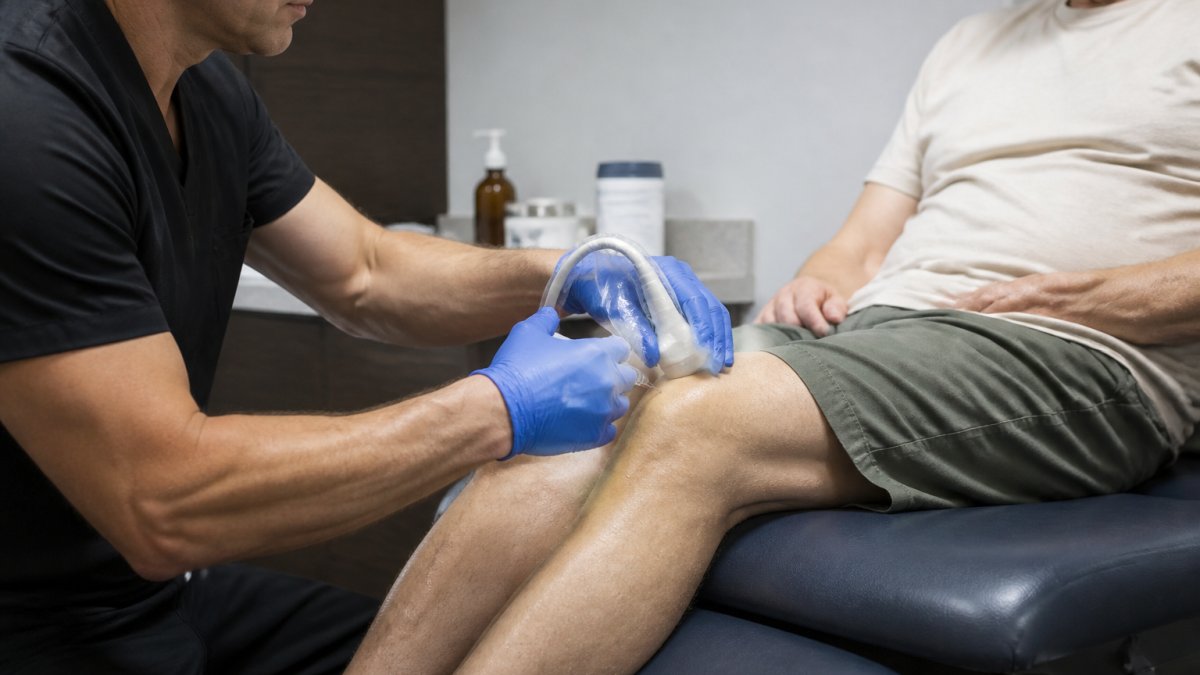 Physician performing ultrasound-guided knee prolotherapy near me in a clinic
Recovery follows a predictable arc. The first three to five days bring soreness and swelling as the inflammatory response peaks.
Activity modification matters during this window. Heavy lifting, repetitive strain, and high-impact exercise can work against the healing you are trying to provoke.
How OPDAHL Regenerative Medicine Approaches Prolotherapy Near Me Searches
Searching for prolotherapy near me usually means you have already tried something that did not work.
We also emphasize preventative treatment, because the goal is not just getting you out of pain today.
Chronic joint pain rarely resolves on its own, and the search for prolotherapy near me often ends at a clinic that treats symptoms without finding the source.
Frequently Asked Questions
Does prolotherapy work for knee pain?
Research on prolotherapy for knee osteoarthritis suggests it may reduce pain and improve function for some patients, particularly when combined with other approaches like exercise. Results vary by individual, and the evidence is not uniform across all studies. A consultation with a qualified provider can help determine whether prolotherapy is a reasonable option based on your specific knee condition, imaging findings, and treatment history.
How does prolotherapy compare with cortisone or hyaluronic acid injections?
Cortisone injections reduce inflammation quickly but typically provide short-term relief, often lasting weeks rather than months, and repeated use may weaken tissue over time. Hyaluronic acid injections aim to supplement joint fluid and can help with lubrication. Prolotherapy takes a different approach by prompting a healing response in damaged tissue. Each option has a different mechanism and timeline, so the right choice depends on your diagnosis, goals, and how your body has responded to prior treatments.
What are the risks and side effects of prolotherapy?
Common side effects include temporary soreness, swelling, and stiffness at the injection site, usually lasting a few days. Less common risks include bruising, infection, and allergic reaction to the injected solution. Serious complications are rare when the procedure is performed by a trained provider using proper technique. Prolotherapy is not appropriate for everyone, so a thorough consultation and medical history review are essential before treatment.
How much does prolotherapy cost, and is it covered by insurance?
Prolotherapy pricing varies by provider, the number of treatment areas, and the specific solution used. Insurance coverage for prolotherapy is limited in many cases because it is often considered investigational for certain conditions. Some providers offer payment plans or package pricing. Contact the clinic directly to discuss current fees and payment options, and check with your insurance carrier about whether any portion of the treatment may be reimbursable.
How do I choose a qualified prolotherapy provider?
Look for a provider with formal training in regenerative injection techniques, experience treating your specific condition, and the use of image guidance such as ultrasound to improve injection accuracy. Ask about their complication rates, how they assess candidacy, and what follow-up care they provide. A provider who explains the evidence honestly, discusses limitations, and does not guarantee outcomes is generally a better sign than one who promises a cure.