Last Updated: October 25, 2026
Quick Summary
Whether is regenerative therapy worth it for knees depends on your joint: it is worth it for mild to moderate arthritis with cartilage remaining, but not for bone-on-bone changes where no injection reverses damage. Good candidates have failed conservative care and hold realistic expectations.
- Regenerative injections are frequently not covered by insurance and most patients pay out of pocket.
- PRP is the most studied regenerative option, with mixed but real results and variable response.
- Stem cell therapy evidence is promising but not settled, and cartilage regrowth claims are overstated.
- If steroids helped but wore off within weeks, PRP may be a reasonable next conversation.
- Clinics promising guaranteed results or cartilage regrowth are a red flag; ask for protocol and complication data.
Table of Contents
What Regenerative Therapy for Knees Actually Involves
The core idea is straightforward. Damaged cartilage and inflamed tissue release chemical signals that keep the knee in a cycle of irritation and breakdown. Regenerative injections aim to interrupt that cycle.
Most treatments fall into three groups:
- Platelet-rich plasma (PRP): concentrated growth factors from your own blood
- Stem cell therapy: cells often harvested from bone marrow or fat, sometimes called medicinal signaling cells
- Prolotherapy: an irritant solution injected to trigger a local healing response
A physician uses dynamic ultrasound to guide the needle to the exact damaged tissue, then injects the material into the joint space or surrounding structures.
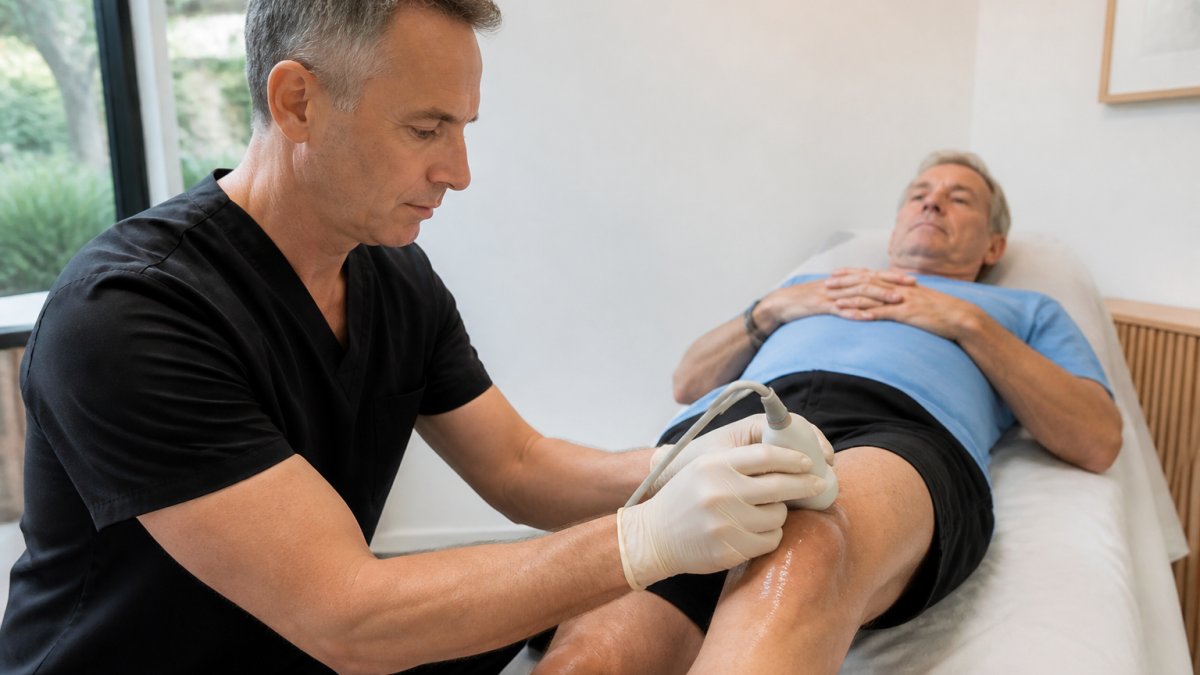 A physician in a clean, modern clinic room using an ultrasound probe on a patient’s knee, eyes fixed on the screen, patient relaxed on the exam table under soft natural light
Stem Cell Therapy for Knees: What the Evidence Shows
The honest answer is that evidence for stem cell therapy for knees is promising but not settled. For details on the benefits of stem cell joint injections and what the procedure involves, see our guide.
What the research community generally agrees on:
- These are medicinal signaling cells that release growth factors and calm inflammation, not cells that rebuild cartilage like a construction crew
- Cartilage regeneration claims are overstated in most marketing
- Younger patients with milder osteoarthritis tend to respond better than those with advanced arthritis
Regulatory status matters here. In the United States, the FDA regulates these products, and clinics that claim to regrow cartilage are worth scrutinizing. Ask any provider for their protocol, their cell source, and their complication data.
PRP Injections for Knee Arthritis: Benefits and Limits
PRP injections for knee arthritis are the most studied regenerative option, and the results are mixed but real. Many patients report reduced pain and swelling for months at a time. The catch is that response varies widely.
What PRP does well:
- Reduces inflammation in the short to medium term
- Carries low risk because it uses your own blood
- Can be repeated without the cumulative downsides of steroid shots
What PRP does not do:
- Reverse advanced cartilage damage
- Guarantee results; some patients get little benefit
- Replace the need for surgery in severe cases
If you have tried steroid injections and found relief fading within weeks, PRP is a reasonable next conversation. It acts differently, and many patients find it holds longer.
Knee Arthritis Treatment Without Surgery: How Regenerative Options Compare
Knee arthritis treatment without surgery covers a wide spectrum, and regenerative therapy sits between conservative care and joint replacement. The right choice depends on severity, goals, how much structural damage exists, and, critically, how much evidence backs each option.
| Option |
How It Works |
Evidence Quality |
Typical Relief Window |
Out-of-Pocket Reality |
Best For |
| Physical therapy |
Strengthens quadriceps, glutes, and hip stabilizers; improves joint mechanics and load tolerance |
Strong for function and pain in mild to moderate arthritis |
Ongoing with adherence |
Usually covered by insurance; copays apply |
Early arthritis, maintenance, pre-hab before any injection or surgery |
| Oral NSAIDs (ibuprofen, naproxen) |
Reduce prostaglandin-driven inflammation |
Moderate for short-term pain; long-term use limited by GI, kidney, and cardiovascular risk |
Hours per dose |
Low; generic versions inexpensive |
Flare-ups, bridge therapy |
| Corticosteroid injections |
Suppress inflammatory cytokines directly in the joint |
Moderate for short-term relief; repeated shots may accelerate cartilage loss |
Weeks to a few months |
Often covered; copay varies |
Acute flares, short-term functional goals |
| Hyaluronic acid (viscosupplementation) |
Adds lubricant to the joint; cushioning and possibly anti-inflammatory effects |
Mixed; guidelines differ on benefit over placebo |
Weeks to months, variable |
Coverage varies widely by plan; often denied |
Patients who want a non-steroid injection with established coverage pathways |
| PRP |
Concentrated growth factors from your own blood; modulates inflammation and supports repair signaling |
Moderate and growing; most studied regenerative option, but protocols vary |
Months, variable |
Typically not covered; out of pocket |
Mild to moderate arthritis, failed steroid response |
| Stem cell therapy (bone marrow or fat-derived) |
Medicinal signaling cells release growth factors and calm inflammation; do not rebuild cartilage |
Limited and heterogeneous; promising but not settled |
Months, variable |
Typically not covered; out of pocket |
Moderate arthritis, select patients with realistic expectations |
| Knee replacement |
Replaces damaged surfaces with metal and plastic components |
Strong for advanced disease |
Years to decades |
Covered by most plans after deductible; out-of-pocket maximum applies |
Advanced, bone-on-bone arthritis |
A common mistake is treating these as competitors. For an overview of the best non-surgical treatment for knee pain, see our comparison guide.
Three practical rules of thumb:
- If you still have cartilage and your pain is inflammation-driven, conservative care plus a regenerative injection is a reasonable conversation. Start with therapy; it is the lowest-risk, best-evidenced option and it makes any injection work better.
- If steroids helped but wore off within weeks, that pattern suggests inflammation is the driver and a non-steroid option such as PRP may hold longer for some patients, though response is variable and not guaranteed.
- If imaging shows bone-on-bone changes, no injection reverses that. Surgery deserves serious consideration, and delaying it with repeated out-of-pocket injections can cost more in the long run than the procedure itself.
Key Takeaway
Compare options on four criteria, not one: evidence quality, expected duration of relief, total out-of-pocket cost, and risk. An option that is cheap but ineffective is not a bargain, and an expensive option without supporting evidence is not worth the premium.
Regenerative Therapy vs. Knee Replacement: A Side-by-Side Look
Regenerative therapy vs. knee replacement is not really a fair fight, and that is the point. They solve different problems at different stages.
Knee replacement is a major surgery with a real recovery period, but it delivers durable, predictable relief for advanced osteoarthritis.
| Factor |
Regenerative Therapy |
Knee Replacement |
| Invasiveness |
Minimally invasive injection |
Major surgery |
| Recovery |
Days |
Weeks to months |
| Durability |
Varies, may need repeat |
Long-term |
| Best stage |
Mild to moderate |
Advanced |
| Reversibility |
Repeatable |
Permanent implant |
The practical takeaway: if your imaging shows bone-on-bone changes, surgery deserves serious consideration. If you still have cartilage and your pain is driven by inflammation, regenerative options are worth exploring first.
Cost, Insurance, and What You Will Actually Pay
Cost is where most patients get surprised. Regenerative injections for knee arthritis are frequently not covered by insurance because most plans classify them as investigational or experimental for that indication.
Schedule Appointment →
These are ranges, not quotes. Prices vary by geographic market, clinician credentials, whether ultrasound guidance is used, whether imaging and follow-up visits are bundled, and how many injections the protocol requires.
Why coverage is so inconsistent:
- Most commercial plans and Medicare treat regenerative injections for knee osteoarthritis as investigational, so claims are denied.
- Some plans cover PRP or hyaluronic acid for specific indications; coverage can hinge on diagnosis codes and prior authorization.
- If a claim is denied, you have the right to request the plan’s denial rationale in writing and to appeal. Ask the billing office whether they will help with a peer-to-peer review.
How to judge value rather than just price:
- Compare against your surgery deductible and out-of-pocket maximum. If you are close to meeting your out-of-pocket maximum, a covered knee replacement may cost you less than a series of cash-pay injections.
- Ask what happens if the first injection fails. Reputable clinics will discuss a protocol adjustment or a stop rule rather than simply selling another round.
- Ask whether the price includes ultrasound guidance, imaging, and follow-up. A low headline price that excludes these is not comparable.
- Ask about financing. Many clinics offer payment plans or third-party medical financing; understand the interest rate before signing.
- Do the math on repeat treatment. If relief lasts months and you need repeat injections, the annualized cost can exceed the one-time cost of surgery.
Watch Out
Be skeptical of any clinic that quotes a single all-in price before examining your knee, or that pressures you to pay for a multi-injection package upfront. A legitimate evaluation comes first, and the recommendation should follow the imaging and your history, not a sales script.
We do not publish fixed pricing because it depends on the treatment type, the number of injections, and your individual evaluation. Ask for a written estimate during your consultation so there are no surprises.
Who Is a Good Candidate and Who Should Skip It
Good candidates share a few traits: mild to moderate osteoarthritis, pain that limits activity, failed conservative care, and realistic expectations.
You are likely a strong candidate if:
- You have cartilage remaining on imaging
- Steroid injections helped but wore off quickly
- You want to delay or avoid surgery
- You can commit to rehab and activity changes
You should probably skip it if:
- You have advanced, bone-on-bone arthritis
- You have an active infection or certain bleeding disorders
- You expect cartilage to regrow completely
- You cannot take time for the recovery and follow-up
Watch out: clinics that promise guaranteed results or claim to regrow cartilage are a red flag. Ask for their protocol and complication data before you commit.
Whatever you decide, keeping the joint moving helps. Our knee osteoarthritis exercises guide offers step-by-step routines with modifications for all pain levels.
Schedule a Knee Evaluation to See if Regenerative Therapy Is Worth It for You
So, is regenerative therapy worth it for knees? For the right patient, yes. For the wrong one, it is an expensive detour. The only way to know which group you fall into is a proper evaluation.
At OPDAHL Regenerative Medicine, we use dynamic ultrasound to see exactly what is happening inside your knee before recommending anything.
Our approach centers on:
- Advanced diagnostics, including dynamic ultrasound, to find the root cause
- Non-surgical, preventative care aimed at avoiding surgery and heavy pain medication
- A patient-centered plan built around your mobility goals
If you are tired of temporary fixes and want a clear answer, schedule a knee evaluation with OPDAHL Regenerative Medicine and find out where you actually stand. Learn more about our regenerative medicine program and how to get started.
Frequently Asked Questions
Do stem cells actually help knees?
Stem cell therapy for knees is still being studied, and results vary by patient and product. Some trials show meaningful pain reduction and improved function, especially for mild to moderate osteoarthritis, but others show little difference from placebo. The strongest evidence supports modest, short-term relief rather than cartilage regrowth. Your candidacy depends on arthritis severity, age, and overall health, so an evaluation with imaging is the best way to know if it is worth trying.
How long do the effects of regenerative knee injections last?
Relief from regenerative knee injections typically lasts six to twelve months, though some patients report longer benefit. Durability depends on the type of injection, the severity of cartilage damage, and how well you maintain strength and activity. Repeat treatments are common, and many patients use them to delay or avoid knee replacement. Your provider can track outcomes with follow-up visits and adjust the plan as needed.
Is regenerative therapy covered by insurance?
Most regenerative knee treatments are not covered by insurance and are paid out of pocket. Coverage varies by plan and procedure, so check with your insurer before scheduling. Costs depend on the type of injection, the number of treatments, and the clinic. Ask for a written estimate.
Who is not a good candidate for stem cell therapy?
Stem cell therapy may not be right for people with advanced bone-on-bone arthritis, active infection, uncontrolled diabetes, or certain bleeding disorders. Patients who are pregnant or have a history of cancer should discuss risks with their doctor. If you have severe joint deformity or have already been told you need a knee replacement, regenerative options may still help with pain but are unlikely to reverse structural damage. A thorough evaluation can clarify your options.
Your knee will not tell you when it is time to change course. A proper evaluation will. Get started with OPDAHL Regenerative Medicine and get a clear, ultrasound-guided answer about whether regenerative therapy fits your knee, your goals, and your timeline.