Quick Summary
Chronic knee pain when walking downstairs happens because your knee absorbs roughly three to four times your body weight with every step down, and your quadriceps must brake that load eccentrically. Changing technique, like using the handrail and leading with your stronger leg, reduces joint load right away, while strengthening the quadriceps, hamstrings, and hip stabilizers is the most reliable long-term fix.
- Going down stairs, your knee absorbs roughly three to four times your body weight per step.
- Lead with the stronger leg going down so the weaker knee takes less braking force.
- Lower slowly and deliberately, aiming for a two-second descent per step.
- Move to the next exercise stage only when pain stays at 3 out of 10 or below.
- Every pound of body weight adds roughly three to four pounds of knee load on stair descent.
Table of Contents
Why Chronic Knee Pain When Walking Downstairs Happens
Chronic knee pain when walking downstairs has a clear mechanical explanation. Going down is where the joint gets tested. (Source: the U.S. Department of Health and Human Services’ National Institutes of Health (NIH))
That explains why so many people climb a flight without trouble and then wince on the way down: the load lands on a bent knee, the kneecap presses against the thigh bone, and any weak link makes itself known.
The Biomechanics of Descending Stairs
Descending stairs is a controlled fall. Your quadriceps work eccentrically, meaning they lengthen under load to lower your body weight step by step. That eccentric demand is what makes downstairs harder on the knee than upstairs.
Three things happen at once:
- The knee bends to about 60 degrees or more, which raises pressure on the kneecap
- Your shin angle shifts forward, increasing load through the joint
- The quadriceps must brake your body weight rather than push it
When strength, cartilage health, or alignment is off, that braking job lands on structures not built for it, producing the familiar dull ache, sharp twinge, or pain behind the kneecap.
Common Causes: From Runner’s Knee to Arthritis
Several conditions produce chronic knee pain when walking downstairs. The pattern of your pain usually points to the cause.
- Patellofemoral pain syndrome (runner’s knee): Pain behind or around the kneecap, worse on stairs, squatting, or sitting long periods.
- Osteoarthritis: Morning stiffness, tender joints, a dull ache that builds with activity, common in adults over 50.
- Chondromalacia: Softening or irritation of the cartilage under the kneecap, often felt as grinding or pain behind the kneecap.
A common mistake is assuming arthritis is the only explanation. In practice, weakness and tracking problems drive much of this pain, even when imaging shows cartilage wear.
How to Go Down Stairs With Knee Pain: Step-by-Step Technique
You can reduce pain on stairs today by changing how you move, not just how much. Better technique lowers joint load without giving up the stairs.
Here is the approach we teach patients:
- Use the handrail every time. It offloads a meaningful share of your body weight.
- Lead with the stronger leg going down. The weaker knee stays behind and takes less braking force.
- Take one step at a time. Skip the two-at-once habit.
- Lower slowly and deliberately. Aim for a two-second descent per step.
- Keep your knee tracking over your toes. Do not let it collapse inward.
- Land mid-foot, not on the toes. A softer landing means less shock through the joint.
- Go sideways if needed. Turning sideways and stepping down with the handrail turns a hard movement into an easy one.
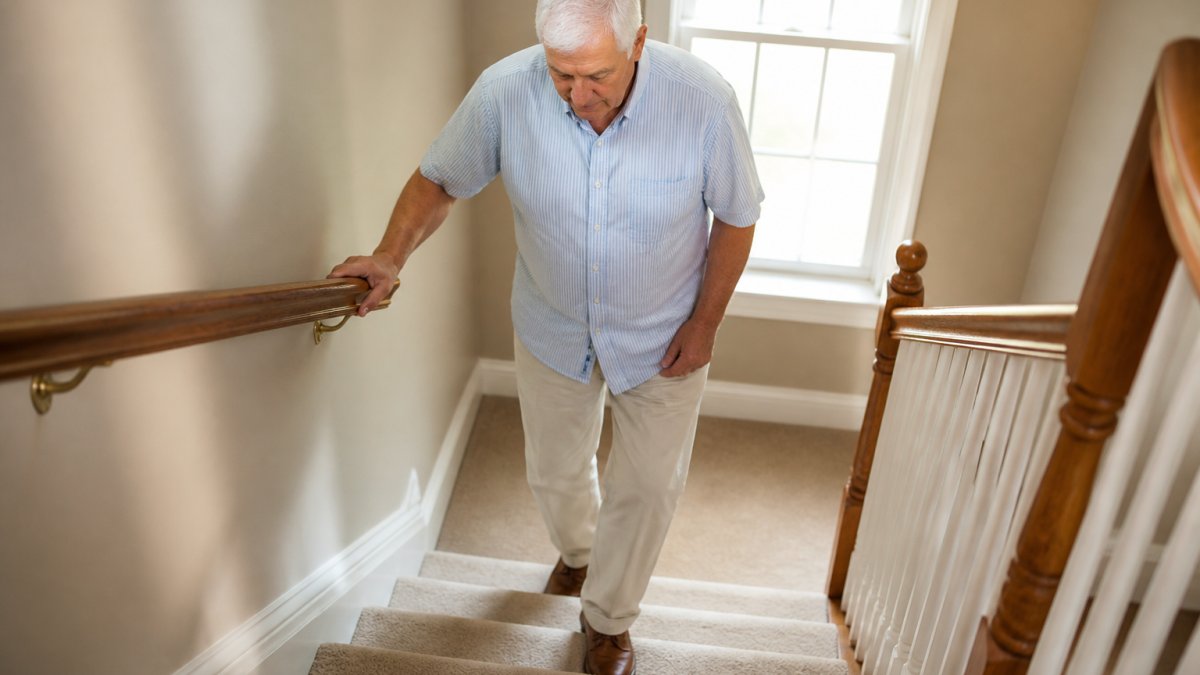 A person in their 60s carefully descending a carpeted staircase, one hand firmly on the wooden handrail, looking down at their feet with a focused expression, warm natural light from a window
Pro Tip
Going down sideways, handrail in both hands, feels awkward for about a week and then becomes second nature. It is the single fastest way to keep using your stairs while the knee calms down.
The Handrail Rule and Weight Shift
The handrail is not a courtesy, it is a load-sharing tool. Gripping it and shifting even part of your weight onto your arm reduces knee pressure with each step.
The weight shift matters too: as you lower your body, push your hips back slightly and keep your chest tall so the knee does not drift forward, where joint load spikes.
Foot Placement and Shin Angle
Foot placement controls your shin angle, and shin angle controls knee load. Place the whole foot on the step; hanging your heel off the edge forces the shin forward and concentrates pressure behind the kneecap.
A simple cue: knee over toes, not knee past toes. Small changes in where you plant your foot change how the joint feels within a single flight.
Pain Behind the Knee When Walking Downstairs: What It Signals
Pain behind the knee when walking downstairs usually points to one of three things: kneecap tracking problems, a meniscus issue, or swelling in the back of the joint.
Tone and Tighten
Where the pain sits tells you a lot:
- Behind the kneecap: patellofemoral pain, chondromalacia, or quadriceps weakness
- Back of the knee, diffuse and achy: often a Baker’s cyst, which is a fluid-filled sac that forms when joint fluid escapes
- Back of the knee, sharp or catching: possible meniscus tear
A Baker’s cyst is usually a symptom, not the problem, it signals extra fluid from arthritis or a cartilage issue, and treating the underlying cause is what makes it settle.
Watch Out
A knee that locks, gives way, or swells within hours of an injury needs medical assessment, not a new exercise routine. Pushing through those signs can turn a treatable meniscus tear into a bigger problem.
Exercises for Knee Pain Going Downstairs
Exercises for knee pain going downstairs should target the muscles that control the descent: quadriceps, hamstrings, and hip stabilizers.
A common mistake is doing too much too soon. A small, consistent dose beats an aggressive routine that flares the knee and forces a week off. Pick two or three options below and add load only when the current dose feels easy and pain stays stable.
Starting Exercises (Weeks 1-2)
These low-load options suit an irritable knee. Do them on non-consecutive days, three days per week.
- Sit-to-stand: Stand up from a standard chair without using your hands, then lower yourself back down slowly over about three seconds. Start with 2 sets of 6. The slow lowering is the point, it trains the same eccentric quadriceps action used on stairs.
- Calf raises: Rise onto your toes slowly, pause, and lower over three seconds. 2 sets of 10. The calf and ankle complex controls how your shin angle loads the knee.
- Wall sit: Slide down a wall until your knees are bent to about 45 degrees, not a full 90, and hold for 15 to 20 seconds. 3 holds. Keep the hold short enough that pain does not build.
Building Exercises (Weeks 3-4)
Add these once the starting exercises feel easy and your pain during activity is no worse than 3 out of 10.
Schedule Appointment →
- Step-downs: Stand on a low step, 4 to 6 inches is enough at first, and lower one foot slowly to the floor, tap, and rise. Aim for a three-second descent. Start with 2 sets of 5 per leg. This is the closest gym exercise to the actual stair movement.
- Hamstring curls: Lie face down and curl your heel toward your glutes over three seconds, then lower slowly. 2 sets of 8. Add a light resistance band when body weight feels easy.
- Single-leg balance: Stand on one foot near a counter for 20 to 30 seconds per side. Balance training improves the hip and ankle control that keeps your knee tracking over your toes on stairs. (Source: the American Academy of Orthopaedic Surgeons (AAOS))
Progression Criteria and Stop Rules
Progression is not calendar-based. Move to the next stage when all three are true:
- You can complete the current dose without pain rising above 3 out of 10 during the exercise.
- Any soreness settles within 24 hours.
- The movement feels controlled rather than shaky.
Stop or modify an exercise if:
- Pain during the exercise climbs above 5 out of 10.
- Soreness is still present the next morning and limits your normal walking.
- The knee swells, locks, or gives way.
A mild pain increase that settles within a day is acceptable when you add load. Pain that lingers, climbs week over week, or changes how you walk means you progressed too fast, drop back a stage for a week.
A Four-Week Structure
| Week | Focus | Frequency | Key Exercises | Progression Cue |
|---|
| 1 | Gentle activation | 3 days | Sit-to-stand, calf raises, wall sits, hamstring sets | Pain ≤3/10 during exercise |
| 2 | Add controlled load | 3 days | Slow sit-to-stand, longer wall sits, band hamstring work | Soreness settles within 24 hours |
| 3 | Build eccentric control | 3-4 days | Step-downs from a low step, hamstring curls, single-leg balance | Descent feels controlled, not shaky |
| 4 | Return to stairs | 3-4 days | Step-downs from a higher step, full flights with handrail | Pain-free or near-pain-free flights |
Track pain on a 0 to 10 scale before and after each session, date, exercise, pain before and after, and how the knee felt the next morning. That log is also useful at a physical therapy or medical appointment because it shows what your knee tolerates.
Pro Tip
If stairs are the specific problem, practice the descent itself as an exercise. Use a single step with a handrail and step down slowly, leading with the stronger leg, five times per side. It is the most specific training you can do for the movement that hurts.
Quadriceps and Hamstring Strengthening
The quadriceps brake your body on the way down. The hamstrings protect the knee from excess forward drift. Both need attention.
A common mistake is training only the quads. Balanced strength keeps the kneecap tracking properly and takes pressure off the cartilage.
Strengthening is not a one-time fix. Most people need a maintenance dose, two sessions per week, to hold onto the gains that made stairs comfortable again.
Non-Surgical Treatment for Knee Arthritis
Non-surgical treatment for knee arthritis focuses on load management, strength, and reducing inflammation. Surgery is not the only path, and for many it is not the first. But the right combination depends on what is actually driving your stair pain, arthritis on an X-ray and the source of your pain are not always the same thing.
First-Line Measures: Load Management and Strength
These are the foundation, and most guidelines place them first for knee osteoarthritis.
- Physical therapy: A structured program builds quadriceps and hip strength and teaches stair technique. This is the intervention with the most consistent evidence for reducing pain and improving function in knee arthritis.
- Weight management: Every pound of body weight translates to roughly three to four pounds of load through the knee during stair descent. Even modest weight loss reduces joint load meaningfully. This is not a cosmetic recommendation, it is a mechanical one.
- Activity adjustment: Swap high-impact work for swimming, cycling, or flat walking. The goal is to keep moving, not to rest the joint into stiffness.
Medication and Injections: What They Do and Do Not Do
- Topical or oral anti-inflammatory medication: Can reduce pain and swelling for a period of time, under a doctor’s guidance. They treat the symptom, not the joint surface, and long-term use carries risks that should be discussed with a clinician.
- Corticosteroid injections: Often provide short-term relief, commonly weeks to a few months, but do not change the course of arthritis. Repeated injections are generally limited because of potential effects on cartilage and other tissues.
- Viscosupplementation (hyaluronic acid injections): Used by some clinicians for knee osteoarthritis. Evidence is mixed, and insurance coverage varies widely, so it is worth confirming coverage before planning around it.
Regenerative and Emerging Approaches
Regenerative approaches, such as platelet-rich plasma or other biologic injections, aim to support the joint’s own healing response. Evidence is still developing, results vary, and they are generally not covered by insurance for knee arthritis. They are worth discussing with a clinician who can set realistic expectations and explain the out-of-pocket cost, but they are not a substitute for strength and load management.
Matching Treatment to Your Pattern
The right sequence depends on your situation:
- Gradual onset, morning stiffness, age over 50: Start with physical therapy, weight management if relevant, and activity adjustment. Add medication for flares. Escalate to injections only if first-line measures are not enough.
- Pain after a specific injury or with locking/catching: This is not a simple arthritis picture. Imaging and an exam come first, because a meniscus tear or other structural issue changes the plan.
- Recurrent kneecap pain in a younger or active person: Strength and tracking work usually lead, not injections.
What to Ask Before Choosing a Treatment
Before agreeing to any injection or procedure, ask:
- What is the evidence for this specific option in someone with my pattern of pain?
- How long is the expected benefit, and what are the risks?
- Is it covered by insurance, and what will I pay out of pocket?
- What should I do at home alongside it, and what happens if I do nothing?
We use advanced diagnostic tools, including dynamic ultrasound, to identify what is actually driving the pain rather than treating the whole joint blindly, because arthritis on an X-ray and the source of your stair pain are not always the same thing.
If you have tried steroid injections and found the relief short-lived, a proper diagnostic workup is the logical next step. Our team focuses on non-surgical care and preventative measures, supporting lasting recovery and a pain-free life.
Key Takeaway
The most reliable non-surgical plan for arthritis-related stair pain combines strength training, load management, and a clear-eyed view of what each medication or injection can and cannot do. Match the option to your pattern, ask what the evidence is, and confirm cost and coverage before committing.
Red Flags: When to See a Doctor for Chronic Knee Pain
See a doctor promptly if you notice any of the following:
- The knee locks, catches, or gives way
- Swelling appears within hours of an injury
- You cannot bear weight on the leg
These signs point to problems that need imaging and a proper exam. General strengthening advice does not replace an assessment when red flags are present.
For everyone else, a structured self-check helps. Note where the pain sits, whether it started gradually or after an injury, and what makes it worse.
Chronic knee pain when walking downstairs rarely resolves on its own, and it should not force you to give up the stairs or accept surgery as the only option.
Frequently Asked Questions
Why does my knee hurt more going downstairs than upstairs?
Descending stairs places up to three times your body weight through the kneecap joint as your quadriceps work to control the downward motion. Going upstairs relies on concentric muscle contraction, while going downstairs uses eccentric contraction, which puts more load on the patellofemoral joint and surrounding cartilage. This is why conditions like runner’s knee and osteoarthritis often cause sharper pain on the way down.
What exercises help knee pain when walking downstairs?
Focus on controlled eccentric strengthening of the quadriceps and hamstrings. Try slow step-downs from a low platform, seated leg extensions, and wall sits held for 20 to 30 seconds. Add hamstring curls and glute bridges to support the knee joint. Start with two sets of 8 to 10 repetitions every other day, and increase difficulty only when pain stays below a 3 out of 10 during and after exercise.
Can knee arthritis cause pain going downstairs?
Yes. Osteoarthritis wears down the cartilage that cushions the knee joint, and the extra load of descending stairs concentrates pressure on the kneecap and the inner compartment of the knee. Many people with arthritis report a dull ache or sharp twinge specifically when going downstairs. Non-surgical treatment for knee arthritis, including targeted strengthening and activity modification, often reduces this stair-specific pain.
When should I see a doctor for chronic knee pain when walking downstairs?
See a qualified professional if pain lasts more than two to three weeks, worsens despite rest, or comes with swelling, locking, giving way, or pain behind the knee that does not settle. Red flags include sudden severe swelling, inability to bear weight, fever, or calf swelling and warmth. Early assessment with tools like dynamic ultrasound can identify the root cause and guide non-surgical options before surgery is considered.
Schedule Appointment