Last Updated: November 1, 2026
Quick Summary
You build knee joint strength as a beginner with seven ordered exercises: quad sets, straight-leg raises, seated knee extensions, hamstring curls, sit-to-stand, supported step-ups, and calf raises. Start with 2 sets of 10 reps, 30 to 60 seconds rest, three non-consecutive days per week, and confirm the plan with a qualified professional.
- Do the seven exercises in order, starting with the three gentlest moves for the front of the thigh.
- Hold quad sets for 5 seconds and rest 30 to 60 seconds between sets.
- Add only two reps per week once all seven moves feel slow and controlled.
- Drop to 1 set of 8 reps for a week if pain reaches about 4 to 5 out of 10.
- Stop and contact a clinician if new swelling lasts more than 24 hours.
Table of Contents
Why Knee Joint Strength Matters for Beginners
Knee joint strength is the ability of the muscles around your knee to control, stabilize, and protect the joint during everyday movement. When those muscles weaken, the joint takes the load instead. (Source: the National Institute of Arthritis and Musculoskeletal and Skin Diseases (NIAMS))
Weak quadriceps and hamstrings let the kneecap drift and the joint absorb impact it wasn’t designed to handle. Before you start, it helps to know what not to do with knee osteoarthritis so you don’t make things worse.
Below are seven beginner-safe exercises with sets, reps, and clear rules for when to stop. For a step-by-step osteoarthritis exercise guide with modifications for all pain levels, see our knee osteoarthritis exercises guide.
The Muscles That Support Your Knee
Four muscle groups do most of the protective work:
- Quadriceps straighten the knee and absorb landing forces
- Hamstrings bend the knee and control how fast it extends
- Calf muscles stabilize the ankle, which in turn steadies the knee
A common mistake is training only the quads. Knee stability comes from all four working together.
7 Knee Joint Strength Exercises for Beginners
These seven knee joint strength exercises need only a chair, a wall, and a low step. Do them in order, each builds on the last, from isometric work to controlled single-leg loading.
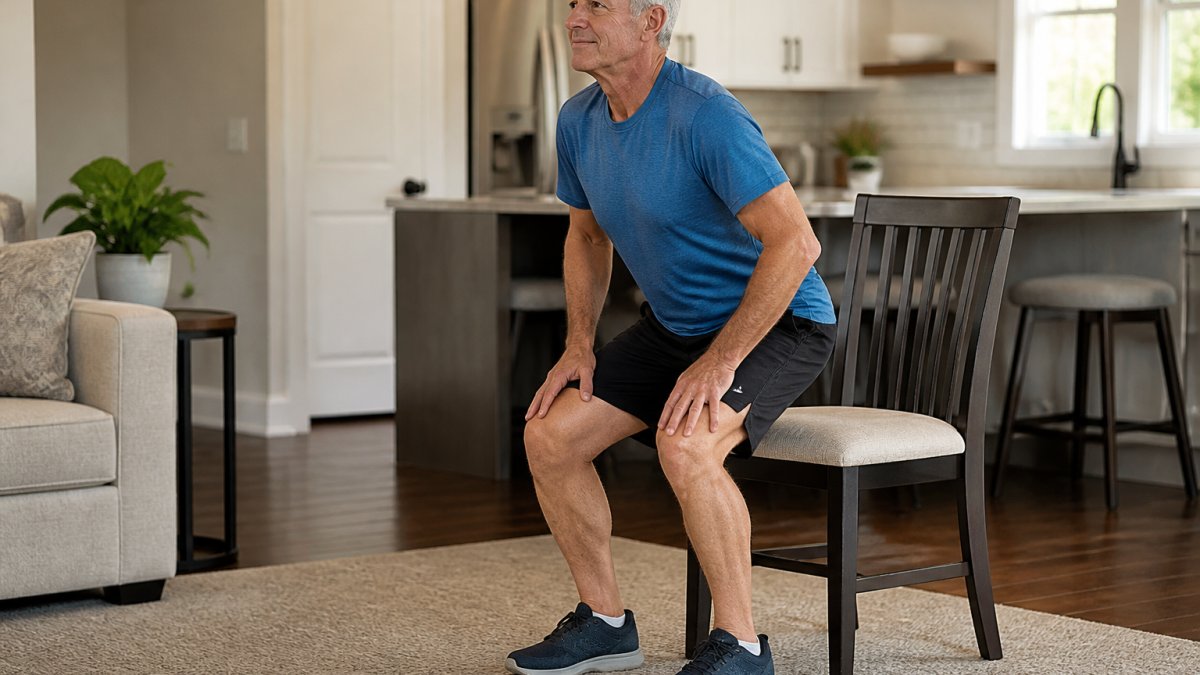 Man in his sixties practicing a sit-to-stand exercise to build knee joint strength in his living room.
A general starting point for beginners is 2 sets of 10 repetitions with 30 to 60 seconds rest between sets, on three non-consecutive days per week, but confirm an appropriate plan with a qualified professional before starting.
1. Quad Sets
Move: Press the back of your knee down into the floor as if flattening a piece of paper under it.
Form cues: The muscle above the kneecap should firm up and the kneecap glide slightly upward. Keep breathing.
Common mistake: Pushing so hard the heel lifts off the floor. The heel stays down; only the back of the knee presses.
2. Straight-Leg Raises
Start: Lie on your back with one knee bent, foot flat, and the other leg straight.
Move: Tighten the straight thigh first (same squeeze as a quad set), then lift the leg about 12 inches off the floor.
Form cues: Keep the knee locked straight throughout. Lift from the hip, not by swinging the leg.
Common mistake: Letting the knee bend at the top or dropping the leg quickly.
3. Seated Knee Extensions
Start: Sit tall in a firm chair, back against the backrest, feet flat, knees bent about 90 degrees.
Move: Slowly straighten one knee until the leg is out in front of you, hold 2 seconds, then lower with control over 3 seconds. That is one rep.
Form cues: Keep the thigh planted on the seat, only the lower leg moves. Straighten as far as you can without pinching.
Common mistake: Kicking up fast and letting the leg drop. Slow on the way down is the point.
4. Hamstring Curls
Start: Stand holding the back of a chair, or lie face down on the floor with legs straight.
Move: Bend one knee to bring your heel toward your glutes as far as comfortable, hold 1 second, then lower slowly over 3 seconds. That is one rep.
Form cues: Keep the hips still, do not let the low back arch. The movement happens only at the knee.
Common mistake: Swinging the leg up quickly and dropping it, or letting the standing hip shift out to the side.
5. Sit-to-Stand
Move: Lean forward slightly from the hips, push through both feet, and stand up without using your hands.
Form cues: Knees track over the middle toes. Push the floor away rather than pulling up with your arms.
Common mistake: Plopping down onto the seat. The controlled descent trains the quadriceps for stairs and chairs.
6. Supported Step-Ups
Start: Stand facing a low step (4 to 6 inches to start), holding a rail, counter, or doorframe with one or both hands.
Form cues: Push through the whole foot of the top leg.
Common mistake: Pushing off hard with the bottom leg to hop up. The top leg should do the work.
7. Calf Raises
Start: Stand holding a counter or the back of a chair, feet hip-width apart.
Schedule Appointment →
Move: Rise onto the balls of your feet as high as comfortable, hold 1 second at the top, then lower slowly over 3 seconds until the heels touch the floor. That is one rep.
Form cues: Keep the ankles straight, do not roll onto the little toes. Stand tall; do not lean into the counter.
Common mistake: Bouncing up and down quickly. The slow lowering phase builds the calf and ankle stability that protects the knee.
Key Takeaway
Do the seven exercises in the order above. The first three (quad sets, straight-leg raises, seated extensions) are the gentlest and work the front of the thigh. The last four add hip, hamstring, and calf involvement. If you can complete all seven with slow, controlled form for two weeks, add two reps per week, not ten.
How to Progress Each Exercise
When you can complete 2 sets of 10 reps with slow, controlled form and no more than mild discomfort, add one of the following: 2 extra reps, a 2- to 5-pound ankle weight, a longer hold, or a slightly higher step. Change only one variable at a time and give each change a full week.
If an exercise causes sharp pain, swelling, or pain that lingers into the next day, drop back to the easier variation for a week. That is a regression, not a failure, it is how beginners build tolerance without flaring the joint.
Gentle Exercises for Knee Pain: How to Modify Each Move
Every exercise above has an easier version. The harder skill for a beginner is knowing when to use it. Use this three-tier decision rule before and during each session.
Tier 1: Modify the Move (Keep Going)
Modify, rather than skip, when you feel mild discomfort (roughly 3 out of 10 or less) that eases within a few minutes of starting, or settles within an hour after the session. This is common for beginners and people with osteoarthritis, and usually a sign to reduce load, not stop.
- Quad sets: reduce the hold to 2 seconds, or skip the towel and press only lightly
- Straight-leg raises: bend the moving knee slightly to shorten the lever, or slide the heel along the floor
- Seated knee extensions: reduce range, stopping before the joint feels pinched
A practical rule: if you can do the easier version with slow, controlled form and discomfort stays at 3 out of 10 or below, finish the set. If it climbs above that, stop and move to the next exercise.
Tier 2: Reduce the Dose (Back Off)
Back off when pain during the movement reaches about 4 to 5 out of 10, or when the knee is noticeably swollen or stiff before you start. In that case:
- Cut to 1 set of 8 reps per exercise for one week
- Do the routine two days per week instead of three
- Keep only the gentlest four moves (quad sets, straight-leg raises, seated extensions, seated calf raises) and skip the loaded standing moves
Tier 3: Stop and Seek Advice (Do Not Push Through)
Stop the session and contact a clinician if you notice any of the following:
- Pain that stays above 5 out of 10 during the movement, or that you would describe as sharp, stabbing, or catching
- New swelling that lasts more than 24 hours after a session
- The knee locking, catching, or giving way
Watch Out
The second most common mistake is pushing through sharp pain because “no pain, no gain.” Use the tiers above to tell the difference.
A Simple Pain-Monitoring Habit
Before each session, rate your knee pain from 0 to 10 at rest. After the session, rate it again, and once more the next morning. A good pattern: pain rises slightly during exercise, settles within an hour, and is back to baseline the next morning.
If you want a gentler starting point, our collection of simple exercises to alleviate knee pain gives you same-day options you can do without any equipment.
Beginners should start with two sets of 10 repetitions for each exercise, once every other day. Hold isometric moves like quad sets for five seconds. Rest 30 to 60 seconds between sets. The whole routine takes about 15 minutes.
Form cues that matter most:
- Move slowly on the way down, not just the way up
- Keep the knee tracking over the middle toes, never caving inward
- Breathe out on effort instead of holding your breath
A common mistake is adding repetitions before the current ones feel controlled. Add two reps per week, not ten.
Knee Exercises for Osteoarthritis: What to Expect
Knee exercises for osteoarthritis follow the same principles, with a slower ramp. Mild discomfort during movement is common for some people, but sharp pain, swelling, or pain that lingers into the next day is a reason to stop and consult a clinician.
Many people with osteoarthritis find that consistency matters more than intensity, though a clinician can advise what suits an individual’s condition.
How Often to Do Knee Exercises
Strength work should happen three times per week on non-consecutive days. Muscles need roughly 48 hours to recover, and beginners recover slower than they expect.
Here is a simple weekly structure:
| Day |
Activity |
Duration |
| Monday |
Full seven-exercise routine |
15-20 minutes |
| Tuesday |
Walking or gentle movement |
20 minutes |
| Wednesday |
Full seven-exercise routine |
15-20 minutes |
| Thursday |
Walking or gentle movement |
20 minutes |
| Friday |
Full seven-exercise routine |
15-20 minutes |
| Saturday |
Light activity of your choice |
As tolerated |
| Sunday |
Rest |
– |
Some people add a short walk on rest days, which keeps the body moving without adding load.
When to Stop and Talk to a Clinician
Stop the exercise and seek professional advice if you notice:
- Pain that stays above a 5 out of 10 during the movement
- New swelling that lasts more than 24 hours
- The knee locking, catching, or giving way
If exercise alone isn’t helping, a clinician can discuss non-surgical evaluation options with you.
Building a Knee-Safe Routine with Opdahl Regenerative Medicine
Exercise builds strength, but it can’t diagnose why your knee hurts. OPDAHL Regenerative Medicine uses diagnostic tools, including dynamic ultrasound, to help identify the source of knee discomfort.
The practice’s patient-centered approach focuses on preventative measures and offers an alternative to surgery or heavy pain medication for both acute and chronic pain. You can also browse our knee pain services to find care that fits your needs.
Frequently Asked Questions
What are the best knee-strengthening exercises for beginners?
Start with seven movements that cover the whole leg: quad sets, straight-leg raises, seated knee extensions, hamstring curls, sit-to-stand, supported step-ups, and calf raises. Each one trains a different muscle group around the knee joint, so together they build balanced support. A qualified professional can advise on an appropriate starting volume and progression for you. Keeping the range of motion small at first makes the routine easier to tolerate while your knee joint strength builds.
How can I strengthen my knees at home without equipment?
Most knee exercises at home need nothing more than a chair, a wall, and a towel. Quad sets and straight-leg raises are done lying on the floor. Seated knee extensions and sit-to-stand use a standard dining chair. Step-ups need one low, stable step, such as the bottom stair. A rolled towel under the knee adds support for quad sets. Do the routine on a non-slip surface and keep a counter or wall within arm’s reach for balance during standing exercises.
How often should beginners do knee-strengthening exercises?
Two to three sessions per week is a common approach that allows time for recovery between workouts. Spread the sessions out, for example Monday, Wednesday, and Friday. Daily walking or gentle range-of-motion movement is fine on the off days. If soreness lasts more than a day after a session, consider reducing the load and speaking with a clinician.
Should I exercise if my knee hurts?
Mild discomfort during a movement is common and usually settles within an hour. Stop the exercise if pain sharpens, or if you notice swelling, locking, or giving way, and consult a qualified clinician about your symptoms.
Can exercise help with knee osteoarthritis?
Strengthening the muscles around the knee may help support it during daily activity. A consistent, moderate routine is one approach many people find manageable, and a clinician can advise what suits your situation. Start with the gentlest versions, such as quad sets and seated knee extensions, and progress only when a session leaves you feeling better rather than worse. A clinician can confirm which movements suit your stage of joint change.
Your knee pain has a cause, and guessing at it costs you months. Get started with OPDAHL Regenerative Medicine and find out what’s actually driving the discomfort, so your exercise routine works with your knee instead of against it.