Quick Summary
Regenerative medicine for chronic knee pain uses minimally invasive treatments, such as mesenchymal stem cells, platelet-rich plasma, and prolotherapy, that aim to calm inflammation and support tissue repair rather than just mask symptoms. Outcomes vary from person to person, and no treatment of this kind is guaranteed.
- Orthobiologics are treatments made from your own blood or tissue, most commonly mesenchymal stem cells.
- Prolotherapy injects a simple dextrose solution to trigger the body’s own healing response.
- Good candidates include adults with mild to moderate degeneration, meniscus tears, or tendon strain who want to stay active.
- Avoid treatment if you have an active knee infection, certain blood or immune conditions, or severe end-stage arthritis.
- Skipping the rehab phase is the most common reason patients feel underwhelmed at the three-month mark.
Table of Contents
How Regenerative Medicine for Chronic Knee Pain Works
Regenerative medicine for chronic knee pain is a set of minimally invasive treatments that use your body’s own healing cells to repair damaged tissue. Advanced diagnostic tools, including dynamic ultrasound, can help identify the source of knee pain before treatment is considered.
The goal is joint preservation, not just pain relief. Instead of masking symptoms, these therapies aim to calm inflammation and support tissue repair in the joint.
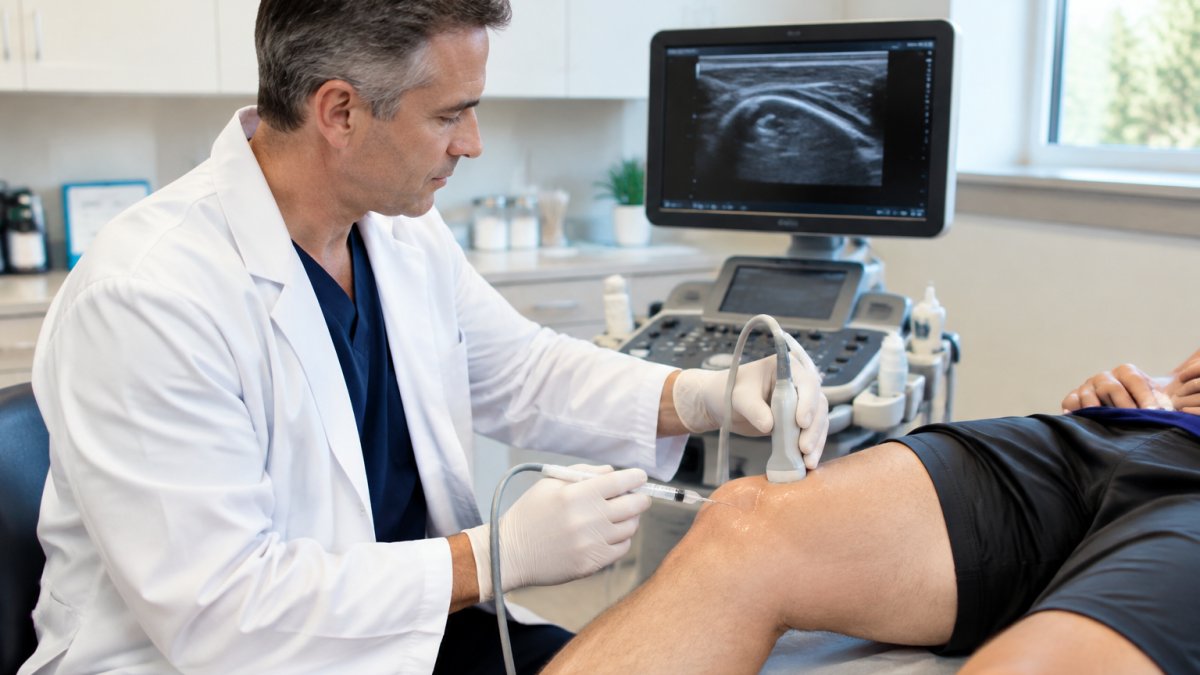 Diagram of an ultrasound-guided injection process for regenerative medicine to treat chronic knee pain
Mesenchymal Stem Cells and Orthobiologics
Orthobiologics are treatments made from your own blood or tissue. The most studied type uses mesenchymal stem cells, which can develop into cartilage, bone, or other tissue.
These cells are usually collected from bone marrow aspirate concentrate or fat tissue. The sample is processed and then injected into the damaged knee.
Regenerative approaches are an area of ongoing research, and outcomes vary from person to person. For a full comparison of stem cells, PRP, and prolotherapy, read our guide on the types of regenerative medicine.
Platelet-Rich Plasma and Prolotherapy
Platelet-rich plasma, or PRP, is a concentration of platelets from your own blood. Platelets release growth factors that may reduce inflammation and support tissue repair.
Prolotherapy uses a simple dextrose solution injected at the site of ligament or tendon injury. It creates mild, controlled inflammation that triggers the body’s own healing response.
Outcomes vary, and no treatment of this kind is guaranteed. For a deeper look at the second option, see our page on prolotherapy treatment.
Knee Cartilage Regeneration Injection: What It Is and Who It Helps
A qualified clinician should review your imaging and history to determine whether any treatment is appropriate for you.
Prolotherapy Near Me: Finding a Qualified Provider
Searching “prolotherapy near me” turns up plenty of clinics. The harder question is which one is qualified.
When comparing providers, it is reasonable to ask about the clinician’s licensing and training, how imaging is reviewed, and whether risks and realistic outcomes are explained in writing. Be cautious of any provider that promises guaranteed results.
Regenerative care is a non-surgical intervention, but it still needs a skilled hand. The American Academy of Orthopaedic Surgeons offers general guidance on knee arthritis care that can help you ask better questions.
The Cost of Regenerative Knee Therapy and Insurance Coverage
Pricing for regenerative knee therapy depends on the specific treatment, the number of treatments, and what is included. OPDAHL Regenerative Medicine does not publish prices; contact the clinic directly for current pricing or a quote.
Ask for a written quote that itemizes the provider fee, ultrasound guidance, any processing or lab fee, and follow-up visits.
Insurance coverage. Coverage for these treatments varies by plan and is not guaranteed. Before you book, ask your insurer whether a predetermination or prior authorization is available and request the decision in writing.
What to ask before you pay. Get the quote in writing and confirm whether the price covers one injection or a series, what is included, and how follow-up visits are billed.
Watch out: be skeptical of any quote that guarantees a result. Confirm exactly what the quoted price includes before agreeing to treatment.
Schedule Appointment →
For context on why patients pursue non-surgical options and what the evidence base looks like, the National Institutes of Health publishes patient-facing summaries on knee osteoarthritis management.
Who Is a Candidate and Who Should Avoid Regenerative Treatments
Good candidates are adults with chronic knee pain from mild to moderate degeneration, meniscus tears, or tendon strain who want to stay active. Many have already tried physical therapy or steroid injections.
Some people should avoid these treatments or wait:
- Anyone with an active infection in or near the knee
- People with certain blood or immune conditions
- Patients on blood thinners, without clearance
- Those with severe, end-stage arthritis
A consultation with a qualified clinician is the only way to know what fits your case.
The article sets out who may be a good candidate and who should avoid or delay these treatments.
| Category | Details |
|---|
| Good candidates | Adults with chronic knee pain from mild to moderate degeneration |
| Good candidates | Meniscus tears or tendon strain who want to stay active |
| Good candidates | Many have already tried physical therapy or steroid injections |
| Avoid or wait | Active infection in or near the knee |
| Avoid or wait | Certain blood or immune conditions |
| Avoid or wait | Patients on blood thinners, without clearance |
| Avoid or wait | Severe, end-stage arthritis |
Recovery Timeline and Post-Procedure Rehabilitation
Recovery depends on the individual and the treatment, and rehabilitation plays an important role after any procedure. The injection is a stimulus; rehabilitation is what turns that stimulus into functional improvement. Skipping the rehab phase is the most common reason patients feel underwhelmed at the three-month mark.
The first 72 hours. Expect mild soreness, warmth, and sometimes a small effusion (fluid swelling) in the joint. Ask your clinician for their specific aftercare and medication guidance, since practices differ. Ask your clinician for their specific medication guidance; practices differ.
How success is measured. Pain scores and objective measures such as range of motion and strength testing can help track progress. Ask your provider which measures they will use to monitor your recovery.
Red flags during recovery. Call your provider if you develop fever, spreading redness or heat at the injection site, a rapidly expanding swelling, or pain that worsens sharply after the first week. These are uncommon but worth knowing.
Watch out: the biggest rehab mistake is doing too much too soon because the knee feels better, the pain relief can arrive before the tissue has adapted, and overloading in weeks two through four is a common cause of a setback.
A structured home program supports the injection between visits. Our step-by-step guide to knee osteoarthritis exercises shows routines you can start at home, and the American Academy of Orthopaedic Surgeons publishes general rehabilitation guidance for knee conditions.
Schedule Your Consultation at OPDAHL Regenerative Medicine
If chronic knee pain is limiting your work, your hikes, or time with your grandkids, a real evaluation is the best next step. At OPDAHL Regenerative Medicine, we use dynamic ultrasound to find the source of your pain and build a non-surgical plan around it.
We focus on preventative care, joint strength, and reducing inflammation, with an alternative to surgery or heavy pain medication. Our team is here to answer your questions.
Browse our knee pain services and request a consultation to get started.
Frequently Asked Questions
Does regenerative medicine work on knees?
Regenerative medicine for knee pain aims to reduce inflammation and support tissue repair using orthobiologics such as platelet-rich plasma or mesenchymal stem cells. Research shows many patients report less pain and better function, but results vary by condition severity and provider technique. It is not a guaranteed cure, and outcomes depend on factors like cartilage damage, alignment, and rehabilitation. A qualified provider can assess whether you are a candidate.
How much does regenerative knee treatment cost?
The cost of regenerative knee therapy varies widely based on the type of injection, the number of treatments needed, and the provider’s location. Insurance coverage varies by plan, so check with your insurer. OPDAHL Regenerative Medicine does not publish prices; contact the clinic directly for a personalized quote and to discuss payment options.
What is the typical recovery process after regenerative knee injections?
Recovery timelines vary by treatment. Recovery experiences vary. A structured rehabilitation program is generally an important part of recovery after many musculoskeletal procedures. Your provider will give specific guidance based on your procedure and health status.
Are regenerative medicine treatments for knee pain covered by insurance?
Coverage for regenerative medicine injections for knee pain varies by plan. Patients should verify coverage with their insurer and plan for possible out-of-pocket expenses. Some clinics offer payment plans or financing. Contact OPDAHL Regenerative Medicine for a quote.
Chronic knee pain rarely gets better on its own, and guessing at treatment wastes time. Get started with OPDAHL Regenerative Medicine and a plan built around your knee, your goals, and your daily life.
Schedule Appointment