Last Updated: November 10, 2026
Quick Summary
Knee pain without injury usually comes from joint degeneration, soft-tissue inflammation, crystal deposits, or mechanical overload rather than a single event. Osteoarthritis, bursitis, tendonitis, gout, and Baker’s cysts are among the most common causes we evaluate. Most knee pain develops slowly as cartilage wears down and tendons fray over months or years.
- Osteoarthritis involves cartilage breakdown that causes stiffness, swelling, crepitus, and shrinking range of motion.
- Bursitis and tendonitis can flare without a fall, often from repetitive stress or sudden activity increases.
- Gout and pseudogout cause sudden swelling and sharp pain, sometimes striking overnight.
- Set chair height so hips are level with or slightly above the knees, feet flat.
- Stand or walk for a few minutes every 30 to 45 minutes during prolonged sitting.
Knee pain with no clear cause?We find the root cause with advanced diagnostics and non-surgical care.
Schedule Your Evaluation
Table of Contents
Why Your Knee Hurts When Nothing Happened
Knee pain without injury causes is one of the most common reasons adults seek orthopedic care, and the answer is rarely a single event. Most people expect a knee to hurt after a fall, a twist, or a bad landing. When it doesn’t, the pain can feel confusing and even a little alarming. A knee that aches on stairs, stiffens after sitting, or swells for no clear reason is a pattern many adults describe.
The truth is that most knee pain develops slowly. Cartilage wears down, tendons fray, and joint fluid changes over months or years. The American Academy of Orthopaedic Surgeons notes that osteoarthritis alone affects millions of adults, and it typically builds without any memorable trauma. Below, we break down the real causes, the triggers most guides skip, and how a proper evaluation finds the source.
Common Causes of Knee Pain Without Injury
Knee pain without injury usually comes from one of a few categories: joint degeneration, soft-tissue inflammation, crystal deposits, or mechanical overload. Identifying which category fits your symptoms is the first step toward relief. Here are the most common causes we evaluate.
Osteoarthritis and Cartilage Degradation
Osteoarthritis is the breakdown of cartilage, the smooth tissue that cushions the knee joint. As cartilage thins, bones rub closer together, and the joint loses some of its shock absorption. This leads to stiffness, swelling, and a grinding sensation called crepitus. Many people notice it most in the morning or after sitting for a while. Range of motion can shrink gradually, and the knee may feel less stable on uneven ground.
Bursitis, Tendonitis, and Pes Anserine Pain
Bursitis is inflammation of the fluid-filled sacs that reduce friction around the joint. Tendonitis is irritation of the tendons that connect muscle to bone. Both can flare without a fall, often from repetitive stress or a sudden increase in activity. Pes anserine pain is a specific type of bursitis on the inner knee, common in people with muscle imbalance or a sedentary lifestyle that weakens supporting muscles.
Gout, Pseudogout, and Baker’s Cyst
Gout and pseudogout are crystal-related conditions that cause sudden swelling and sharp pain, sometimes overnight. A Baker’s cyst is a fluid-filled swelling behind the knee that can create tightness or a feeling of fullness. These conditions are not caused by a single injury, which is why they surprise people. They often reflect systemic inflammation rather than a mechanical event.
The most common causes of knee pain without injury fall into a few clear categories.
| Cause |
What it involves |
Typical signs |
| Osteoarthritis |
Breakdown of cartilage cushioning the knee joint |
Stiffness, swelling, crepitus, shrinking range of motion |
| Bursitis |
Inflammation of fluid-filled sacs that reduce friction |
Flares from repetitive stress or activity increases |
| Tendonitis |
Irritation of tendons connecting muscle to bone |
Flares without a fall, often from repetitive stress |
| Pes anserine pain |
Bursitis on the inner knee |
Common with muscle imbalance or sedentary lifestyle |
| Gout and pseudogout |
Crystal-related conditions |
Sudden swelling and sharp pain, sometimes overnight |
| Baker’s cyst |
Fluid-filled swelling behind the knee |
Tightness or a feeling of fullness |
Bone Spurs in Knees: When Wear and Tear Leaves a Mark
Bone spurs are bony growths that form along joint edges as the body responds to long-term wear. They are a hallmark of joint degeneration and often accompany osteoarthritis. Spurs themselves may not hurt, but they can rub against surrounding tissue and limit movement. For a deeper look at how they form and what they mean for your knee, see our guide on bone spurs in knees.
Knee Pain When Bending and Straightening: What It Signals
Pain that spikes when you bend or straighten the knee points to specific structures. The meniscus, the cartilage pad inside the joint, can become irritated with age. Patellofemoral pain syndrome, which affects the kneecap, often flares with bending under load. Synovial fluid changes and joint stiffness can make these movements feel tight or creaky. If stairs are the trigger, our guide on knee pain when walking downstairs explains why that specific motion stresses the joint.
Sudden Knee Pain Without Injury: Why It Can Appear Overnight
Sudden knee pain without injury can appear overnight for several reasons. A Baker’s cyst can rupture and cause sharp pain and swelling. Gout attacks often strike at night. A small meniscus tear from normal wear can finally give way. In these cases, the “sudden” pain usually has a slow-building cause underneath. That is why an evaluation matters more than guessing.
Stress, Sleep, and Ergonomics: The Overlooked Triggers
Most guides stop at the joint itself. In practice, a large share of “no-injury” knee pain is driven by what happens around the joint: how you sit, how you sleep, how you manage stress, and what you eat. These factors rarely appear in clinical summaries, but they are often the difference between a knee that aches for a week and one that aches for a year.
Work-from-Home Ergonomics and Sedentary Load
Prolonged sitting is not a passive activity for the knee. When you sit for hours, the hip flexors adaptively shorten, the gluteal muscles lose activation, and the quadriceps spend long stretches in a shortened position. Over time, that changes how the knee tracks under load when you finally stand, walk, or climb stairs. A chair that is too high leaves the feet dangling and the knees unsupported; a chair that is too low forces the knees above hip level and increases patellofemoral compression. Desk setups that encourage crossing the legs or sitting on one hip create asymmetric loading that shows up as inner-knee or outer-knee pain. A practical rule many physical therapists use is to set the chair height so the hips are level with or slightly above the knees, keep the feet flat, and stand or walk for a few minutes every 30 to 45 minutes. A standing desk is not a cure-all; static standing for long periods loads the knee differently and can aggravate patellofemoral symptoms.
Stress, Sleep, and Central Pain Processing
Chronic stress does not damage the knee directly, but it changes how pain is processed. Sustained stress raises muscle tension around the hip and thigh, alters breathing patterns, and can increase sensitivity to pain signals through central sensitization. Poor sleep amplifies this: sleep deprivation lowers pain thresholds and is consistently associated with worse musculoskeletal pain reports (Sleep deficiency and chronic pain). A common pattern is a patient whose knee pain flares during busy work periods or after several nights of poor sleep, with no change in activity. Addressing sleep hygiene, stress management, and gentle daily movement often reduces the frequency of these flares even when imaging looks unchanged.
Nutritional and Systemic Inflammation Triggers
Diet affects joint symptoms through systemic inflammation, not just through gout. Diets high in ultra-processed foods, refined sugars, and excess omega-6 fats, and low in fiber, omega-3 fats, and polyphenol-rich vegetables and fruits, are associated with higher markers of systemic inflammation. For some people, that shows up as more joint stiffness and swelling. Specific triggers vary by person; a food-and-symptom log is more useful than blanket elimination diets. Alcohol and high-fructose intake matter particularly for people with gout or elevated uric acid. Weight matters too: excess body weight increases load across the knee with every step and also contributes to low-grade systemic inflammation, which is why even modest weight loss is often recommended for knee osteoarthritis.
Age-Specific Prevention
The triggers above play out differently across the lifespan. Younger adults with no-injury knee pain often have biomechanical and load-management issues: sudden increases in running volume, weak glutes, or prolonged sitting. Seniors more often have degenerative and systemic contributors, and benefit from lower-impact strength work, balance training, and attention to sleep and nutrition. A prevention plan that ignores age tends to be either too aggressive for older joints or too timid for younger ones.
Watch out: sharp, one-sided calf swelling, chest pain, or shortness of breath after a period of prolonged sitting warrants urgent medical attention, since these can signal a blood clot rather than a knee problem.
How an Orthopedic Evaluation Finds the Real Cause
An orthopedic evaluation finds the real cause by combining history, physical exam, and diagnostic imaging. An orthopedic evaluation typically includes a check of range of motion, joint stability, and swelling, and may include diagnostic imaging. This is different from a static X-ray, which shows bone but not soft tissue. For patients weighing options, our overview of the best non-surgical treatment for knee pain explains what regenerative approaches can and cannot do. The goal is to identify the source, not just the symptom.
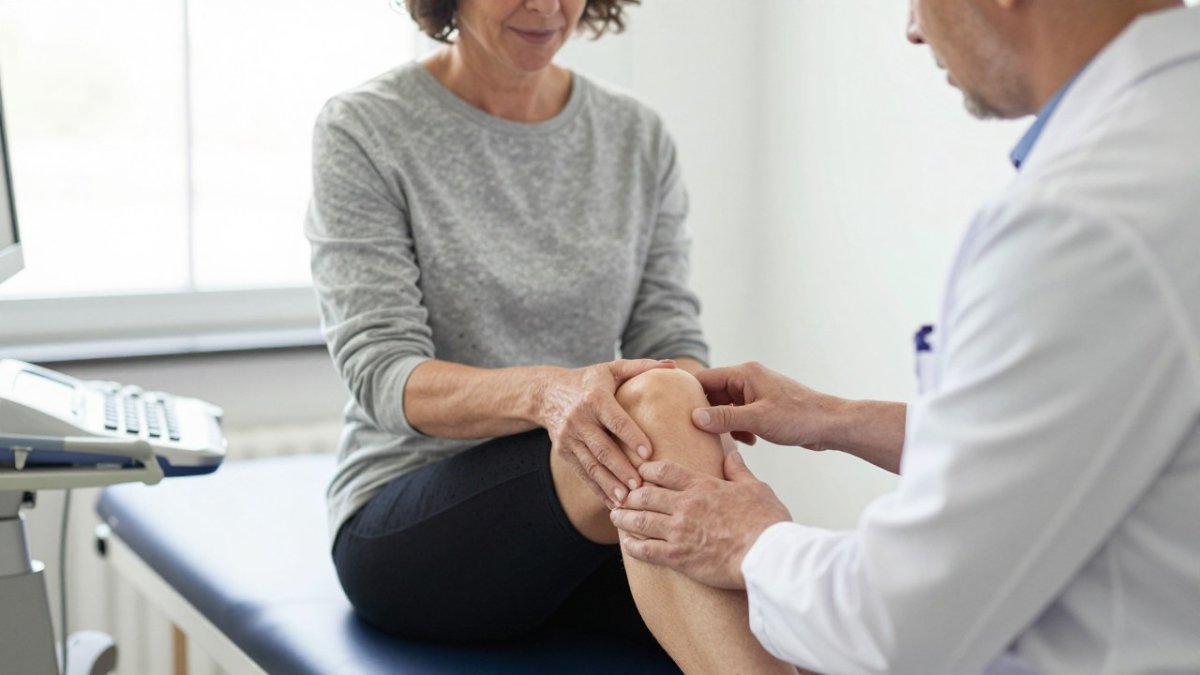 Clinician performing a diagnostic knee pain assessment using ultrasound technology in an orthopedic exam room.
Schedule an Evaluation at OPDAHL Regenerative Medicine
If knee pain has been building without a clear injury, the next step is a proper evaluation. OPDAHL Regenerative Medicine offers patient-centered, non-surgical care for knee, hip, shoulder, and spine pain. Our team uses advanced diagnostic tools, including dynamic ultrasound, to help identify the source of discomfort. We focus on preventative measures and offer an alternative to surgery or heavy pain medication, with the aim of supporting mobility and reducing stiffness and inflammation. If you are considering PRP injections, our guide on PRP injections for knee pain covers what to expect. You can also explore our regenerative medicine services to see how an evaluation works.
Knee pain that arrives without a clear injury is a signal worth investigating. OPDAHL Regenerative Medicine can help you find the source and build a plan that supports lasting recovery. Get started with OPDAHL Regenerative Medicine and take the first step toward moving with less pain.
Frequently Asked Questions
Can arthritis cause knee pain without a specific injury?
Yes. Osteoarthritis is one of the most common causes of knee pain without injury. Cartilage wears down gradually, synovial fluid thins, and the joint loses some of its cushioning. The result is joint stiffness, swelling, and pain that builds over months rather than appearing after a fall or twist. Many people first notice it after prolonged sitting or when climbing stairs, not after any single event.
What is the fastest way to relieve knee pain at home?
For mild flare-ups, rest the joint, apply ice for 15 to 20 minutes at a time, and elevate the leg. Over-the-counter anti-inflammatory medication may help short term. Gentle range of motion exercises keep the joint from stiffening. If pain persists beyond a few weeks, or if swelling, warmth, or crepitus appear, an orthopedic evaluation can identify whether osteoarthritis, bursitis, or another cause is driving the pain.
What could be causing pain on the inner side of my knee?
Inner knee pain often points to pes anserine bursitis, a medial meniscus issue, or osteoarthritis in the medial compartment. It can also come from a muscle imbalance that changes how the knee tracks during walking. Because these causes produce similar symptoms, diagnostic imaging such as ultrasound or MRI is often needed to tell them apart before treatment begins.
Does knee pain without injury ever go away on its own?
Some cases do settle with rest and activity modification, especially mild bursitis or tendonitis. Osteoarthritis and joint degeneration may progress over time, and a professional evaluation can help clarify the outlook. Ignoring chronic pain can lead to muscle imbalance and reduced range of motion. A physical therapy plan or a regenerative medicine consultation can help address the underlying cause rather than just masking symptoms.