Last Updated: November 17, 2026
Quick Summary
Knee inflammation can often be eased at home by resting the knee, applying ice wrapped in a thin towel for 15 to 20 minutes every 2 to 3 hours, compressing it gently, and elevating it above heart level. Seek prompt medical care if the knee is hot and red, you have a fever, you cannot bear weight, or swelling is not improving.
- Pause high-impact activities like running, deep squats, kneeling and long periods of standing.
- Apply a cold pack wrapped in a thin towel for 15 to 20 minutes every 2 to 3 hours while awake.
- Avoid heat, alcohol and vigorous massage for the first 1 to 3 days after an injury.
- Do not drain fluid from the knee yourself; fluid buildup needs a clinician to find the cause.
- Check with a clinician before using turmeric, fish oil or glucosamine if you take blood thinners.
Is your knee swelling not going away?OPDAHL Regenerative Medicine offers non-surgical joint care with dynamic ultrasound diagnostics.
Book Your Knee Evaluation
Table of Contents
Knee inflammation is one of the most common reasons adults in the United States reach for home care, and for good reason. Swelling, warmth and stiffness can make everyday movement hard. This guide walks through practical, low-risk steps you can take at home, and it explains when those steps are not enough. Knee inflammation is the body’s response to irritation or injury inside or around the knee joint. It often shows up as puffiness, warmth, tenderness and reduced range of motion. (Source: American Academy of Orthopaedic Surgeons)
Knee Inflammation: Routine Swelling Versus Urgent Symptoms
Most mild knee swelling after a long day, a new workout or a bump settles with rest and simple care. Some signs mean you should not wait. Seek prompt medical care if the knee is hot, red and swollen, if you cannot bear weight, if the knee locks or gives way, if you have a fever, or if the swelling appeared suddenly after a fall or injury.
- Routine: mild puffiness that improves over a few days with rest
- Urgent: fever, a locked or unstable knee, or inability to walk
A clinician should evaluate any knee problem that is severe or getting worse.
Step 1: Rest and Modify Activity to Calm Knee Inflammation
Rest does not mean complete stillness. It means pausing the activities that load the knee most. For more on habits that aggravate the joint, see the companion guide on what to avoid with knee osteoarthritis. Many people with knee pain find that repetitive stairs, deep squats, kneeling and long periods of standing make flare-ups worse. You can learn which everyday activities to avoid and safer alternatives on this practical guide to what not to do with knee osteoarthritis. Cutting back on those for a few days often helps the knee settle.
Try these adjustments:
- Take breaks from stairs and kneeling
- Swap high-impact running for walking or cycling on low resistance
- Use a stool or pillow to reduce bending
- Keep moving gently so the joint does not stiffen
Watch out: rest that drags on for weeks can weaken the muscles that support the knee, so ease back into activity as swelling drops.
Step 2: How to Reduce Swelling in Knee Quickly With Ice, Compression and Elevation
When the knee is swollen and warm, the first 24 to 72 hours matter. A sequenced plan works better than scattered tips, and the right sequence depends on why the knee is swollen. Swelling after a fall, twist, or sports injury behaves differently from an arthritis flare or overuse swelling, so start by matching your situation to one of these patterns.
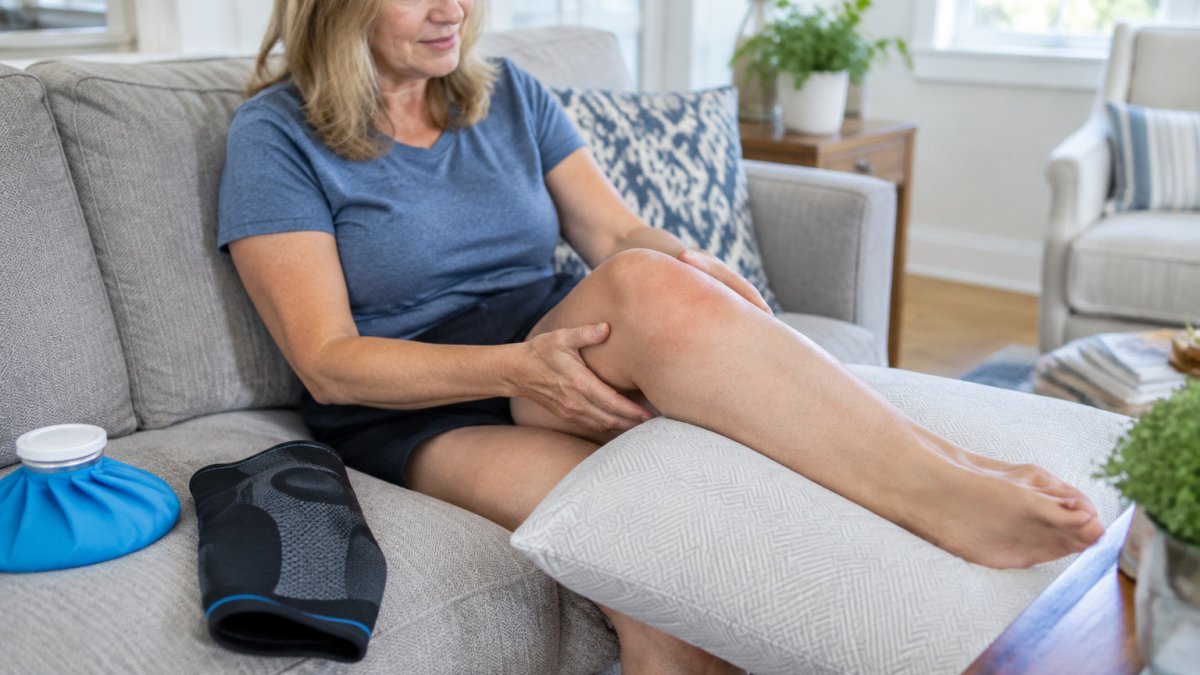 Middle-aged person resting a swollen knee on a pillow to treat knee inflammation with ice and compression
If swelling followed an injury (a fall, a twist, a direct blow, or a sudden pop): assume there may be tissue damage until proven otherwise. Use protection, relative rest, ice, compression, and elevation, often called the PEACE and LOVE framework in sports medicine. In the first 1 to 3 days, avoid heat, alcohol, and vigorous massage, which can increase swelling.
If swelling is from an arthritis flare or overuse (gradual puffiness, stiffness, no specific injury): the same ice-compression-elevation basics apply, but gentle movement matters more. Prolonged complete rest can stiffen an arthritic knee, so pair short rest periods with gentle range-of-motion work.
A practical first-72-hour sequence:
- Hours 0-24: Apply a cold pack wrapped in a thin towel for about 15 to 20 minutes every 2 to 3 hours while awake. Elevate the leg on pillows so the knee sits above heart level when lying down. Use a soft compression sleeve or wrap that feels snug but not tight. Keep weight-bearing to comfort; use crutches if walking is painful.
- Hours 24-48: Continue ice and elevation as needed. Begin gentle ankle pumps and slow knee bending within a comfortable range. Loosen compression if toes tingle, turn pale, or feel numb.
- Hours 48-72: If swelling is settling, add short walks on flat ground and gentle range-of-motion work. Heat can be introduced for stiffness once acute swelling has calmed, but not while the knee is still hot and puffy.
How to monitor progress. Simple measures help you know whether care is working: compare knee circumference at the same point each morning, rate pain at rest and with movement on a 0-10 scale, and note how far you can bend and straighten the knee. A common pattern is gradual improvement over 3 to 7 days. Watch out: seek professional advice if swelling worsens after 48 to 72 hours, if the knee becomes hot and red, if you develop a fever, if you cannot bear weight, or if pain and stiffness are not improving with consistent home care.
What not to do. Do not attempt to drain fluid from the knee yourself, do not apply ice directly to skin, and do not use heat in the first 48 hours after an injury. Forceful massage over a swollen knee can increase irritation.
The first 72 hours follow a sequence that depends on the cause of the swelling.
| Window |
What to do |
Key caution |
| Hours 0-24 |
Cold pack 15-20 min every 2-3 hours while awake |
Wrap ice in a thin towel |
| Hours 0-24 |
Elevate knee above heart level when lying down |
Keep weight-bearing to comfort |
| Hours 24-48 |
Continue ice and elevation as needed |
Loosen compression if toes tingle or go pale |
| Hours 24-48 |
Begin gentle ankle pumps and slow knee bends |
Stay within a comfortable range |
| Hours 48-72 |
Add short flat-ground walks and range-of-motion work |
Add heat only once the knee is no longer hot and puffy |
| After injury, first 1-3 days |
Avoid heat, alcohol and vigorous massage |
Heat and massage can increase swelling |
Step 3: Heat, Gentle Movement and Range-of-Motion Work
Once acute swelling calms, heat can ease stiffness. A warm pack or warm shower may make it easier to move in the morning. Follow heat with slow, gentle range-of-motion work, such as straight-leg raises, heel slides and short walks on flat ground. You can find step-by-step knee exercises with modifications for every pain level to build this movement into a routine.
Stop if movement causes sharp pain. Gentle motion should feel like a stretch, not a strain.
Step 4: Natural Remedies for Knee Pain Arthritis and What the Evidence Shows
Natural remedies for knee pain and arthritis are among the most-searched topics in joint care, but the evidence behind them is uneven. For a closer look at what the evidence says about regenerative medicine for chronic knee pain, read that article.
Turmeric (curcumin). Curcumin, the active compound in turmeric, has been studied for knee osteoarthritis, with mixed results. Products differ widely, so follow the label and check with a clinician before use.
Ginger. Ginger has been studied in relation to joint discomfort. Like turmeric, ginger may have a mild blood-thinning effect, so people on anticoagulants should ask a clinician before using concentrated supplements.
Omega-3 fatty acids (fish oil). Evidence for fish oil and knee osteoarthritis is mixed. Watch out: fish oil can increase bleeding risk and may interact with blood thinners, so check with a clinician first.
Glucosamine and chondroitin. These supplements are widely studied for knee osteoarthritis, with mixed findings. They can interact with blood thinners and may affect blood sugar, so check with a clinician before use.
Epsom salt baths. Warm water can relax surrounding muscles and ease stiffness, and many people find a warm bath comforting.
Topical options. Some people use topical creams containing ingredients such as menthol, camphor, or capsaicin. Watch out: do not apply topical products to broken skin, and wash hands after use.
Over-the-counter anti-inflammatory medicines. Oral NSAIDs such as ibuprofen and naproxen can reduce pain and swelling, but they carry risks including stomach irritation, kidney effects, and increased cardiovascular risk with long-term use.
Natural remedies are not a substitute for activity modification, strengthening, and weight management. If a remedy causes stomach upset, unusual bruising, or any new symptom, stop it and check with a clinician.
Step 5: Anti-Inflammatory Foods for Joint Pain and Daily Habits
A balanced eating pattern is part of general health. Many people focus on fruits, vegetables, whole grains, beans and fish.
Daily habits can matter just as much:
- Keep a healthy weight to reduce load on the knees
- Stay active with low-impact exercise such as swimming, cycling or tai chi
- Build leg strength to support knee stability
- Track your pain and swelling each day to spot patterns
Step 6: Removing Fluid From the Knee Naturally: What Is and Isn’t Safe
Some people search for ways to remove fluid from the knee at home. Be cautious. Fluid buildup can signal an injury or a joint problem, and draining it is a medical procedure. Do not attempt to puncture, squeeze or drain the knee yourself. Home massage that is too forceful can also cause harm.
What is generally safe: rest, elevation, gentle movement and compression as described above. If fluid keeps returning, a clinician can determine the cause and the safest next step.
Booking an Evaluation When Knee Inflammation Persists
If swelling lasts more than a few days, keeps coming back, or limits your daily life, a professional evaluation can help identify the cause. OPDAHL Regenerative Medicine uses advanced diagnostic tools, including dynamic ultrasound, to look at the joints and soft tissues around the knee, and book an evaluation with OPDAHL Regenerative Medicine to discuss what may be driving your symptoms.
Frequently Asked Questions
How can I reduce knee inflammation naturally at home?
Most mild knee inflammation responds to a combination of rest from aggravating activities, icing for 15 to 20 minutes every 2 to 4 hours during the first couple of days, compression with a supportive wrap, and keeping the leg elevated above heart level when resting. Gentle range-of-motion exercises and low-impact activity such as walking, cycling or swimming can help prevent stiffness as swelling settles. Anti-inflammatory foods and sleep also support recovery. If swelling is severe, worsening, or accompanied by fever, redness or inability to bear weight, see a doctor promptly rather than continuing home care alone.
What is the fastest way to reduce knee swelling?
The fastest way to reduce knee swelling at home is to combine rest, elevation and cold therapy. Elevate the knee on pillows so it sits above the level of the heart, and apply an ice pack wrapped in a thin towel for 15 to 20 minutes at a time, every 2 to 4 hours while awake. Use a compression sleeve or elastic wrap that is snug but not tight enough to cause tingling or color change. Swelling often improves within a few days, but it can persist longer, so track progress and seek care if it does not improve.
Can I remove fluid from my knee naturally?
Home measures cannot drain fluid that has built up inside the knee joint. Rest, elevation, compression and icing can reduce the swelling that fluid causes, but draining a joint effusion is a medical procedure that a clinician must perform and evaluate, because the cause of the fluid matters. Large or recurring knee effusions should be assessed rather than managed only with home remedies. Schedule an evaluation with a qualified provider to identify the underlying cause and discuss appropriate options.
When should I see a doctor for a swollen knee?
See a doctor promptly if your knee is hot, red, or very painful, if you cannot bear weight or the knee locks or gives way, if you have a fever, if the swelling appeared after a fall or injury with a popping sound, or if swelling is getting worse rather than better after several days of home care. These signs can point to infection, a torn ligament or meniscus, or another condition that needs medical attention. Routine persistent knee inflammation is also worth an evaluation so a qualified professional can identify the cause and suggest a plan.