Last Updated: November 24, 2026
Quick Summary
Reduced stiffness comes mainly from gentle, regular movement such as range-of-motion exercises, stretching, and low-impact activity, while inflammation eases with rest, cold therapy, and anti-inflammatory medication. Matching the treatment to whether the joint is stiff or inflamed is what makes home care work.
- Use cold therapy for acute, swollen joints and heat for stiff, quiet joints before activity.
- Physical therapy has the strongest evidence for improving function and range of motion over 6-12 weeks.
- Corticosteroid injections often relieve pain within days but effects fade over weeks to a few months.
- See an orthopedic specialist if joint pain lasts beyond a few weeks or limits walking and stairs.
- A hot, swollen joint with fever needs urgent care and should not wait.
Stiff and swollen joints not improving?We use dynamic ultrasound to find the cause and build a non-surgical plan around your goals.
Schedule an Evaluation
Table of Contents
Why Joint Stiffness and Inflammation Need Different Treatment Approaches
Joint stiffness and inflammation are related, but they are not the same problem, and treating them as one is where many home care routines go wrong. People often spend months icing a stiff joint that actually needed movement, or pushing through exercise on a joint that needed to calm down first. (Source: National Institutes of Health research)
The distinction matters because the two problems respond to opposite inputs. Inflammation often eases with rest, cold, and anti-inflammatory medication. Stiffness usually improves with gentle movement, heat, and stretching. Get the order wrong and you can slow your own recovery.
Below, we break down each nonsurgical option by what it does, who it suits, and where it stops. We also show how to sequence these treatments into a stepwise care pathway, which is the part most guides skip.
Nonsurgical Treatments for Joint Pain: A Side-by-Side Comparison
Most people with joint pain start with nonsurgical treatments for joint pain, and for good reason: they are accessible, low-risk, and often effective when matched correctly. But “nonsurgical” is not one category. The options differ in how fast they work, how long relief lasts, how strong the evidence is, and who should avoid them. The table below summarizes those differences so you can see the trade-offs side by side rather than as a list of interchangeable choices.
| Treatment |
Typical onset |
Typical duration of effect |
Evidence strength |
Best suited for |
Key cautions |
| Cold therapy |
Minutes |
15-20 minutes per application |
Well established for symptom relief |
Acute flare-ups, post-activity swelling |
Avoid prolonged direct skin contact; not for cold-sensitive circulation |
| Heat therapy |
10-20 minutes |
20-30 minutes per application |
Well established for symptom relief |
Morning stiffness, tight muscles before activity |
Avoid on hot, swollen joints; not for acute inflammation |
| OTC oral pain relievers (acetaminophen, NSAIDs) |
30-60 minutes |
4-8 hours per dose |
Strong for short-term symptom control |
Mild to moderate pain, short flares |
GI, kidney, and cardiovascular risks with regular NSAID use; check interactions |
| Topical NSAID gels and creams |
30-60 minutes |
Several hours per application |
Moderate; good for localized joint pain |
Hands, knees, and other accessible joints |
Skin irritation; wash hands; avoid broken skin |
| Corticosteroid injections |
Hours to a few days |
Weeks to a few months |
Strong for short-term flare control |
Significant inflammation, flare in a single joint |
Repeat limits; blood sugar spikes; small infection risk |
| Physical therapy |
Weeks |
Durable with continued program |
Strongest for function and range of motion |
Weakness, mobility loss, post-injury recovery |
Requires consistency; progress plateaus without home program |
| Regenerative approaches (e.g., PRP) |
Weeks |
Variable; evidence still developing |
Limited and evolving |
Selected tendon and joint conditions after evaluation |
Out-of-pocket cost; variable outcomes; not a substitute for diagnosis |
Heat Therapy and Cold Therapy
Cold therapy constricts blood vessels and reduces swelling and numbing pain, which makes it the better choice during an acute flare-up or after activity. Heat therapy does the opposite: it increases circulation and relaxes tight tissue, which helps with morning stiffness and before exercise.
A common mistake is using heat on a joint that is already hot and swollen. That can worsen inflammation. Use cold for acute, angry joints and heat for stiff, quiet ones. For readers exploring noninvasive options to lower swelling, our guide to the benefits of laser therapy for pain relief covers how light-based treatment fits alongside these methods.
Over-the-Counter Pain Relievers and Topical Gels
Over-the-counter pain relievers and anti-inflammatory medication can reduce pain and inflammation short-term, but they address symptoms rather than underlying causes.
Watch out: long-term daily use of oral anti-inflammatories carries real risks, particularly for the stomach, kidneys, and heart. Anyone with kidney disease, heart conditions, or stomach ulcers should talk to a clinician before regular use. These medications are a bridge, not a plan.
Steroid Injections and Regenerative Approaches
Steroid injections can calm significant inflammation quickly, and many patients get meaningful short-term relief. The limitation is durability: relief often fades, and repeated injections carry their own considerations. Regenerative approaches are an area of ongoing research, so realistic expectations matter.
Watch out: steroid injections can raise blood sugar for days in people with diabetes, and repeated injections in the same joint are generally limited because of effects on cartilage and tendon.
If you have had injections and the pain returned, other options may be worth discussing with a qualified clinician. Our comparison of PRP vs cortisone, physical therapy, and surgery lays out how these approaches differ head to head.
Physical Therapy for Joint Pain: What It Does and Where It Stops
Physical therapy for joint pain is widely regarded as a nonsurgical route for restoring strength and range of motion, and it generally works best when it is consistent and progressive. A therapist assesses how you move, identifies weakness or compensation patterns, and builds a program around your goals.
Where it stops: PT cannot reverse advanced cartilage loss, and it does not resolve mechanical problems on its own. It also depends heavily on adherence. Patients who do their home program progress; those who attend sessions only often plateau. If you want to pursue this route, you can browse physical therapy services and request an appointment to see whether it fits your situation.
Joint Stiffness Relief at Home: Exercise, Stretching, and Low-Impact Activity
Joint stiffness relief at home starts with movement, not rest. Gentle, regular activity keeps synovial fluid circulating and maintains range of motion, supporting reduced stiffness, which is why joints feel worst after long periods of stillness.
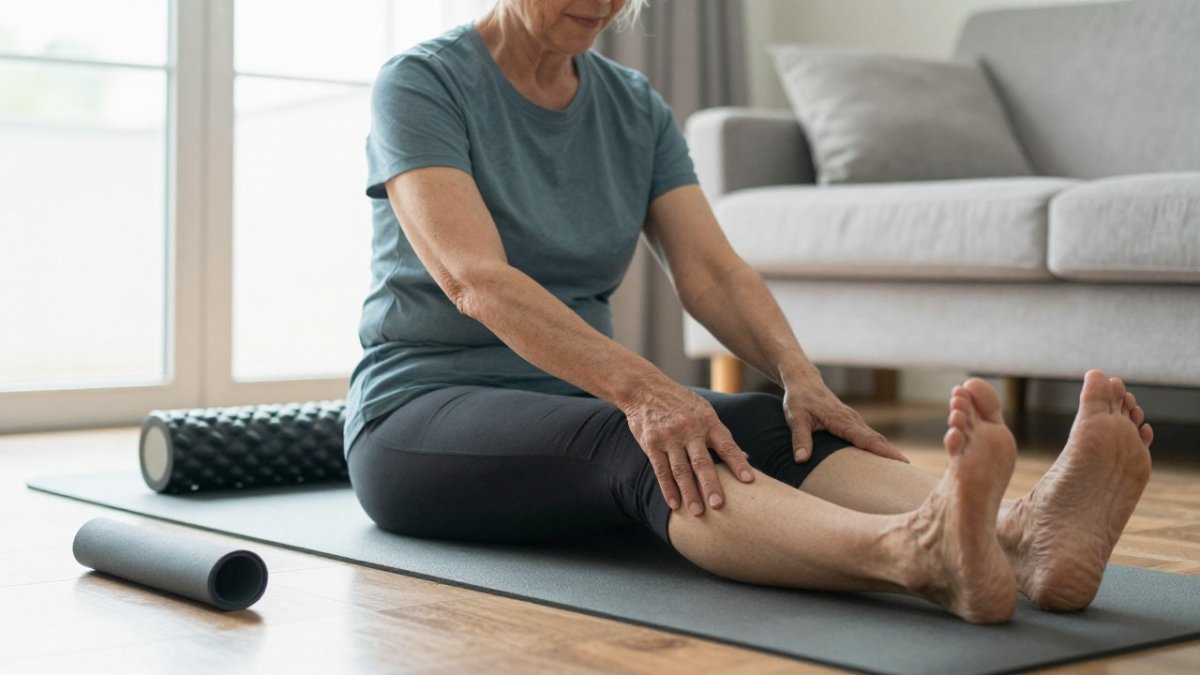 Older woman performing a seated knee stretch at home for reduced stiffness with exercise equipment nearby
A practical home routine:
- Range of motion first: slow, pain-free circles and bends before any loading
- Stretching second: hold 20-30 seconds, no bouncing
- Strengthening third: resistance bands, wall sits, chair squats
- Low-impact cardio: walking, swimming, cycling, yoga, Pilates
Beginners should start small and build. Our guide on how beginners can strengthen knee joints safely walks through a progressive approach without aggravating pain. Stop any exercise that causes sharp pain or new swelling.
Evidence Quality and Realistic Expectations for Each Option
Not every option has the same strength of evidence behind it, and being honest about that helps you set realistic expectations. The most useful question is not “does this work?” but “how strong is the evidence, how big is the realistic benefit, and how long should I give it before reassessing?”
A practical way to grade the options:
- Strong evidence for function: Physical therapy and structured exercise have the most consistent support for improving strength, range of motion, and daily function in knee and hip osteoarthritis. Realistic expectation: meaningful improvement over 6-12 weeks with a consistent home program, not overnight relief.
- Well established for symptom relief, not disease modification: Heat and cold therapy reliably ease symptoms for many people, but they do not change the underlying joint condition. Realistic expectation: comfort around activity, not structural change.
- Strong short-term, weaker long-term: Oral NSAIDs and topical NSAID gels reduce pain and inflammation effectively for short flares. Realistic expectation: symptom control measured in hours to days per dose, with risks that grow with duration.
- Reliable but temporary: Corticosteroid injections often produce meaningful relief within days, but the effect typically fades over weeks to a few months, and repeat injections are limited. Realistic expectation: a window of relief that should be used to do the rehab that lasts.
- Promising but evolving: Regenerative approaches such as platelet-rich plasma show promise in selected tendon and joint conditions, but the evidence is still developing and outcomes vary by patient, joint, and injury. Realistic expectation: possible benefit in the right candidate, not a guaranteed repair.
A common pattern is that patients who combine a short-term symptom-control option with a longer-term movement program do better than those who rely on either alone.
Watch out: be skeptical of any single treatment marketed as a cure for joint stiffness or inflammation. If a clinic cannot explain the evidence, the realistic timeline, and the alternatives, that is a reason to get a second opinion.
When to See an Orthopedic Specialist
See an orthopedic specialist when joint pain persists beyond a few weeks, limits walking or stairs, wakes you at night, or comes with swelling, redness, or warmth that does not settle. Prompt evaluation is also warranted after an injury, or if you notice numbness, significant weakness, or a joint that locks or gives way.
Red flags that need urgent care include a hot, swollen joint with fever, sudden severe pain, or inability to bear weight. These can signal infection or fracture and should not wait.
Matching the Treatment to Your Joint, Your Pain, and Your Goals
Treatment selection should follow the joint, the pattern of symptoms, and what you need to get back to. A stiff knee in the morning after rest behaves differently from a swollen shoulder after overhead work. A construction worker needs durability under load; a hiker needs endurance and range of motion.
This is where a proper evaluation changes the plan. If you are weighing injections against therapy, our breakdown of knee injections vs physical therapy for chronic pain helps match the choice to your situation.
Building Your Stepwise Care Pathway at OPDAHL Regenerative Medicine
A stepwise care pathway means starting with the lowest-risk, highest-value options and escalating only when they stop working. Our approach at OPDAHL Regenerative Medicine follows that logic: identify the root cause first, then match treatment to it.
Our approach focuses on the root cause of discomfort in knees, shoulders, hips, and the spine, and aims to help patients restore mobility and reduce stiffness and inflammation.
If stiffness and inflammation have been running your life, an evaluation is the sensible first step. Schedule an appointment to discuss your joint symptoms and goals.
Chronic joint pain rarely improves by guessing. A structured evaluation tells you what is actually driving your stiffness and inflammation, and which option is worth your time.
Frequently Asked Questions
What orthopedic treatments can help reduce joint stiffness and inflammation?
A combination approach works best for most people. Heat therapy eases morning stiffness, cold therapy calms acute swelling, and over-the-counter anti-inflammatory medication or topical gels can lower pain during flare-ups. Physical therapy for joint pain builds the strength and range of motion that keep joints moving. For persistent cases, a clinician may discuss options such as steroid injections or regenerative approaches. A clinician can match the option to your joint, your pain level, and how long you have had symptoms.
What is the difference between physical therapy for joint pain and other nonsurgical treatments?
Physical therapy is active: you do the work, building muscle support, mobility, and range of motion over weeks. Passive options like heat, ice, medication, and injections reduce symptoms without changing joint mechanics. Many people need both. Physical therapy for joint pain tends to deliver gradual, durable gains, while medication and injections act faster but wear off. If pain persists despite earlier care, a qualified clinician can help determine whether further evaluation is appropriate.
When should I see an orthopedic specialist for joint pain and stiffness?
Book an evaluation if stiffness lasts more than 30 minutes each morning, pain persists beyond six weeks, swelling does not settle, or the joint locks, gives way, or loses range of motion. Numbness, redness, or pain that wakes you at night are also reasons to seek care. A specialist can identify the cause through examination and imaging, then lay out nonsurgical options before surgery is considered.
How long does it take for joint stiffness to improve with treatment?
Timelines vary by cause and approach, and a clinician can give a realistic estimate for your situation. Tracking range of motion and daily activity gives a clearer picture than pain scores alone, so ask your clinician what milestones to expect.