Last Updated: November 15, 2026
Quick Summary
Regenerative medicine reduces stiffness and inflammation by delivering growth factors and cells directly to damaged joints, interrupting the cycle where inflammation causes swelling, limited movement, and worsening stiffness. Treatments like PRP, bone marrow aspirate, and prolotherapy support the local healing environment rather than masking pain, with the clearest changes in stiffness and function typically appearing 6 to 12 weeks after injection.
- Growth factors may reduce inflammatory signaling, encourage blood flow, and recruit the body’s own repair cells to treated tissue.
- PRP is typically given as a series of 2 to 3 injections, often 3 to 4 weeks apart.
- Prolotherapy suits ligament laxity and mild instability rather than advanced cartilage loss.
- Most patients notice the clearest difference in stiffness and function at weeks 6 to 12.
- Track how far you can walk, how many stairs you manage, and how long morning stiffness lasts.
Could regenerative care ease your stiff joint?We use dynamic ultrasound to find the root cause and build a non-surgical plan.
Schedule Appointment
Table of Contents
How Regenerative Medicine Targets Stiffness and Inflammation
Regenerative medicine is a branch of care that uses the body’s own biological materials to support tissue repair and calm inflammation in damaged joints. Many clinicians explain it as a shift in goal: instead of masking joint pain, the aim is to support the tissue itself. (Source: National Institutes of Health overview)
The stiffness-inflammation cycle is the reason this matters. When a joint is injured or worn, inflammation builds. Swelling and pain then limit movement, and a joint that stops moving gets stiffer. That stiffness feeds more irritation, and the loop tightens. Regenerative injections are designed to interrupt that loop by delivering growth factors and cells directly to the damaged area. For a practical guide to applying this to joint treatment, see how to use regenerative medicine for joints.
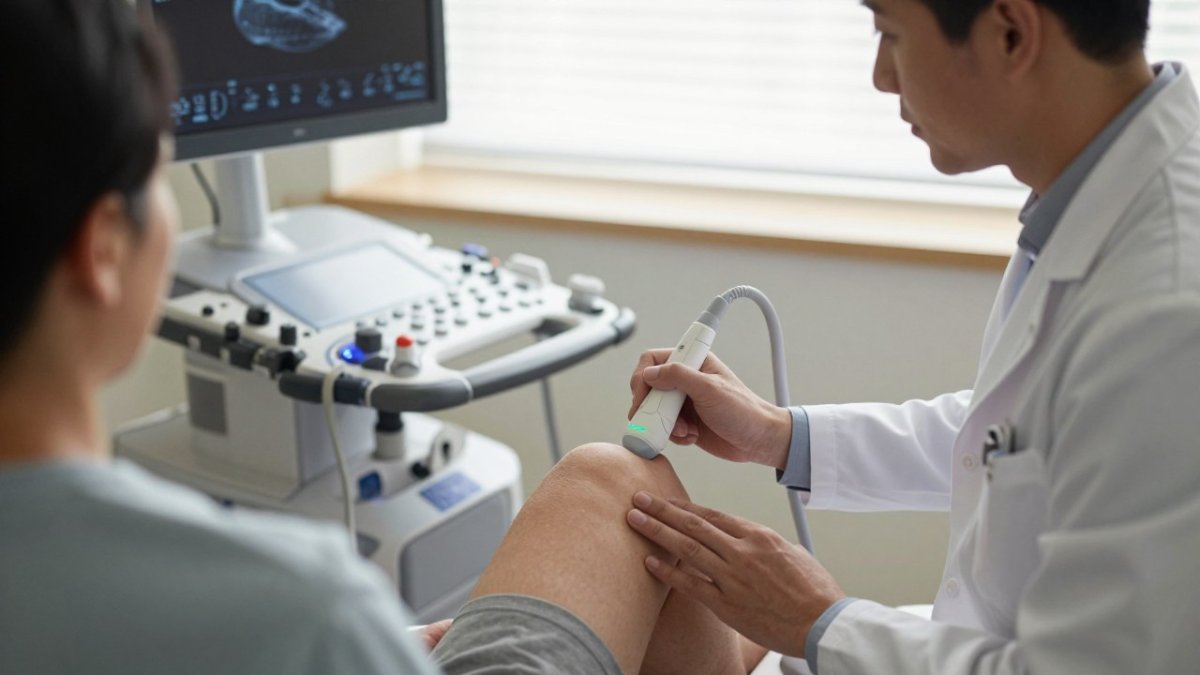 Clinician using an ultrasound probe on a patient knee for regenerative medicine treatment
The Inflammation-Stiffness Cycle in Joints
Inflammation is the immune system’s response to injury, and in a healthy joint it resolves. In an arthritic or overused joint, it can persist at low levels for months. That ongoing irritation changes how the joint feels and moves.
The practical result is a morning stiffness that lasts longer than it should, plus pain that flares with activity. Many patients describe it as a joint that “never warms up.”
What Growth Factors Actually Do
Growth factors are signaling proteins that tell repair cells where to go and what to build. Platelets release them in large numbers when blood clots, which is the basis for platelet-rich plasma.
In practice, growth factors do not rebuild cartilage on command. They support the local healing environment: they may help reduce inflammatory signaling, encourage blood flow, and recruit the body’s own repair cells to the treated tissue. That is a modest but real mechanism, and it explains why results build over weeks rather than days.
Comparing Regenerative Treatment Options: PRP, Stem Cells, and Prolotherapy
No single regenerative option fits every joint, and the differences between them matter more than most clinic marketing admits. The table below compares the three main modalities on what is injected, typical course, evidence strength, and best-suited presentations, then the sections that follow explain the mechanisms and trade-offs behind each row.
| Treatment |
What Is Injected |
Typical Course |
Evidence Strength |
Best Suited To |
Key Limitation |
| PRP |
Concentrated platelets and growth factors from your own blood |
Series of 2-3 injections, often 3-4 weeks apart |
Moderate for knee osteoarthritis; limited for other joints |
Tendon and ligament injuries, mild to moderate knee arthritis |
Preparation methods vary widely; no standard dose |
| Stem cells / bone marrow aspirate |
Nucleated cells and growth factors drawn from bone marrow |
One or more sessions |
Preliminary for most musculoskeletal uses; strongest for select tendon and cartilage defects |
Larger joints, more advanced degeneration |
Cell count and potency vary by patient; no standardized dosing |
| Prolotherapy |
Irritant solution (often dextrose) to trigger a localized healing response |
Several sessions, typically 3-6 |
Limited and mixed; strongest for ligament laxity and mild instability |
Loose ligaments, mild instability, select tendinopathies |
Evidence base is thinner than PRP; technique-dependent |
Platelet-Rich Plasma (PRP)
PRP takes a sample of your blood, concentrates the platelets, and injects that concentrate into the damaged joint or tendon. The mechanism is straightforward: platelets release growth factors and signaling proteins that recruit repair cells and modulate local inflammatory signaling.
PRP is often given as a short series, and improvement is typically gradual. Preparation matters more than most patients realize, platelet concentration, activation method, and whether white blood cells are included all vary between systems, and studies that use different preparation protocols are hard to compare directly. Ask your provider which system they use and why.
Stem Cell Therapy and Bone Marrow Aspirate
Bone marrow aspirate is drawn from the pelvis and contains the body’s own repair cells along with growth factors. It is a same-day procedure in most clinics.
Where it falls short: the number of active cells varies from person to person, and no standard dose exists across clinics. Cell yield declines with age and varies by harvest technique, so two clinics offering “stem cell therapy” may deliver very different products. Ask any provider how they handle that variability, whether they count cells, concentrate the aspirate, or culture-expand, and be skeptical of claims that a single injection regrows cartilage.
Prolotherapy and Autologous Conditioned Serum
Prolotherapy injects a mild irritant, most commonly dextrose, to restart a healing response in stretched ligaments. It is best suited to ligament laxity and mild instability rather than advanced cartilage loss.
Autologous conditioned serum (ACS) is a processed blood product rich in anti-inflammatory proteins, including interleukin-1 receptor antagonist (pubmed.ncbi.nlm.nih.gov). It is incubated from your own blood and injected as a series. Evidence for ACS is preliminary but growing, particularly for knee osteoarthritis and select tendon conditions.
For a direct look at how PRP stacks up against cortisone, physical therapy, and surgery, see our PRP vs. cortisone and surgery comparison.
Watch out: clinics sometimes use “stem cell” as a marketing label for products that contain no viable stem cells, such as processed amniotic fluid or placental tissue. Ask what is actually in the syringe and whether the cells are your own, living, and counted.
Does Regenerative Therapy Work? Evidence Quality and Uncertainty
The evidence for regenerative therapy is uneven, and results vary by condition and by patient. That is different from saying it works for everything. The most useful way to read the evidence is to separate it by modality and by condition, because a strong result for PRP in knee osteoarthritis says little about stem cells for shoulder arthritis.
How Evidence Varies by Treatment
PRP for knee osteoarthritis is among the more studied regenerative options, and published trials report a range of results in pain and function, with effect sizes that vary across studies. Preparation methods differ between studies, which makes pooling results difficult.
Autologous conditioned serum has preliminary but growing evidence, mainly for knee osteoarthritis and select tendon conditions.
What the Evidence Does and Does Not Show
Watch out: any clinic that presents regenerative injections as proven to regrow cartilage is overstating the science. A useful question is whether the clinic can name the specific studies behind a claim and describe their limitations.
If you want to see what conditions PRP has actual evidence behind, our guide to what conditions PRP can treat breaks it down by body area.
Regenerative Therapy for Knees: Cartilage, Osteoarthritis, and Mobility
Knee osteoarthritis is the most common reason people ask about regenerative options. The cartilage lining the joint thins over time, and as it does, stiffness and pain limit walking, stairs, and standing.
Regenerative therapy for knees is generally aimed at the joint environment rather than the worn cartilage itself. The realistic goal is pain improvement and better function, not a new cartilage layer. Many patients measure success in longer walks and easier stairs, not on an imaging report.
For a deeper, evidence-focused look, read our article on whether regenerative medicine works for chronic knee pain.
Realistic Timelines and Measurable Outcomes
Most regenerative injections do not work in a week. A realistic timeline looks like this:
- Days 1-3: Mild soreness and swelling at the injection site are common.
- Weeks 2-6: Early changes in pain may appear, though this varies widely.
- Weeks 6-12: Most patients notice the clearest difference in stiffness and function.
- Months 3-6: Results are assessed, and a second course may be discussed.
Measurable outcomes worth tracking are specific: how far you can walk without stopping, how many stairs you can manage, and how long morning stiffness lasts. Bring those numbers to follow-up visits.
Risks, Contraindications, and Who Should Avoid Treatment
Regenerative injections, like any injection, carry risks, and they are not right for everyone. Possible side effects include temporary pain, swelling, and bruising at the injection site, and infection is possible. Discuss your individual risks with a qualified provider.
You should discuss alternatives carefully if you:
- Take blood thinners or have a bleeding disorder
- Have an active infection or are immunosuppressed
- Have an active cancer diagnosis
- Are pregnant or breastfeeding
A qualified clinician decides whether treatment is appropriate. This article is general information, not individual medical advice.
Regenerative Therapy Cost, Insurance, and Value
Regenerative therapy cost varies, and coverage depends on your insurance plan. Check with your insurer about what is covered before you commit.
Pricing depends on the treatment type and the number of sessions. For current prices or a quote, visit the OPDAHL Regenerative Medicine website. Compare the total course cost, not the price of a single injection. For a full picture of the therapies and conditions involved, our regenerative medicine guide covers what to expect.
How to Evaluate a Regenerative Medicine Clinic Before You Book
Credentials and honesty separate good clinics from sales operations. Use this checklist before you commit:
OPDAHL Regenerative Medicine offers non-surgical care focused on preventative measures, with the goal of reducing stiffness and inflammation and supporting lasting recovery.
Joint pain that is left unexamined can persist, and masking it with medication does not address the underlying tissue. If you have tried physical therapy or steroid injections without lasting relief, a proper evaluation is the next step. Get started with OPDAHL Regenerative Medicine and find out whether regenerative care fits your joint.
Frequently Asked Questions
Can regenerative medicine reduce joint stiffness?
It can, though results vary by treatment and by how much cartilage damage is already present. Injections such as platelet-rich plasma and prolotherapy deliver growth factors that support tissue repair and may calm inflammation in and around the joint, which is what patients often feel as less morning stiffness. Functional improvement, where it occurs, tends to build over months rather than days. A clinical exam, often with dynamic ultrasound, is the reliable way to find out whether your stiffness is coming from inflammation, tissue damage, or both.
Does regenerative therapy work for knees?
Evidence varies by condition. Results are generally less predictable in advanced joint disease with significant cartilage loss. Regenerative therapy for knees is not a cartilage replacement, and no treatment regrows a worn joint. Candidacy depends on your exam findings, imaging, and how you respond to conservative care. A consultation is the right place to get an honest answer about your specific knee.
How long does inflammation last after stem cell therapy?
A short increase in soreness and swelling for a few days after injection is common and is often described as part of the healing response. Stiffness and function typically improve gradually over several weeks to months. Timelines differ by injection type, the joint treated, and your activity level. Your provider should give you specific aftercare instructions, including what activity to avoid and when to expect follow-up assessment.
What does regenerative therapy cost, and will insurance cover it?
Regenerative therapy cost varies by treatment type, the number of joints treated, and whether imaging or follow-up visits are included. Coverage depends on your insurance plan, so confirm with your insurer what is and is not covered. For current prices or a quote, visit the OPDAHL Regenerative Medicine website.